Monuments
By Jenelle Porter
One must possess a well-honed sense of humor and hubris to title a sculpture My Balzac. Arlene Shechet’s sculpture stands six feet high, a mass of coils piled and leaning into space that trespasses the vertical plane of its support, a two-tiered pedestal composed of a round hunk of wood balanced atop a simple welded steel trestle. The uppermost part appears to be bronze, but is actually glazed ceramic. What could be less grandiose than fired clay? And what could be less like Auguste Rodin’s Monument to Balzac than Shechet’s sculpture? In a body of work that focuses on the most challenging of the plastic arts—sculpture—Shechet’s nod to one of the greatest of all sculptors is an unlikely (odd, possibly disingenuous, and perilously antifeminist) place to begin a survey of her work. After all, Rodin himself is a monument, and his is a monument to the human condition. In Rodin’s Balzac, Shechet intuits a host of generative contradictions: sensitivity and power; fragility and strength; bravura and pathos; surface and volume; ephemerality and permanence; figuration and abstraction. Rodin was obsessed with surface, finding in it not only a vehicle of internal expression, but also a locus for material exploration. His surfaces record their making as a “passage of the medium from one state to another.”1
Let us return to the idea of the monument: an object (a pillar, a building, a sculpture, a fountain) erected to memorialize a person or event. And the monumental, a concept and adjective the feminists among us have labored for decades to eradicate from art discourses. Monuments are things made by men; women don’t go in for such heroic gestures. Or do they? And if they do, is it with tongue firmly planted in cheek? Shechet’s Monuments series is composed of ten porcelain sculptures, the tallest nine inches high. Made at the Meissen Porcelain Manufactory, each work combines drapery, ware, and plinths cast, respectively, from Meissen figurines, cups and bowls, and stands. With drapery, Shechet nods to classic statuary, especially that part of the surface on which sculptors have long demonstrated their skills. Here, it is disembodied, small, glazed, and peeking out, like so much excess cloth, of the top of a cast vessel. The vessel evokes the functional language of ceramic, an artist’s jab at the bias against craft. Though ceramic would likely never be used for anything like a monument, the small but noble plinth on which each pairing sits disagrees. Shechet’s Monuments, alongside My Balzac, point to the way she weds, in all of her work, classic monumental language with the everyday.
Shechet’s work—composed of diverse materials, found and made, equally sculpture and architecture—recall another sculptor who irrecoverably transformed sculpture: Constantin Brancusi. The art of Rodin and Brancusi, Rosalind Krauss writes, “represented a relocation of the point of origin of the body’s meaning— from its inner core to its outer surface—a radical act of decenter- ing that would include the space to which the body appeared and the time of its appearing.” Minimalism continued this trajectory of decentering, Krauss theorizes, through a vocabulary of radical abstraction that despite its abstractness is no less about the body and “our experience of our bodies.”2 Process art continues the story, and so does Shechet’s work. Primarily made of plaster and clay, her abstract sculpture is willed to form through process: it is an expression of materials realized by a body.
Queens
As a girl, Arlene Shechet wanted to grow up and work in a factory. She liked making things, and by her logic, things were made in factories. I imagine such a declaration, delivered by a city kid growing up during the 1950s in Queens, probably landed with a resounding thud. She had a fairly traditional childhood. Her mother was a housewife, her father an accountant. She has a brother. Inserting this personal biographical gloss defies art- historical conventions, but Shechet’s life — like that of every artist, every person—is in her work, so it all matters. Shechet was the independent type and took the subway alone to Manhattan every chance she got. Her mother painted as a hobby and took her daughter to art museums. Shechet attended New York University during the late 1960s, an era defined by the civil rights, women’s, and antiwar movements—all of which she was involved with. Though inspired by professors in art history and German literature, she considered the arts decadent and artists self-absorbed. Still, Shechet immersed herself in downtown performance and experimental theater. After several years of post-college odd jobs she decided, after all, to apply to art school. She had been making art her entire life and knew she needed to pursue it.
Providence
A visit to the Rhode Island School of Design (RISD) in Providence, and its renowned Nature Lab, a lending library of scientific specimens, convinced Shechet to apply to their graduate art school. During her two-year program, she experimented with a range of media, including photography, video, ceramics, sculpture, and drawing. Immediately upon completing her degree in 1978, RISD hired Shechet to teach “Form and Space,” a wide-ranging foundation course that introduced concepts and images—along with materials and making — to freshmen. Shechet relished the expansiveness of the curriculum, for which she could survey everything from postwar fashion to eighteenth-century architectural follies to improvisational dance. During the five years she taught the course, she used the college’s vast slide and clippings libraries, a process that furthered her own visual education. She regularly attended guest artist lectures, and remembers as particularly inspiring Robert Grosvenor’s provisional constructions, and that Elizabeth Murray said things about art and life—things that women weren’t allowed to say, considering how negatively the art world judged the artist/mother duality—that led Shechet to realize that she, too, could have an artist’s life that might include marriage and kids.
Shechet commuted to Providence from downtown Boston, where she shared a vast nonresidential loft on Temple Place. She was making photographic abstractions, and convinced the architecture office downstairs to let her use their blueprint machine, on which she printed a series of diazoprints from her 36-inch positives. She spent hours at Harvard’s Busch-Reisinger Museum look- ing at German expressionists such as Otto Dix and Alexej von Jawlensky. On Sunday mornings, she listened to repeats of Alan Watts’s syndicated radio program on Boston public radio. Watts, a British-born philosopher based for decades on the West Coast, was a widely recognized proponent of Asian philosophy and religion.3 She saw the Sun Ra Arkestra perform, yet another encounter with mind-expanding philosophies. These experiences, as experiences do, settled in. The education of an emerging artist. In 1982, she moved back to New York City.
Triangle Below Canal
In 1983, Shechet and her husband, Mark Epstein, honeymooned in Indonesia, where they visited the ninth-century temple com- pounds Prambanan and Borobudur. The latter is recognized as one of the greatest and largest of Buddhist monuments. Its thou- sands of stone reliefs tell the story of the Buddha’s life, teachings, and death. For Shechet, the experience of literally climbing among this vast trove of sculptural reliefs was profound, “an experience of sculpture as a language for transmitting information, feelings, beliefs, and thoughts.”4 That same year, she saw an exhibition of self-taught artist Forrest Bess’s work, and saw in it a formal link to tantric drawings.
In 1985, Shechet moved to Tribeca, left her job in (and commute to) Providence, and began teaching sculpture at Parsons School of Design in Manhattan, a position she would hold for the next decade. Teaching continued to provide an income that relieved some of the financial pressures of making art. Her art- work at that time included sculpture in clay and papier mâché, as well as hybrid painting-sculptures: acrylic paint skins (paint applied to glass, dried, then peeled off in sheets) affixed to paper and to cast slabs of modeling plaster. For Shechet, the demands of motherhood (Shechet and Epstein’s children were born in 1986 and 1990), teaching, and the studio added up to a fundamental problem of time — not having enough of it. On top of this problem, the illness and premature death of her closest friend sent Shechet looking for solace and direction. Her husband’s Buddhist teacher shocked her from her profound grief and gave her a way to cope with loss: “Don’t make such a big deal out of it,” the teacher said. “Life is like fireworks, vibrant and alive, and then gone.” Shechet understood that the teacher’s words were intended to point to life’s preciousness. Working in New York City during the 1980s, one of the epicenters of the AIDS/HIV crisis, was equally significant. The impact of those years of birth and death reverberated in her studio. “I was gripped by the need to pay attention and to be more alive in every aspect of my life.”5
The painful loss of her friend, especially, stirred countless questions about what to do in the studio, how to act, think, and make—how to be. In response, Shechet rededicated her attention to plaster. She found in plaster a material that was affordable, available, and resilient. She began to experiment with its alchemical properties: it begins as a powder, you add water to make a liquid, it gets hot (even smokes a bit), then hardens. Shechet was smitten with it. She found plaster to be the timekeeper she needed to maintain a consistent state of awareness in the studio. In other words, by setting up fast, it forces concentration. Shechet began to work provisionally, pouring and patting and exploring form by making plaster blobs. The amount of material used and the size of the shape were dictated by the length of time Shechet had to make art: less time, small blob; more time, large blob. (Shechet’s studio was in the basement of her building, a convenience that allowed her to run downstairs to work between mom duties.) Plaster led to an unexpected form: “One day I was making something blobby and it looked, I thought amusedly, like a buddha. In a different state of mind it would have looked like a pile of shit.” For Shechet, who had no previous interest in representational or figurative work, “it suddenly made sense to use the buddha form as a signifier of my resolve to embrace aliveness. I became aware that having the physical presence of an icon functioned as a reminder to stay awake, in the broadest sense. Having the Buddhas in my studio became a source of comfort.”
The first buddhas Shechet made in 1993 lacked armatures, a decision that allowed her to model them without structural constraints. (Later, larger works contained amorphous chunks of polystyrene so as not to be prohibitively heavy.) She incorporated her store of multicolored acrylic paint skins as she worked, embedding them within and layering them on top of the wet plaster. She at first called them “decoys,” as she considered them stand-ins for what they really were: transcriptions of the studio. Still Time #1, the very first buddha, is coarsely surfaced, patted plaster with a bit of blue and a slash of red paint on its “chest.” The surfaces of subsequent works grew increasingly painterly, and demonstrate Shechet’s growing mastery of the buddha form as well as plaster’s indexical properties. The artist says of those works, “Though I aimed myself toward the Buddha, I was most interested in making these images slip and slide so that they simultaneously contained a language of abstraction and evoked the icon.” The plasters were displayed atop items that ranged from wheeled plywood boxes to rescued-from-the-garbage wooden stools and welded iron chairs. Formally and conceptually recalling Joseph Beuys’s Chair with Fat — an organic and psychically loaded material piled on top of a domestic object—the bases were simultaneously Shechet’s nod to the Buddha’s lotus and Chinese scholars’ rocks.
Shechet worked in intentional and relative isolation in the early 1990s. One reason was her demanding personal schedule. Another was her perception that her interests weren’t reflected in the New York art scene, which was characterized at that time by the culture wars, race, abject art, installation, and conceptual photography. Shechet labored for over a year, amassing dozens of buddha sculptures before sharing her work in early 1994. The reactions of fellow artists and friends ranged from bafflement to embarrassment. In other words, her work struck a nerve, which provoked Shechet to keep working. Soon enough, her work was included in dialogues and exhibitions about art and spirituality, which she initially found surprising, since she viewed Buddhism as a philosophical tool. Yet she found that for a time, these themes offered a productive conversation and led her to further study of Asian art. Just as Buddhist art was a teacher for followers, Asian art became a tutor for Shechet. For her part, Shechet came to feel that she was trying to make an American buddha for the twentieth century. She received a kind of confirmation from eminent Buddhist scholar Robert Thurman, who told her, “If you make a buddha, it is a buddha.” Though Buddhist imagery rarely appeared in contemporary art during this time, Shechet shared its influence with artists as varied as John Cage, Bruce Conner, Philip Guston, Agnes Martin, Nam June Paik, Robert Rauschenberg, and Mark Tobey.
Simultaneous with the buddhas, Shechet created a series of heads from 1994 to 2000. They are materially like the buddhas —plaster with applied paint skins — and just as raw and pro- visional, but in the case of the heads, Shechet courts chance and time even more insistently. After setting cut steel bars vertically into individual cast concrete blocks, and gripping the bar where it met the base, Shechet poured plaster onto her clenched fist. Instead of two hands patting material into being, one hand pours while the other grasps and forms. Compositionally, the heads are less overtly figurative than the buddhas, but their form resonates with an expansive vocabulary of portrait sculpture. For example, Picasso’s exquisitely faceted Head of a Woman, 1909–10, is evoked by the “crown” of Shechet’s Minds Eyes, 1997. The ascending protuberances look as well to Buddhist shrines such as Borobodur. With the heads, the physicality of making became integral to the finished objects, an outcome Shechet explored further in a concurrent body of paper works.
In 1997, New York City paper studio Dieu Donné invited Shechet to be a resident artist.6 It was a place where she could experiment, at an opportune moment, with a new material along- side experts. After four years of making Buddha-oriented sculpture, the artist sought to complicate and disrupt readings of the figure: specifically, to represent the Buddha in other forms, to, figuratively, turn him inside out. Shechet began to study architectural drawings of stupas: reliquaries or burial mounds, architectural manifestations of the Buddha’s body and mind. Like sculpture, the stupa is to be circumambulated as an enactment of the turning wheel of the Buddha’s teachings: liberation from the cycle of life, death, and rebirth. Shechet was especially struck by the fact that stupas exist throughout Asia, and that, like Buddha imagery, their formal characteristics reflect their geographical location. Shechet researched archival stupa floor plans in books and archaeological records. Her study deepened and expanded to new concerns, for example, the circle as a place, an idea, and a physical movement, which in turn led her to mandalas. A mandala is, to oversimplify, a two-dimensional blueprint of a three-dimensional stupa, a cosmic diagram of a real place that can be visited by the meditating mind. Shechet was struck by this architectural analogy, especially the formal appearance of all those geometric lines meeting up with circles. However, she wanted to strip the mandala of all the “New-Agey stuff” in order to show it as a place, a specific architecture.
Shechet turned her research into a kind of handmade blueprint. To do so, she transferred her stupa drawings to Mylar, then—with the Japanese stencil craft katagami influencing her technique—made stencils that could be layered and pieced together to create diagrams of her own devising, her own architecture of the mind. Desiring a fine and precise paper to match the delicate tracery of the diagrams, Shechet decided on the onion- skin-like abacá. Using pochoir, Shechet added blue liquid pulp to white pulp; while the works appear to be ink on paper, they are in fact paper in paper. This material distinction — of in, not upon — is fundamental to Shechet’s oeuvre. As in all of her work, Shechet flagrantly courted manufacturing mistakes, preserving air bubbles and allowing colors to migrate. She found that the immediacy of papermaking, like plaster, allowed her to make provisional forms. Working in both materials during these years provided the “meditative consciousness” she sought.
The works in the resulting paper series, titled Mind Field, vary in imagery, size, and value, ranging from square sheets with centered, symmetrical plans to rectangular sheets with repeating, sparse motifs that almost resemble quilts, and in color treatment from fine lines of blue to saturated fields. In addition to referencing the blue and white of architectural blueprints, the hues Shechet chose generated provocative associations with blue-and- white porcelain—and yet another connection between East and West. Buddha, paper, porcelain. The Chinese invented porcelain (and paper, for that matter), and for centuries Westerners tried to crack its code. These histories inspired Shechet to convert her two- dimensional paper works to three-dimensional objects. She resisted accepted opinion that paper could not be properly cast, and with six months of material research under her belt, devised a laminate method to wrap wet paper around a plaster mold. Shechet worked again at Dieu Donné, but transported the wet paper sheets to her studio. Imagining each of the vessels as a stupa, she affixed the “blueprints” to over forty different molds of vessels specific to the locations in Asia documented in her collection of stupa drawings. After the paper shrank around the mold, it was cut away and the incision mended with additional paper.
The resultant paper vessels were balanced on their white plaster molds—a mirror, a doubling, an amplified vessel/figure, and all the more architectural. Once Removed, 1998, an installation numbering over 100 sculptures, was exhibited at Shoshana Wayne Gallery in Santa Monica in 1998. In the square gallery, Shechet composed a circular installation, leaving only a narrow path around the grouping so that visitors were guided to circumambulate it. The installation demonstrated the artist’s conviction that the vase is a kind of sacred domestic architecture; that the stupa, a reliquary, is a vessel.
Buildings
Each morning, Shechet escorted her children to school in Brooklyn, and each morning she walked home alone across the Brooklyn Bridge. Like many people on the morning of September 11, 2001, Shechet saw the planes slice through the Twin Towers, the explosions, the shower of paper and debris, people falling to their deaths, the buildings collapse. The total devastation was particularly profound for downtown New Yorkers, whose neighborhoods were destroyed, filled with ash, and cordoned off for weeks. Shechet’s south-facing windows, only several blocks from the Towers, offered a daily view. Every day, for years, she had walked across the Brooklyn Bridge and considered the Manhattan skyline a shrine of shimmering stupas. Now the city was transformed, and Shechet, like so many others, found herself traumatized.
Shechet responded with contemplative site-specific projects for two different exhibitions. The first took place in 2001 at the Cathedral of St. John the Divine in Manhattan.7 Using the circular baptistry as inspiration, Shechet applied tape to the floor in the shape of a stupa diagram. This was accompanied by Buddhist verses applied with temporary letters to the baptistry’s base.8 In 2003, she made a project for an exhibition at the Snug Harbor Cultural Center on Staten Island, a nineteenth-century retirement home for mariners.9 Shechet’s work was installed in a historic room chosen by her for its ceiling painting of a ship’s wheel. This seafaring link to the Buddhist wheel inspired Shechet to paint on the floor of the room a spoked wheel of text from Japanese Zen master death poems; the words, applied with temporary paint, wore away as they were walked on by viewers. The perimeter walls were “pierced” by lengths of pale blue cast crystal ropes.10
In 2002, Shechet began a yearlong commission for the Henry Art Gallery, part of a larger curatorial project about spirituality in art. Because the Henry is part of the University of Washington, Shechet decided to include students in the commission. After determining that the ceramics facilities were exemplary, she chose to make a large installation of porcelain vases. The department faculty agreed to a yearlong course on mold making and casting using Shechet’s project as their assignment, and Shechet directed the work during ongoing visits to Seattle. First, her drawings were used as guides by the students, who threw the shapes on the potter’s wheels and made molds of the vessels. Shechet then painted the mold interiors with black-hued glazes, slips, and stains, and filled them with liquid porcelain, a process that integrated the marks of the mold within the clay. The casts emerged with dynamic, dark surfaces — that is, during the first few casts. Subsequent casts emerged with less and less (transferred) color, a process in printmaking called ghosting.
Each leather-hard vessel was then cut into parts—Shechet’s way of dismantling the cylindrical vessel so intrinsic to ceramic—to be used as components for reconfigured stacks (in the manner of her papermaking stencils). Finally, the sculptures were fired. Each finished vase/stupa was a unique object that conveyed a balance between stability and instability.
With Building, 2003, Shechet further refined her skillful transposition of materials and processes. In effect, she made porcelain vases the very same way she made paper, with surface and structure integrated. Building was installed above eye level, on a long horizontal shelf, its objects organized in such a way that their color value travels from both ends to the center, black to white. The line of stupa/building-like forms evokes a cityscape, the mottled surfaces paper and soot—all of which, for Shechet, are a very personal document of September 11.
Art is a true account of the activity of the mind. Because consciousness, in Husserl’s formulation, is always consciousness of something, art thinks ever of the world, cannot not think of the world, could not turn its back on the world even if it wished to.11 —Donald Barthelme
Breathing
The stupa form so prevalent in Shechet’s work of this time appears in the curvilinear clear and opaque crystal shapes of In the Balance, a series from 2004. The works were the result of a complex pro- cess producing mouth-blown shapes that were sliced into pieces, cold-worked, then stacked—somewhat precariously—to create a composed sculpture that references breath, as well as the Japanese meditative exercise of rock stacking. Some works have air bubbles, imperfections deliberately generated as a way to draw on the surface as well as to link the works to the bubbles in the paper pieces. The mistakes, the little failures.
While Shechet enjoyed the collaboration and choreography of the glass studio, her concern with its labor-intensiveness, historical associations, and focus on the end result rather than process led her to seek a material she could touch and work with in her studio. The final years of her parents’ lives provided another kind of momentum. Shechet nursed them through the prolonged illnesses that led to her mother’s death in 2003 and her father’s in 2007. Her father suffered from congestive heart failure, and during his last months his breathing became labored. The clarity, and lack thereof, of breath became the focus of Shechet’s days. She coped with this lengthy, grief-filled period by spending the end of the day exploring a new material in the studio: “I began to work with clay because I wanted a material with a history but also a plasticity that would allow me to make anything. Clay provides an opportunity for building slowly, poking around, and figuring things out while finding what I want to make by making it, rather than thinking it and then making it. I want the pieces to embrace the contradictions that I see and feel life to be about.”12 She used, and has continued to use, red clay on account of its visual appearance as much as its plasticity: red clay is matter-of-fact; it looks exactly like what you think it is. Its coloration prohibits it, unlike porcelain, from masquerading as paper or canvas. She also found in clay a material that allowed for a sort of skin-to-skin, or flesh-to-flesh, relationship: a material that required no intermediate tools, that brokered no resistance to the hand. Clay provided the conceptual and material resistance she sought for her work.
Between 2007 and 2009, Shechet made ceramic sculptures about breath, about air moving and air frozen in time and space. They are hollow, with breathing tubelike apertures punctuating lumpy, voluptuous forms. Their baroque shapeliness is tempered by monochromatic, industrial-looking glazes that range in color from matte gray to reflective, shiny metallics that appear factory- finished. They are human-scaled, underscoring clay’s bodily associations. Loll, 2006–7, and Air Time, 2007, are like solidified puffs of smoke or frozen breath with reflective surfaces that bounce light about the form. Others like What I Heard and Good Ghost, both 2007, resemble comic-book innards, a dead, flat gray glaze add- ing symbolic weight and contrasting with flues and spouts that expose unglazed reddish interiors. The droll affect of the protuberances invite comparisons to the work of Carroll Dunham or Jim Nutt, while orifices and holes call to mind Lee Bontecou and Lucio Fontana. Shechet has said of her works: “I want them to be funny. People have referred to the openings . . . as a sexual language, and it is. But they’re also dancing limbs and classic vessels and aortas. . . . There’s a hybrid comic clumsiness, while at the same time they have airiness and elegance. That contradiction is really interesting to me because I don’t want to make something that’s just [one] idea. I want to make something that’s visceral.”13
Twin Rockers, 2007, is a pair of genie lamps topped by a smoky puff and glazed with luminous gold. Its inspiration was not the shape of an oil lamp so much as the fact that an oil lamp holds fire—an element central to ceramics. Twin Rockers toys with balance and structural integrity, as did Peter Voulkos’s Rocking Pot, 1956, a subversive commentary on functional pottery. Though Shechet’s awareness of this specific Voulkos work is more recent than her own Twin Rockers, the formal, conceptual, and material comparisons are enlivening.
When Shechet began making ceramic objects, she recognized she would have yet another confrontation with the pedestal. She knew that plywood bases couldn’t stand up to the formal rigor of the ceramic, so she cast about for a new idea. By this point in her career, she’d been spending time in Woodstock, New York, where she owned a house in the woods. Surrounded by trees, Shechet began to consider their potential, and to that end pro- cured leftover cuts to use as pedestals. The relatively monochromatic, metallic surfaces of the ceramic gave Shechet more latitude in relation to the bases she composed; the ceramic is merely the superstructure in an integral stack, as opposed to the “sculpture” on the “pedestal.” Her “bases” are constructed from cast concrete blocks, wood blocks or discs (with and without bark), cast plaster discs, steel sheet metal, and sculpture stands—mostly geometric shapes stacked in a formal arrangement that complement or contrast with the surface, hue, and form of the fired clay.
In the fall of 2007, Shechet exhibited this body of work at Elizabeth Harris Gallery in New York. To counter the restricted palette of the work, Shechet installed a group of small, experimental shapes glazed in gesturally applied, bright colors. Their title, Y Wabi, references the Japanese aesthetic principle of wabi-sabi, a concept of transience and imperfection. Critically well received, the show was considered something of a breakthrough for the artist. Her intentionally awkward objects, impossible to resist, questioned both sculpture and material in novel ways. It had been decades since the mainstream art establishment had seen clay foregrounded as a material for contemporary sculpture. Shechet’s work motivated artists and curators to take another look.
The Garden
In 2009, Shechet built a spacious studio in Woodstock. Its size allowed her to work on numerous works simultaneously, which meant that she could make more work and move through ideas with increasing facility. A new large, front-loading kiln, unlike the small, top-loading type she was using in her New York City studio, allowed greater precision with loading (one of the most critical parts of ceramics), and therefore less breakage, which in turn led to increasingly large sculptures. In short, Shechet began to transform her work. She ramped up formal experimentation, most discernible in her use of colored glazes—a return to painting absent since the buddhas. As with those works, faith has something to do with it. In its liquid state, glaze is just gray and gray and gray. Colors appear only after firing, and still one does not know exactly how they will behave: “You have to get it so that as you’re brushing on the gray matte, you’re seeing green. So your brain is at one with this thing that’s not actually the thing in front of you.”14 This way of seeing—or rather, not seeing—reminds one of Anne Truitt, an artist renowned for her painted sculpture, who described her working method as one of trying to paint clearly the colors she could see only in her head.15
Shechet characterized her first year in the new studio as transitional: “I was finally able to breathe.”16 To emphasize the fragility of those renewed breaths, she pursued unprecedented forms. She began to pile clay coils into haphazard-looking, tenuous shapes, seemingly collapsing, in order to accentuate the provisional nature of solid material. Though coils are the primary method with which to hand-build, Shechet subverts this by not smoothing the coils into a uniform surface. Her forms are paradoxical: fragile but substantial, solid but fluid. They appear buffeted, ungainly, even a little repugnant. The brown Mountains Are Aware, 2012, I would contend, looks like a giant pile of shit.17 Shechet’s work is nowhere near so tongue-in-cheek or funky as Robert Arneson’s “Johns,” or Fontana’s polychromed, blackened lump Ceramica Spaziale, 1949, but she delights in clay’s icky qualities. Not Knot, 2010, exploits the warm fleshiness of bisque clay, drawing the eye to the slithery coils. It swirling motion and rough handling evokes Bernini’s bozetti. In this new work, Shechet counters the extreme play of light and shadow with dark, light-absorbing glazes that mute their energetic shape.
Concurrently, Shechet developed large round or oblong spheres. They are three-dimensional canvases for the gestural application of color. So and So and So and So and So and On and On, 2010, a diptych of two glazed, round forms above stacked kiln bricks, was pivotal. The two large fleshy pink “heads” are glazed in such a way that color layers in zigzagging paths, like trails or meanders. Blue dots look like eyes. Horizontal patched seams encircle the form, showing the practical side of how such large forms come to be. The roseate heads reference one of Shechet’s heroes, Philip Guston. But buddha and Olmec heads are here, too, as well as Ken Price’s late 1950s mounds, and the busts of Medardo Rosso. In the latter’s work, Shechet perceives a certain tenderness, and, most importantly, a provocative mix of classical sculptural language of twisting and spiraling and the minimalist tendency toward stolid, hulking forms.18 Shechet aspires to a similar liminal zone between classical sculpture and minimalism, between modernist sculpture and historical pottery. Because a prolonged liminal state is inherent to clay—it must be wet, it must be dry, it is glazed, then it is fired repeatedly—Shechet spends perhaps more time than most between two languages.
Unlike the more fluid plaster, clay demands a kind of temporality art historian Jennifer L. Roberts describes as central to printmaking: “The temporality of printmaking . . . is not a smooth flow of inspiration or effort, but something closer to a pulsation, with distinct packets of work separated by interstices of waiting.”19 Comparisons between printmaking and ceramic don’t end there. Both have long been considered minor media (as photography was until the 1980s), though both have often been exploited to brilliant effect by a host of artists who find in the minor and the marginal a productive arena. For Shechet, clay is attractive precisely because it marginal, and ultimately unknowable, even uncontrollable.
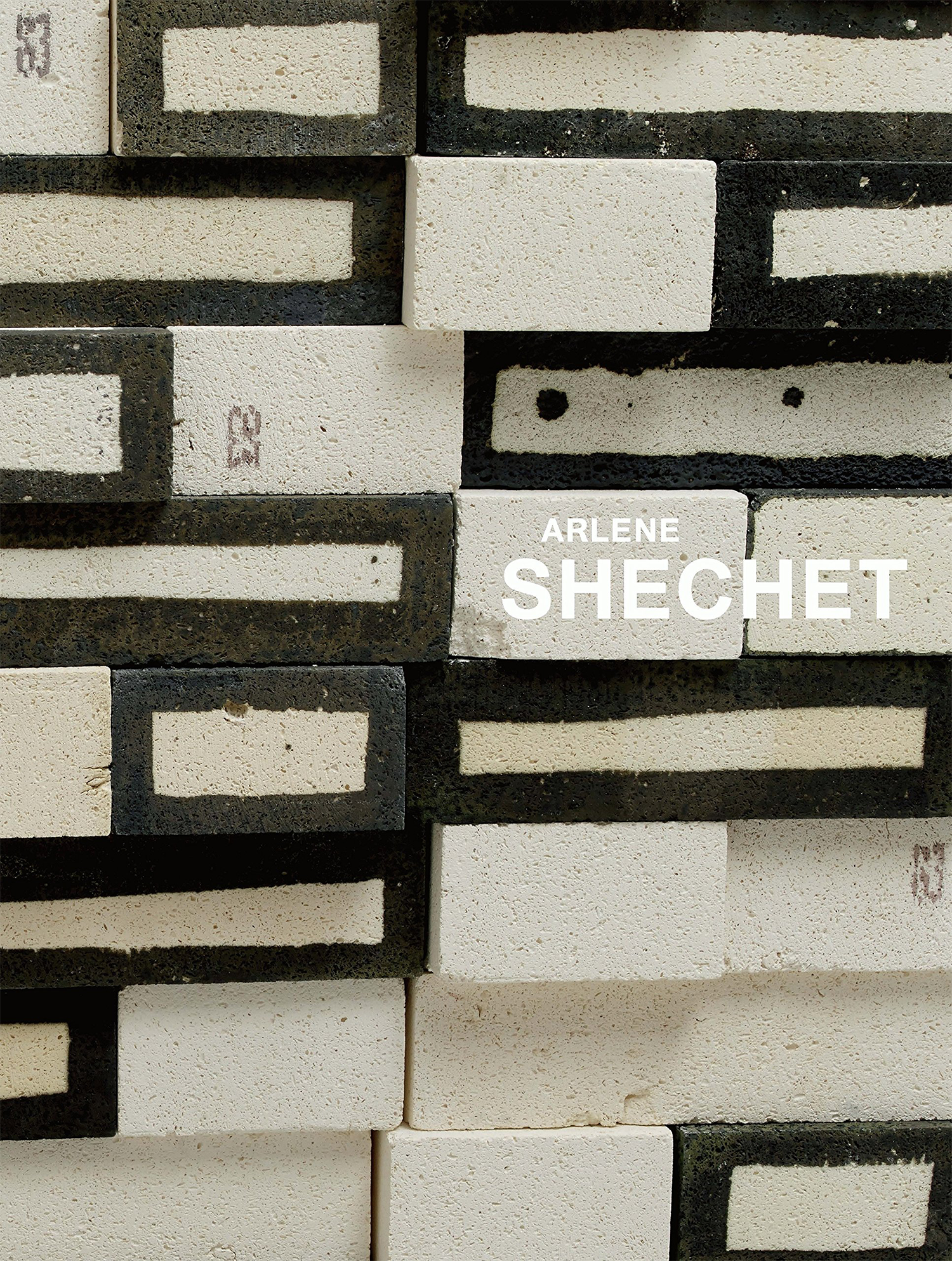
So and So... became the battery for a new body of work. It was not only the heads that were strikingly generative; the bottom halves are composed of kiln bricks. Left in their natural creamy white or edged with black glaze, the bricks are the very same material used in the kiln. The black and white, geometric patterning exquisitely contrasts with the abstract orbs. With one seemingly modest gesture, Shechet turned the kiln inside out, referenced the formal qualities of the stupa paper works, and presented a dazzling exploration of part-and-whole aesthetics. Her use of bricks complicates the serial forms of minimalism. Carl Andre, for example, considers the 137 firebricks of his Lever, 1966, as “objects of use rather than vehicles of expression. In this sense the readymade elements can convey, on a purely abstract level, the idea of simple externality.”20 With So and So..., Shechet combines an interior space central to figurative sculpture with a space of external logic as epitomized by readymade bricks. She further upends the nonhierarchical readymade by painting and glazing, and sometimes cutting, the bricks. Each becomes unique, same but different, one thing after another. And, by juxtaposing readymade bricks and the handmade ceramic, Shechet asks you to consider these forms equal, thereby repudiating minimalist uniformity.
Lever was, in part, Andre’s defiant nod to the relentless verticality of Brancusi’s Endless Column. Verticality is anthropomorphic, and the “gravity columns” minimalists sought to dismantle problematize not only the pedestal but also its hierarchical associations.21 Art historian Arnauld Pierre writes: “If Lever was in a long-distance dialogue with Brancusi’s Endless Column, then [Serra’s] Stack Steel Slabs strikes me as having an equally strong relation to Rodin’s Balzac, whose tilting silhouette Serra’s work spontaneously adopts. . . . Thanks to this tilting, Rodin’s figure was able to leave the fictive space of the monument and enter real space.”22 I find the correspondences with Shechet’s approach to be particularly striking. Serial, stacked, nonhierarchical forms echo in her work, but in the least likely location. Shechet has continued with the kiln bricks as support, leaving them wholly untouched and stacking them as white geometric bases, or, conversely, treating their surfaces with wild color and pattern. In a few works, kiln bricks move to the top of the support. Tattletale, 2012, is a pile of bricks cut into differently sized squares and rectangles and glazed. The architectural form surrounds an intestinal mass of black coils, creating a peculiar mix of the geometric and the biomorphic. A clear acrylic pedestal floats the heavy, unruly pile, underscoring again the element of gravity.
In 2012, Shechet began a new series at Dieu Donné, bas-relief paper works called Parallel Play. Inspired by her concur- rent sculpture, which included casts and molds (and, in terms of the title, all the coincident processes and materials she deploys), Shechet made rubber molds from her studio worktable detritus as well as kiln bricks to create an irregular, relief surface—a kind of flatbed picture plane. The resulting molds were cast with pigment and cotton to create dense mats of color. As the paper dried, Shechet worked the surface like an affichiste, tearing and digging down into the layers of pulp to create palimpsests. These stiff paper works are more a hybrid of painting and sculpture than traditional handmade paper. For the artist, they are the architecture of the studio, a three-dimensional snapshot of the work she made there. Working in paper is for Shechet a way to function with a greater immediacy than clay allows. Clay is all delayed gratification, whereas with paper, though it requires hours of preparation, the result is immediately accessible. The chromatic play of Parallel Play demonstrates once again Shechet’s mastery of color on any surface, flat or in the round, seen and unseen.
The Factory
In 2012, Shechet commenced a residency at the renowned Meissen Porcelain Manufactory. The Manufactory was established in 1710 by the King of Poland to produce fine porcelain, and continues production of its traditional wares in a twentieth-century factory near Dresden. The highly specialized labor force is composed of workers who do their job and their job alone: moldmakers, painters, glazers, sword signers, and so forth. Shechet, as resident artist, was invited to do whatever she liked, without any production obligations. It was an outlandish opportunity, an all-access pass to materials and experts, and Shechet jumped at it. Meissen expert Maureen Cassidy-Geiger affectionately describes Shechet’s other- worldly presence at Meissen: “There was Arlene, wily mistress of a sun-drenched studio, not taking nein for an answer (and not speak- ing a word of German). . . . I glimpsed a visionary at work, harness- ing and taming an anachronistic behemoth.”23 Working at Meissen over the course of two years, for periods ranging from several days to several weeks, Shechet studied every area of the manufactory, from painting to glazing, from molds to clay slaking.24 She focused her work on a few central production processes: molds, decorative painting, fragments, and extruded bricks.
Perhaps the most significant of Shechet’s experiments was her use of Meissen’s three-hundred-year-old molds. She made molds of those molds, then cast them in porcelain. The casts capture all the mold marks, from dates and numbers to signatures, drips, and gouges—all of the incidental markings of time and labor. The sculptures Shechet made with the molds of molds are mostly solid, inexplicable objects, like Casserole, Scallop Bowl, and Six-Sided Vase S141 (Onion), all 2012, which are finished with deli- cate, traditional decorative painting. Compared to her work with red clay and plaster, these small works telegraph a scale beyond their size. In casting molds, Shechet transmutes an industrial object into an art object in order to “celebrate the worker, the fact of the factory, and what’s really happening. In my work I’m always trying to get to what is essential about the material I am using or the situation that I’m in. . . . The most elemental part of the factory is the molds. It’s both the most obvious thing and the most hidden thing, the thing nobody sees.”25
In wealthy eighteenth-century homes, dinnerware hung from the wall so that its form and decoration could be admired, and figurines called the dessert populated the formal dining table. Mining the porous borders of eighteenth-century art and decoration, Shechet fuses dinnerware and figurine in incongruent mash- ups that showcase the elaborate mold-making process, often by extrapolating its countless details. In Böttger Paw Box, 2013, she casts the mold to show the intricacy of one tiny part of the finished figurine. In After the Flood, 2012, she heaps cast bits and pieces in a chaotic jumble, capturing the appearance of detritus left when flood waters recede.26 In related works Shechet calls sculpture gardens — she imagined them as life-size as she made them — small fragments are arranged on serving trays, plates, and bowls. Shechet’s aforementioned Monuments series fits here, considered by the artist as something like a maquette. The mash-up works are witty, uncanny, and altogether magical.
Shechet utilized decorative painting in relatively modest ways, since she was allowed only limited access to the Meissen painters, of whom there are very few. As with the molds, she requested painting based on traditional patterns and motifs. Mix and Match, 2012, for example, is a mash-up of parts painted in traditional patterns she selected from Meissen’s textile catalogue. As in her other work, here she used paint and glaze liberally. And though no piece of Meissen leaves the factory without its shiny clear glaze dip, most of Shechet’s surfaces remained unglazed. She upended another convention by cleaning her paintbrush on top of previously painted motifs, such as the renowned blue onion pattern, to generate a random pattern of energetic lines that recall John Cage’s chance operation Cleaning My Pen. Shechet superimposes the ordinary on the ornamental.
Wanting to dimensionalize the Asian-influenced painting so prevalent at Meissen, Shechet devised a working method to draw with porcelain slip. The method she devised was similar to the one she used to fabricate the paint skins. Essentially, the process is akin to action painting, and I’d ask you here to imagine Hans Namuth’s famous photos of Jackson Pollock dripping and fling- ing paint onto a canvas unfurled on his studio floor. Now imagine something like that, but with porcelain, dripped and thrown about on a factory floor while a bunch of perplexed, highly trained artisans watch. The production was physically demanding, as Shechet applied slip to ten to twelve plaster slabs simultaneously, peeled it up at the precise moment of rigidity, and affixed the sections to a scored pot. Hella Jongerius, who made ceramic works at Nymphenburg, wonderfully describes a way of working that is like Shechet’s: “When you want to tease secrets out of materials, you need what the Germans so beautifully call Ausdauer (stamina).”27 This is how large works such as Swan Vase, 2013, were made — with sheer stamina.
Shechet considered the final part of the factory production not the finished wares, as one might expect, but the leftover porcelain. At Meissen, clay is never re-wedged. In the process called slaking, porcelain is soaked, then extruded into gridded blocks, fired, and ground into grog or aggregate that is added to porcelain to decrease shrinkage. While the gridded blocks are wholly practical, Shechet made an association with the Baroque and the conceptual and aesthetic premises of the modernist grid. Much to the delight of the worker who slaked clay day in and day out, Shechet disrupted the production line by requesting blocks made to her specifications. With yet another kind of brick at her disposal, she made both sculptures and supports, performing manipulations like bending, pressing, and stretching, and decorating their surfaces as one would any fine ware. (One finds echoes in eccentric nineteenth-century potter George Ohr’s talent for smushing a perfectly thrown pot to create expressive forms.)
In 2014, Shechet curated a brilliant exhibition at the Museum of Art at the Rhode Island School of Design (RISD). In the two galleries of Meissen Recast, Shechet arranged their entire Meissen collection alongside her own Meissen sculpture. In the Porcelain Gallery, Shechet arranged her work alongside Meissen wares and figurines in compositions that looked like traditional displays, until one drew up close and noticed witty incongruities. Much of what she composed dispensed with traditional decorative arts display protocols. In the larger exhibition room, Shechet’s own work dominated. At each end of the dark gray oblong room, positive and negative forms—references to molds—were an understated architectural addition to the display. In this stunning composition, Shechet realized, once again, her skill for installation.
To some degree, Shechet considers herself an installation artist who makes objects. Shechet has created installations on more than one occasion, a gesture that links her to her contemporaries. Beginning in the late 1970s, artists began to rely increasingly on the context within which their work was considered, but in a mode counter to that of their phenomenologically inclined predecessors. Form gave way to content, content that was increasingly abject, emotive, even sentimental. The shift was partly brought about by feminist art, experience economies, and cultural and market shifts. Especially remarkable in this regard were the installations of Ree Morton and, later, Robert Gober, two artists Helen Molesworth describes as sharing an “attention to the handmade, to the vicissitudes of craft, to the pleasure and pathos of the daily. There is their mutual flirtation with the monumental even as they champion the banal.”28 In Meissen Recast, a provocatively crafted installation, Shechet continues in the same vein.
Stories
The Meissen oeuvre—a completed body of work, it should be noted—directly informed Shechet’s recent gallery exhibition, Slip.29 The new sculptures push the capacities of form and mate- rial, with Shechet amplifying formal play through wordplay: slip alludes to slipping (and falling), a Freudian slip, lingerie, and the liquid porcelain she recently spent so much time with. The artist reclaims past forms: slouchy, aperture-riddled shapes like the droll No Noise, 2013, is glazed in a volcanic, matte orange; the genie lamp of her 2007 series is here, slumping and exhaling, but still light- hearted and animated. Shechet dislodges readymade kiln bricks by casting them — from molds of cast bricks (casts of casts) — and incorporating into sinuous bodies, as in Stories and The Possibility of Ghosts, both 2013. Openings allow light to penetrate the interior, and the eye follows. Inside out, once again. Twins and doppelgangers are critical. Out and Out, 2013, is an embracing pair of ombre brown pots, huddled and bound by horizontal strips that mimic mold straps. The diptych looks back to So and So..., as well as sideways to a pair of caved-in molds titled Coffee Pot Vase 29694 Pair, 2012, Shechet made at Meissen. Idle Idol, 2013, twins with its punning homonym. Color is subdued and monochromatic, mostly creams, browns, and grays, as in Naked, 2013, creamy except for a lacquered, white-gold vertical stripe. Shechet’s characteristic range of pedestal types—sculpture stands, kiln shelves and bricks, bare and painted wood, welded steel plinths — matches the resolution of the ceramic superstructures. One new gesture is an attempt to incorporate pedestal elements within the ceramic. Raw plywood pedestals, used here for the first time, are mute risers, though one sports a painted blazing red top. All in all, Slip shows another new attitude right at the moment of its formation.
Shechet’s forays in ceramic draw comparisons with other sculptors who have worked almost exclusively with the material: Kathy Butterly, John Mason, Jim Melchert, Ron Nagle, Ken Price, and Betty Woodman, to name a few. These artists all make very different sculpture from one another, and from Shechet. But their dedication to and love of the material often lead to the same hitch in terms: art or craft, sculpture or vessel, and so on and so on. That is a history that begins in the 1950s and partly resolves with 1980s postmodernism; along the way, it dips into Japanese pottery and Zen, pedagogy, Black Mountain College, West Coast Funk, Pattern and Decoration, feminism, and the fusion of East and West. Anything goes, and artists who work in clay know that the sculptural and painterly possibilities of the material are limitless. It is also one of the hardest to work with: “For all the natural- ness of clay, however, ceramic art objects are indirectly arrived at; they’re the result of a kind of quadruple bank shot in terms of process: forming, to drying, to bisque firing, to glazing, to final firing. The ceramic artist has to be thinking at least a couple of moves ahead. What you immediately see isn’t, as it is in, say, painting, what you get.”30
Now several years into a commitment to sculpture in ceramic, Shechet’s work demonstrates her authority by pushing the medium’s very limits. What can sculpture do? she asks time and again. Can it be so asymmetrical it almost falls over? Can a surface be abject and seductive? Can it be ugly and beautiful? Can it be knowable and unknowable? The brinkmanship Shechet deploys is, for her, generative, and it challenges clay’s intrinsic qualities. For Shechet, clay is the material that allows for the most unmediated experience with art; it’s a living material, one capable of recording and externalizing thoughts and feelings. Internal thoughts are not always kind, and sometimes the object is unkind in return. To paraphrase the artist, clay demands an appetite for ugly. You have to possess a tolerance, a fearlessness, for the hideous object in the studio, the one that won’t be attractive for months—perhaps ever. This is the leap of faith that an artist makes in the studio, especially when attempting the monumental, the monument. “When I’m in the studio,” Shechet has said, “I bring all the everyday information of a life, from art, from the street, and everything in between. For me, it’s a monumental way of thinking about living.”