Family Style
Every Angle
A new material and years of patience converge in Arlene Shechet’s latest works.
Words by Ann Binlot
September 11, 2026
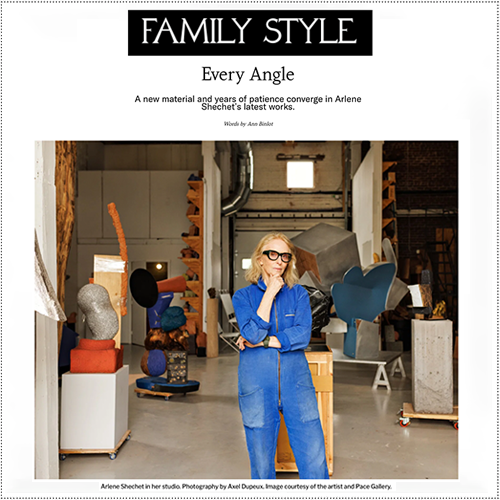
After five decades, Arlene Shechet is experimenting with a new material: corten steel. "It's like a rope," the artist tells me as we walk around one of her latest mammoth creations at one of her two upstate New York studios. "It's very strong and robust, and it's such a powerful material."
The striking metal has traditionally been associated with male sculptors like Richard Serra, known for his gigantic curved walls, Antony Gormley, who creates angular, human-like figures, and Bernar Venet, famous for his thin swirls. Shechet's monumental sculpture, Flo, is like a three-dimensional abstract painting filled with geometric shapes—ovals, circles, trapezoids, curves, and cylinders—morphing into one another. "You'll see that every view is completely a new composition," she says. "It's a new story."
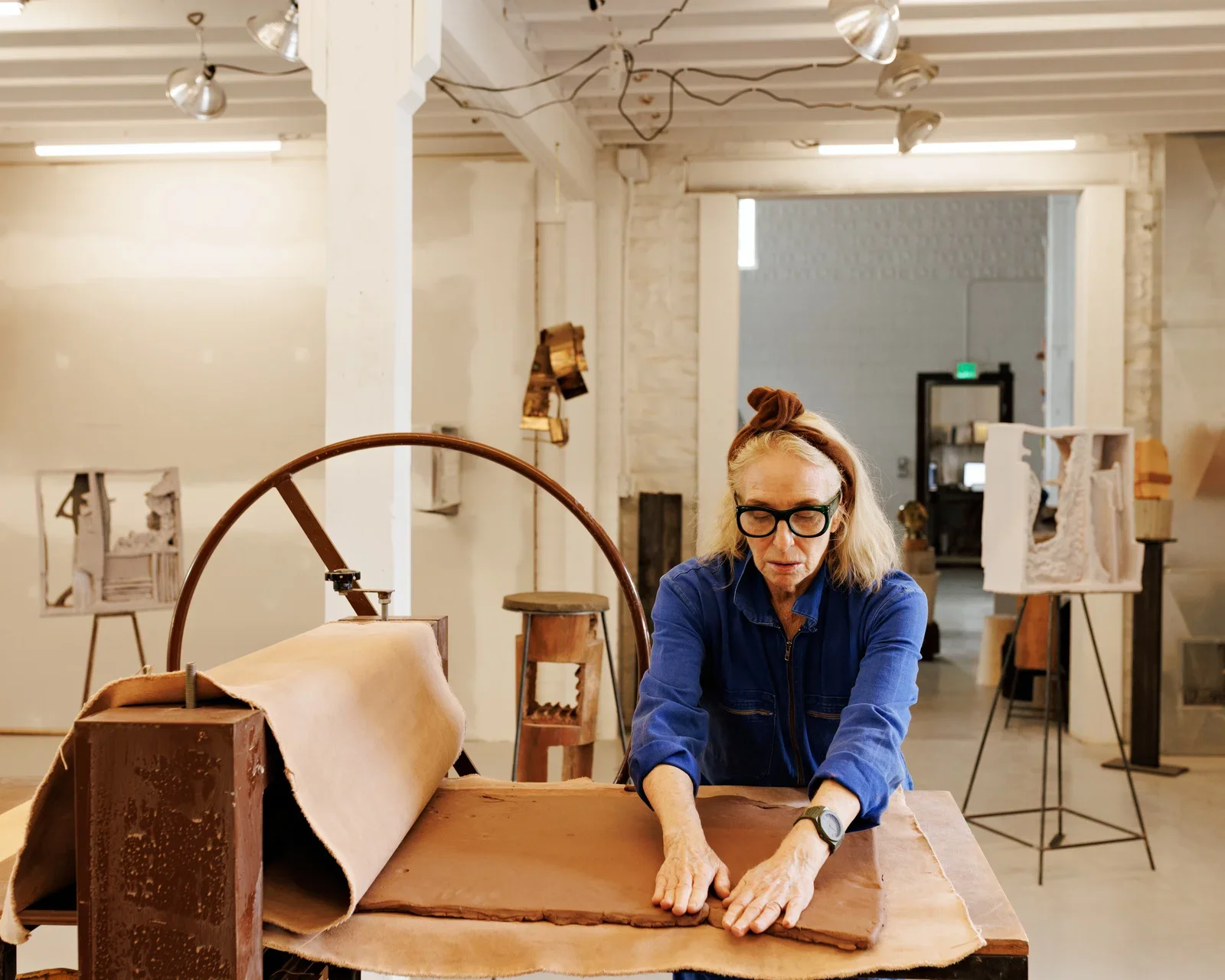
Arlene Shechet's studio. Photography by Axel Dupeux. Image courtesy of the artist and Pace Gallery.
It's a principle that runs through everything on view this fall. Flo is one of about 20 works Shechet created this year for “She Said She Said,” her exhibition at Pace New York's 508 and 510 West 25th Street locations, on view until October 24.
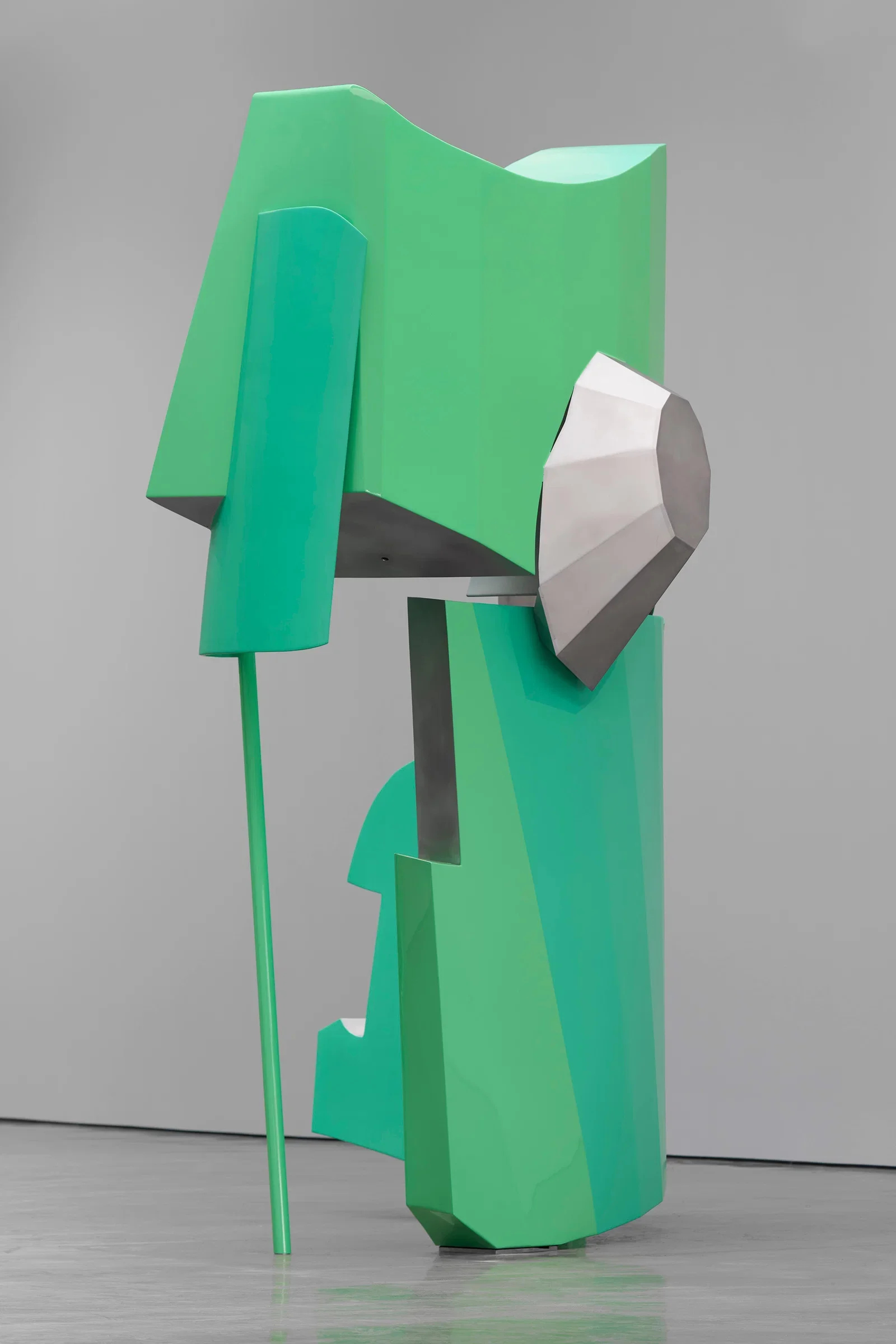
Arlene Shechet's studio. Photography by Axel Dupeux. Image courtesy of the artist and Pace Gallery.
"I'm always pushing myself," says Shechet. "My reputation is built on that, on being innovative." That pressure shows up in her sculpture titles. Each of her larger pieces is named after a woman; along with Flo, there is Eve, a tall and long in lavender and light blue abstract silhouette of a woman, made of welded and cast aluminum. Jewel is a vivid green welded-aluminum sculpture that assembles irregular planes, cylinders, rods, and a faceted silver protrusion into a precarious, almost anthropomorphic form.
I ask her if things have become easier for female artists since she started. Instead, she offers a counterexample: "I went to this conference [Making Their Mark] where they said starting in 2019 things got worse for women, [like] fewer shows, and they actually cited the statistics.”Her studio manager Michael chimes in, saying that no matter who is discussing Shechet's work, it's always gendered—and that titling her pieces after women is one area where the artist can assert themselves.
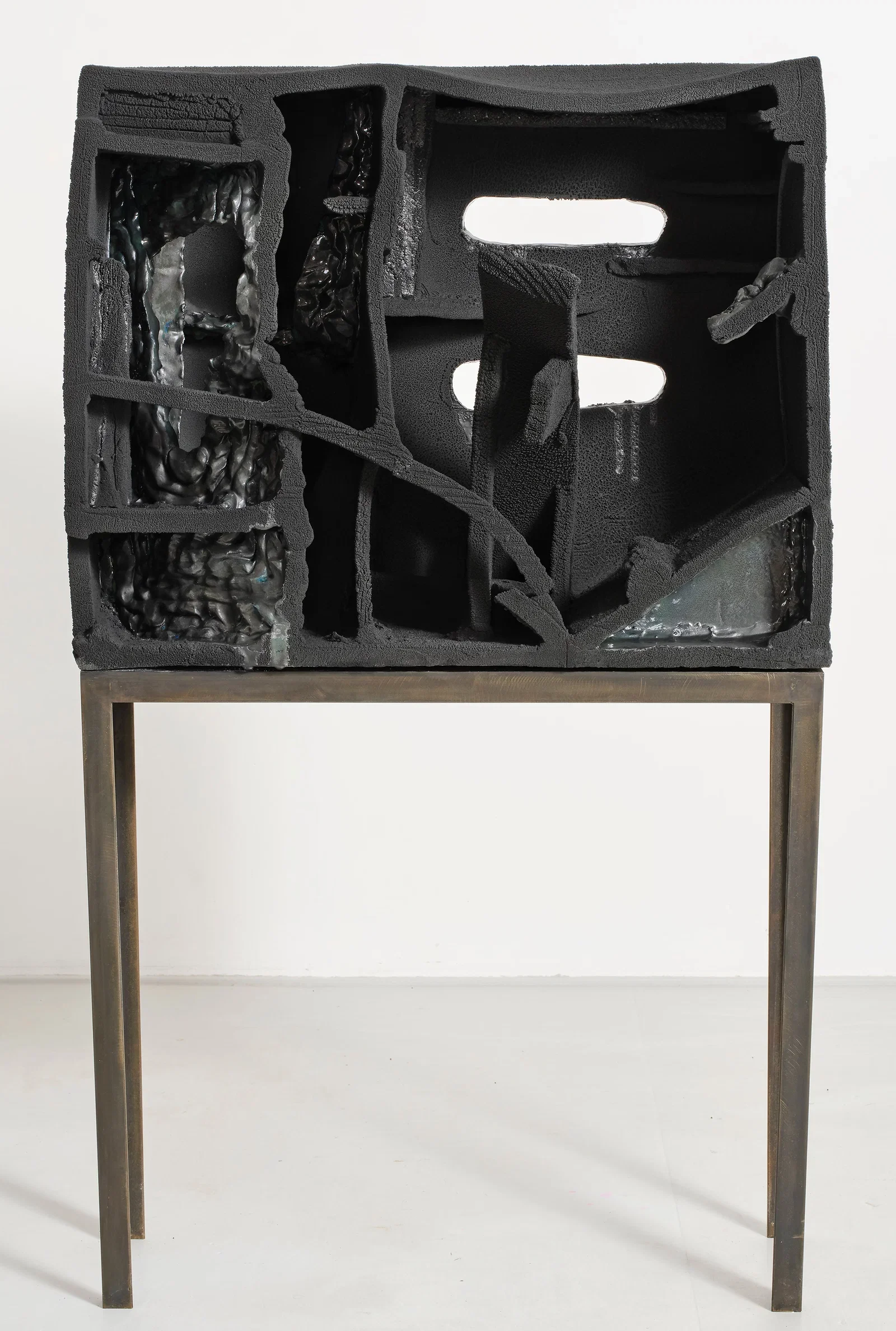
Arlene Shechet's studio. Photography by Axel Dupeux. Image courtesy of the artist and Pace Gallery.
But for Shechet, it’s not that simple. "There's no controlling the narrative," she says. "You can only do what you can do and make what you want to make, and write what you want to write, and cross your fingers, hope that your efforts are acknowledged." She'll name the work what she wants to name it. What people make of that is out of her hands.
In the studio, Shechet shows me “Touching Ground,” another new series she's working on, made of terra sigillata, glazed ceramic, and steel. "They're somewhere between sculpture, painting, and drawing," she says, lifting the plastic off one piece embedded into the wall, titled Touching Ground: Tucked (In). It has four compartments set into the right side. It's like Shechet's version of a cabinet of curiosities, except instead of being filled with objects, it's filled with textures, shapes, and forms from her mind. She's even designed aluminum chairs for viewers to sit on while taking in the show.
We sit down at her computer with Michael, and she explains her process: "I start with a clay thing, and then I gradually take it apart, and I start working with it on the computer drawing. So it's analog, digital, analog, digital, very much back and forth. None of them are more important than the other." It's the same instinct as viewing the sculptures from different vantage points: no single version is the final one, just another angle on the same idea.
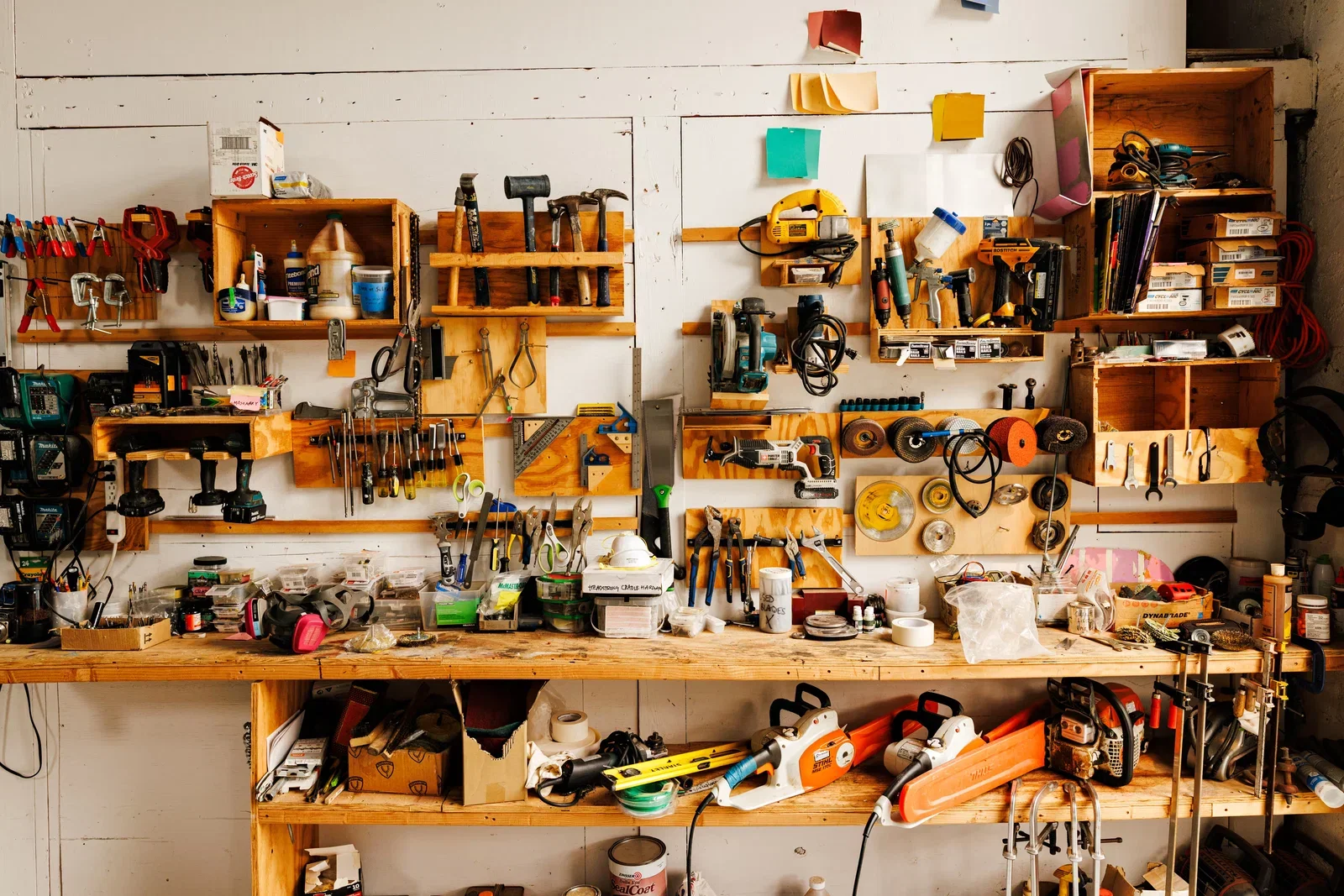
Arlene Shechet's studio. Photography by Axel Dupeux. Image courtesy of the artist and Pace Gallery.
Before she could afford a studio, Shechet worked out of her bedroom, teaching at R.I.S.D. and Parsons through the '70s, '80s, and '90s. She doesn't regret the wait. "When you go up too hard early, there's a big fall," she says. Her advice to young artists is blunt: Get the basics right first. "Take it slow, and, if you make money, buy a place to live."
"Nothing is easy," she adds. Success hasn't simplified anything. "It might look very cushy, but it's not." What she's after hasn't changed. "I hope people are inspired to feel the energy of life that's traveling through the works," she says. "I hope I'm communicating both intelligence and joy—that's what I reach for.”
“Arlene Shechet: She Said She Said” is on view through October 24, 2026 at Pace New York at 508 and 510 West 25th Street, New York, NY 10001.