A Dialogue with Arlene Shechet
by Ian Berry
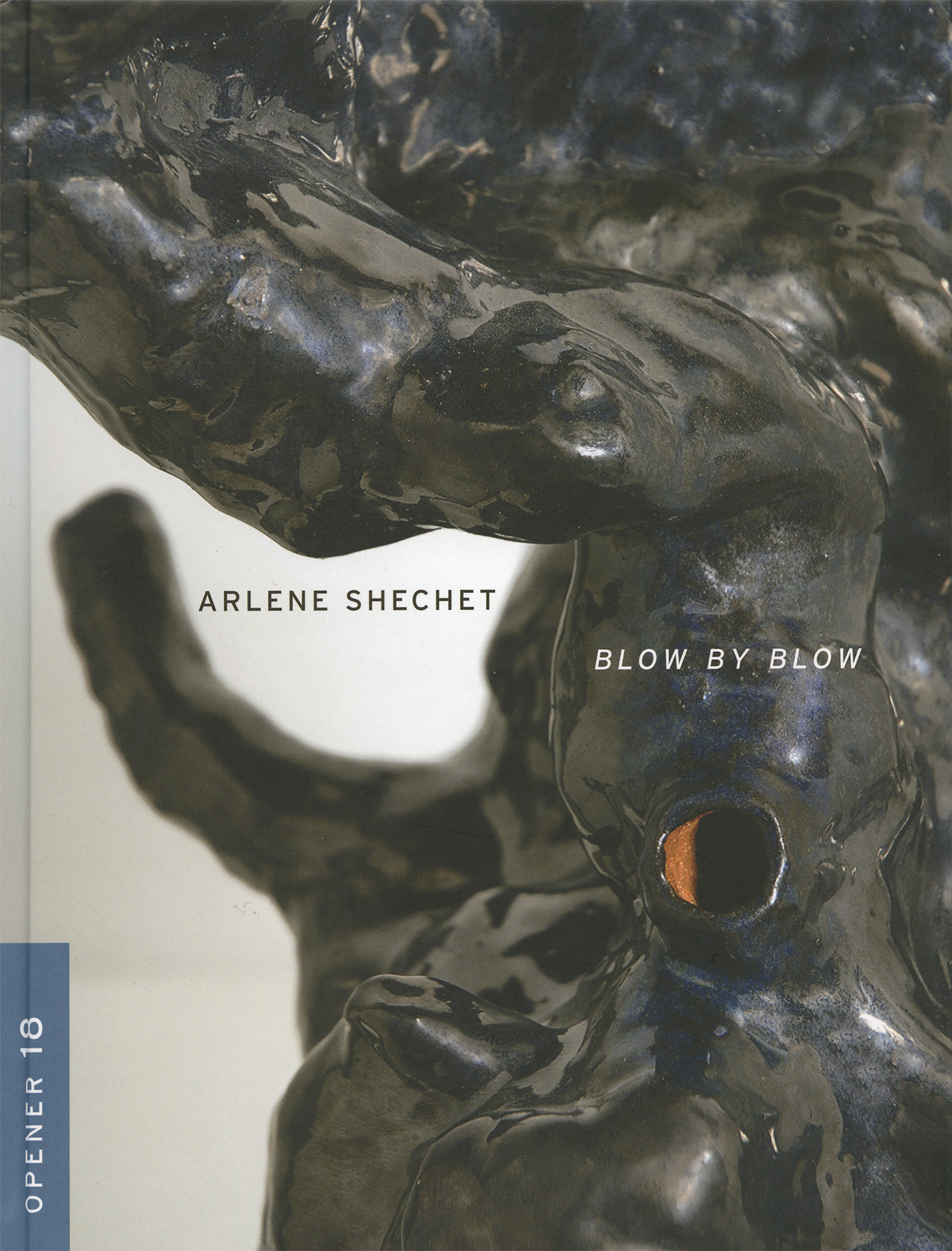
Arlene Shechet’s recent glazed ceramic objects float, twist, and puff-up atop stacks of unadorned concrete, plaster, wood, and steel. While Shechet has worked in sculpture for over two decades, these new works shift away from her earlier explorations of iconographic Buddhist imagery toward more abstract forms and combinations. Confounding any single reading, they hover in the fertile space between East and West, secular and sacred, and modern and ancient. Shechet’s modeled surfaces demonstrate how clay mirrors the artist’s touch. Her objects bear the mark and memory of her hands. The sculpture’s bulges, hollows, spouts, and holes evoke bodily features and, as the artist notes, are “suggestive of the curving forms found in classical Indian sculpture.” By coating the clay with eccentric color combinations and metallic glazes—created with an experimental disregard for traditional firing temperatures—she not only fractures the objects’ surfaces but also undermines any single association with nature. Seeming to expand and deflate with breath, Shechet’s dynamic works continually transform as the viewer changes perspective, reappearing anew moment by moment.
IAN BERRY: As an artist, have you always felt you were doing the thing that wasn’t in?
ARLENE SHECHET: I hope so.
IB: You like that place.
AS: I like that.
IB: It can be lonely.
AS: I am okay with that. Being marginalized represents an opportunity. If you are doing exactly what’s in, you are on your way out.
IB: Do you think of your viewers when you work in the studio?
AS: I am already the audience. When I make the work I get in a place where I allow myself to let the work happen, so my conversation is with the work. I’m like a medium to let the work pass through me, and I’m responding to what’s there.
IB: If you had no show, you would still make the things?
AS: I’d still make the things. But I love the process of having exhibitions. I like that feedback, the spaces; I like moving things around, revisiting the pieces in new contexts. I think art needs the world. If people can see something and have it grow in their minds or bang up against their emotional state, then that makes me happy.
IB: What do you think of the idea of having faith?
AS: I think everybody has faith, unless they are deeply depressed. By nature I am a pretty optimistic person, and yet I feel that things are fragile. The Eastern way would be to say everything is in transition always. And the way to deal with that is to pay attention to how amazing things are.
IB: How did you learn that? Most people don’t have that kind of clarity about things.
AS: I can’t necessarily live it as well as I can say it!
IB: When did you start thinking about living your life that way?
AS: I’ve been lucky enough to have a natural flow of opportunities and ideas. I made one rule for myself early on: if you think it’s not interesting (like the things that give you an immediate repellent reaction), don’t immediately turn away. Those might be the places that create openings. That rule made me aware that everything has possibilities. For instance, about fifteen years ago I was using blue and white in my paper work to refer to architectural blueprints, and this made me suddenly sensitive to blue-and-white porcelains. The way the glazes overlapped with how I was trying to bleed blue into my paper works. I started to look at porcelains from China, Flow Blue from England, Delftware, Willowware, a vocabulary of things both Eastern and Western that I had always dismissed as boring. The idea of the bleed, and impregnation, all that was already happening naturally with the paper had a huge history in ceramics. I had earlier come to believe the vase is a domestic form of sacred architecture—all of these thoughts expanded my relationship to ceramics to and, in turn, inspired the installation Once Removed.
IB: At art school, did you know you were a sculptor right from the start?
AS: Yes. I think it’s an innate predisposition. I like dealing with t he physical world.
IB: Where did you go to school?
AS: I went to graduate school at RISD. And I went to undergraduate at Skidmore and finished at NYU.
IB: You grew up in New York?
AS: In Queens.
IB: Was art part of your family?
AS: My mother was a homemaker but she painted in a studio in the basement of our house and I would go to the art supply store with her—I loved the smell of the art supply store. I was always doing drawings or making things.
IB: Did you grow up with religion?
AS: I grew up Jewish in a fairly observant family. I learned Hebrew, partook of the traditions and felt like I could transition into the world carrying that faith in my back pocket, while totally rejecting it at the same time. After graduate school I listened to Alan Watts on the radio in my studio in Boston for three years. I met my husband Mark during this time. He had sought out Buddhism in his twenties and brought more of that information into my life.
IB: Do you think of yourself as Jewish or Buddhist?
AS: I think of myself as Jewish but don’t see any contradiction in paying attention to a lot of different belief systems. I like the idea that we all have this stuff that we’re given. Pass it on and let the next generation deal with it however they like.
IB: Were you afraid to bring religious imagery into your work? That wasn’t a popular theme for art in the early nineties.
AS: Right. Well, my experience with the Buddhas—those really happened by accident. I was fishing around for a new way to work using wet plaster without an armature. I made a blob and thought it looked very roughly like a Buddha. I wanted to work with time as a material element and found myself receptive to associations. There was the Buddha. When a friend stopped by the studio, the look of horror was profound. First I got scared, then I got interested.
IB: Because it was a religious symbol?
AS: Actually, I was thinking of it more as just a form at firstawith . People started coming to see them in 1993, and their embarrassed reactions gave the pieces more content. It made me think how strangely limited the art conversation can be. I was surprised to find myself in the dialogue about religion, but then I welcomed it. I still cringe if anybody starts talking about the spiritual in art, though. There is a basic problem with vocabulary.
IB: The word spiritual is pretty abstract. You are for faith?
AS: I am for the search, which I see as a search for meaning. Buddhism overlaps quite well with studio art because a lot of the ideas—of mindfulness, time and attention—are relevant for the state of mind essential for studio practice. These pieces were very much process pieces.
IB: Are those bold colors painted on?
AS: All of the colors embedded within the pieces are acrylic paint skins that I had been experimenting with from an earlier series. I embedded them in the pieces as I was making the plaster forms. They provided both structure and surface. When people started to refer to me as the person who made Buddhas, I felt uncomfortable. I wanted to make things that were more about getting inside of the Buddha, more about what it was like to be alive and breathing. You can look into the openings of some of my recent work and see inside the material and the hollowness which relates to the breath.
IB: Talk about being a woman artist with a family in the late eighties and nineties, when a lot of art concerned identity. Women were starting to push harder for shows, and institutions were responding very slowly. How did you fit into those conversations?
AS: I wrote something for the journal M/E/A/N/ I/N/G about being a mother. They had a whole issue about motherhood. I was a little bit angry all around at that point, because when I was pregnant, I remember feeling that being pregnant meant taking yourself out of the conversation.
IB: So you didn’t feel welcome into some of those conversations because you chose to have a family?
AS: I just put my head down and used whatever time I could find for my studio. I feel fortunate to have been able to maintain my studio life. Having a family is a complicated business.
IB: What were you looking at then?
AS: Richard Tuttle and Myron Stout. I bought Stout’s Whitney Museum catalog for a dollar on the sale table. The boldness and quietness of his work got to me. Richard Tuttle had a show at Brown University when I first started teaching at RISD. His relationship to materials and scale were important to me. Elizabeth Murray gave a moving and energizing talk at RISD and even talked about having kids. I was thinking about Lee Bontecou and her work with holes, leather, and wire. I was already attracted to Eastern stuff, so Francesco Clemente and Luigi Ontani were interesting to me as Western artists who were accessing Eastern stuff.
IB: What else was happening in New York?
AS: I remember Holly Solomon Gallery on West Broadway and walking in and seeing an installation by Judy Pfaff. She was interesting to me from the point of view of using many different materials, using the architecture. I remember that space very distinctly, and more than I remember any of Judy’s marks in there, I remember how the space held it and how she pushed out against it. I thought that was quite fabulous.
I remember Kiki Smith’s show of figures at Fawbush Gallery. That work had a broad language: it was not pinned down to one thing. It was figures, but it was also some stuff on the wall. She was having a good time and also dealing with a feminism I could relate to because it was not so strident, even though it was tough. It was beautiful, even though some people would call it ugly, and that has always been attractive territory for me. A few years later I was in a funky group show in a vacant space in Tribeca. It was the first time that I had shown any of the Buddhas. Kiki came by, bought one, then called me up and invited herself for dinner. She said she was interested that I was making such unfashionable handmade stuff. It turned out that she had a lot of interest in the decorative arts, as did I, so she was turning over my dishes to see what I had, and I had lots of weird stuff. We immediately bonded.
IB: There seems to be a renewed interest in the handmade right now in contemporary art.
AS: I think we are always at that moment, but I think you’re right, there is a language now that is completely obsessive. Some work is obsessed with touching things in just the right-wrong way. Things that look really relaxed, even trashy, reveal just as much obsession with craft as the overly refined object. IB: What about humor in your work? Your recent works are funny and they’re awkward, and their awkwardness has humor. They look too big, too fat, too bulgy, too lopsided. What’s the power in that kind of awkwardness or embarrassed feeling?
AS: Embarrassed, that’s a good word.
IB: Some of your pieces look a bit embarrassed to be on view.
AS: Not embarrassed to be on view, but working to embarrass whoever is looking at them. Almost all of the recent pieces are topheavy, in a state of imbalance, precarious, threatening to fall over. Humor is really important for me, because I feel that’s where the fragility comes in.
IB: Because laughing is a way of releasing tension, or a way of showing vulnerability?
AS: The laugh in very literal terms is part of breathing, so the laugh is another kind of breath, another exhale; then the laugh is also uncomfortable, it’s about recognizing something. I don’t think you laugh at things if you haven’t connected to them, so you’re connecting and you’re pushing away. It’s this push - pull that I am interested in. It is ugly and beautiful, it is the very strong and slightly pathetic.
IB: How do you make an object ugly?
AS: That’s the struggle when I am in the studio. I make things and then I throw them out because they don’t hit the mark, that’s basically what I do. I am dealing with an organic vocabulary of forms, so if it goes over the edge and looks a little too nature-like, I have to throw it out. I insist on the forms (no apostrophe necessary)’not being pinned down. They have to be hybrids to be successful.
IB: Do you make drawings beforehand?
AS: I try not to, I don’t want to. That’s one of the interesting things about working with clay: it’s basically a 3-D drawing material. The clay is soft and mushy. I build the pieces bit by bit so I’m working the inside and the outside at the same time. This happens slowly over a period of months, so my relationship to where the form wants to go constantly changes. I am making things that are hollow, I am making things that are hard to stand up. The scale is actually very difficult—--they’re big and so they definitely have lives of their own. That doesn’t mean I don’t start out with some idea, but I don’t want to pin it down in advance.
IB: The way you —play with and rearrange the parts of your bases is an interesting way of continuing that unfixedness.
AS: The potential exists to change and it is my privilege to use that potential. I’m not sure if I think of them as bases anymore. Perhaps in the future the ceramics won’t even be on top in the sandwich of materials. Bases are the eternal problem of the sculptor. Years ago, I had a footstool collection that I had found on the street, and my kids were falling all over them. Mark said, “Get those out of the house,” so I brought them down to the studio and then every time I made a Buddha it sat on one. That was the solution for the Buddha bases. The ceramic pieces feel incomplete without some kind of architecture. The bases provide that.
IB: You mentioned that the ceramics are hollow.
AS: A lot of people imagine that I build them as solid forms.
IB: By carving the exterior?
AS: Right. You couldn’t fire them though—--they would break if they were solid.
IB: Their hollowness can make them seem more alive.
AS: When I talk about the air moving in and out, those appendages which are snouts or spouts or phalluses or handles, or all of those things, those are ways for air to move in and out in both a practical and a symbolic way.
IB: Those suggestive forms are coated with unusual glazes and seductive surfaces.
AS: Sometimes I like to contradict the drooling, weird forms with lustrous satin skins. Other times I prefer to take the baroque ebullience of the form and flatten it out with a mousy matt glaze. In ceramics, there’s a pause between building the pieces and applying the glazes. Because of the long time required for drying and firing, this can be months. When I come back to making the glaze decisions, I have the chance to reintroduce myself to the work. This little bit of space creates enough detachment that I can take more risks with the surfaces. Recently I’ve been experimenting with layering a bunch of white glazes that misfire just enough to make a blanket of pimples that can also read as puckered lace.
IB: The finished forms don’t seem to fit in any one time period.
AS: Not giving it a fixed time is the same for me as trying not to fit into a single subject matter. Modernist sculpture and historical pottery offer similar potential for me. “Ceramic sculpture,” that’s a category I am not interested in. I also don’t want to make “abstract sculpture.” I don’t like that category either. I want to play in the middle. I like addressing the idea of the vessel without taking it on as the only subject matter. I began to work with clay because I wanted a material with a history but also a plasticity that would allow me to make anything. Clay provides an opportunity for building slowly, poking around, and figuring things out while finding what I want to make by making it, rather than thinking it and then making it. I want the pieces to embrace the contradictions that I see and feel life to be about.