Arlene Shechet: From Platescapes to Parkscape
By Lilian Tone
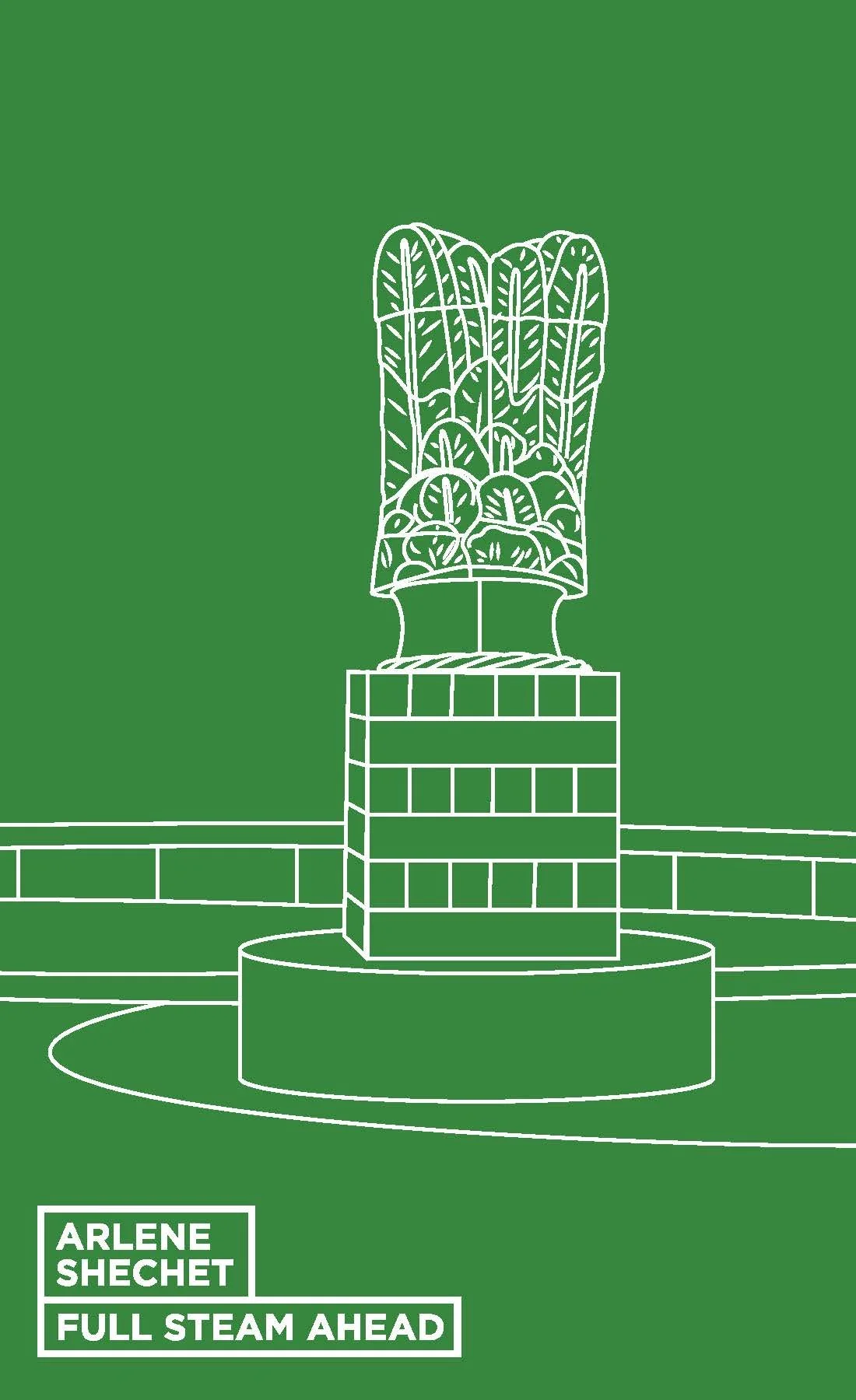
For centuries, parks and gardens have expressed the intersection between nature and culture. The gardens and grottoes of seventeenth-century Versailles, for example, embody the idea of the designed natural world as a form of cultural enlightenment, wherein various art forms—such as dance and music—were mediated through nature, and nature was thereby remade as culture. The swamp that would become Madison Square Park was designated as public land in 1686, and subsequently used for a variety of purposes. In 1847 it officially became a park; it was redesigned later in the century, with various monuments and statues added over time, and was further upgraded in 1997. In 2018, alert to this history, Arlene Shechet explores the Park as a platform for aesthetic jouissance.
In the works constituting Full Steam Ahead, the artist has reimagined a section of the Park as a stage upon which to assemble a constellation of distinct yet interrelated sculptures. It might even be suggested that Shechet approached the Park as a readymade available for adjustment, or to be assisted (in a post-Duchampian sense). Her works perform a kind of meta-theater of interconnections, inviting visitors to rethink how they interact with the Park, with one another, and with art. The locus of her intervention is the pool on the north side of the Park. With the water removed from the pool, she reveals the Park’s design infrastructure, repurposing it as a stage of sorts, and creating a theater of art-in- the-round. In addition to the pool, Shechet’s project involves subtle material inflections and supplements to other elements of the Park’s intrinsic design. In Threads, selected wooden slats from the benches surrounding the pool have been replaced by elements made of Krion, a state-of-the-art pigmented synthetic resin that simulates the look and feel of stone, or even porcelain. This material was also used for the twelve Skirt Seats that have been arranged as an alternative seating system, which indicates Shechet’s interest in staging new forms of social interaction. These playful and somewhat enigmatic utilitarian objects, resembling inverted buckets with patterning, amusingly allude to clothed humans.
Not only are Shechet’s works hybrid on formal, material, and conceptual terms, but they are also about hybridization, often referring to the conditions and processes of their own production. Composed of various materials—porcelain, wood, steel, resin, glazed kiln bricks, tiles, among others—her sculptures reveal that distinct forms, made using a range of methods, possessing distinct kinds of tactility, and carrying diverse referential meanings, can inhabit the same object. And that seemingly contradictory genres can be brought into relation with one another within the same work. We are reminded that the cliché notion of separating visual art and craft as uncontaminated aesthetic categories requires continuous debunking.
Full Steam Ahead finds precedent in Shechet’s intimate, whimsical, imaginary landscapes, wherein fragments of utilitarian and decorative objects are arranged on porcelain plates. Like an after-the-fact three- dimensional sketch, these plate works, created some five years before the Madison Square Park project, introduce not only central aspects of Fig. 19 its iconography, but also presage how Shechet would determine the size of the sculptures in relation to the site. For those precursor plate works, the artist chose elements from Meissen’s centuries-old design grammar, which she studied during her residency at the historic porcelain factory near Dresden, Germany, where she pushed the company’s highly controlled syntax of specialized, household- focused porcelain production in experimental and idiosyncratic directions. One such work, Pool Garden (2012; fig. 19), presents a morphed prefiguration of Double Arm Channel in Proud Bird Pool (fig. 20), both containing a round pool with a sculpture. A mise-en-abyme that is also a mise-en-place that is also a mise-en-scène.
In the aforementioned two works, and in others, such as Pink Boat (2012; fig. 21) and Channel Liberty (with Fallen Arm) and Tilted Channel (fig. 22), the artist repurposed sprues—the hollow channels that are used to pour liquid porcelain into molds to
form teacup handles and that are discarded after the casting process—by redeploying this leftover part, but upside down, so that it resembles a convergence of outstretched human limbs and a tree. In this gesture, she ingeniously transforms an essential yet unseen component of what makes a porcelain cup a porcelain cup into something that moves beyond the ontology of the cup into realms of abstraction and figuration.
Channel Liberty (with Fallen Arm) takes the viewer back to a particular moment in the Park’s history. From 1876 to 1882 an important modular element of the Statue of Liberty—the hand and the torch it is holding— was displayed in the Park, before the statue was fully assembled on its island in Upper New York Bay. Shechet often works modularly, with fragments, and reassembles her works. In Channel Liberty (with Fallen Arm), materials such as sand-cast iron, steel, and powder-coated cast aluminum are used in unexpected ways. Here, the inverted sprue form invokes Lady Liberty’s outstretched arm, but it holds not a torch, but rather a curvilinear Meissen-derived ornament that one might find adorning a teacup. As with many of her multipart sculptures, Shechet delights in playing with unusual combinations of materials and modes of production, and with traditional distinctions between base/pedestal and object.
In the plates that Shechet transformed into miniature sculpture gardens with the material and human resources available at Meissen, one observes an enchanting transfiguration of fragments of the factory’s repertoire—such as a lion’s head and paws, and bird wings and feathers—into suggestive forms and evocative objects (figs. 25, 26). Although the scale of these pieces is limited, they feel like immersive environments. They might be called “platescapes,” each invoking a distinct world. They at once celebrate and challenge certain established ideas about what porcelain can be: namely, a material and vocabulary of contemporary art making that also entails the deep history and present significance of craft and design aesthetics. These platescapes can be imagined as the precursors for how Shechet approached the Madison Square parkscape as an existing outdoor social- environmental ecosystem that could be temporarily altered, transformed into another kind of world. Shechet sited the human-scale works within the parkspace in a way that echoes how she distributed the small fragments of objects in her hand-built gardens-on-a-plate. Tall Feather (fig. 27), located just outside the periphery of the pool, is composed of a squarish structure of interlocking pieces of wood sitting on a cast-concrete pedestal, on top of which rises a majestic white glazed porcelain sculpture of a bird feather. While the feather element can be traced directly to one of the found porcelain fragments in Crazy Yolk Garden (2012), Shechet is also at once referring to and challenging the traditional relationships between base/pedestal and figure found within the historical monuments in the Park. Adding yet another layer, Tall Feather sits on a blown-up image of another platework that Shechet made during her residency at Meissen (fig. 28). The image has been laminated onto the stonework that surrounds the pool, and it extends into the surface of the pool, so that the outer rim of the circular pool overlaps with the outer part of the circular plate image, suggesting a contextual feedback loop of forms. With this gesture, the artist returns the sculpture to its original locus within a microcosmic system of craters, lakes, and valleys of fired glaze, thereby visualizing the interrelationship between her platescapes and her parkscapes. The glazed white porcelain component of this work—as well as Low Hanging Cloud (Lion) and Kandler to Kohler—exposes the seams and joints, denoting the intricate casting process and the method of assembly. These works were produced
in collaboration with another factory, Kohler, the long- standing American manufacturer of porcelain toilets and sinks, where Shechet also had an artist’s residency. Might there be a furtive allusion to Duchamp’s Fountain here? In Ghost of the Water, the absent pool water regains a surrogate presence: the artist replaced one hundred stones that make up part of the bottom of the pool with electroplated sand-cast iron elements, each of which carries on its surface an almost imperceptible image of the sky and clouds as if reflected in the water of the pool. Shechet’s accomplishment in Full Steam Ahead is to have created a synergetic network of sculptures that constitute their own world, while gently coaxing us to navigate the site in new ways. With her complex, sophisticated, humorous, and convivial artworks, Shechet has invented subtle new geographies and spatial dynamics for this place. Full speed ahead, but slow down in the Park.