The Privilege of Being Lost: Arlene Shechet at Storm King
By Anne Reeve
Sculptor Arlene Shechet’s evocatively titled Mystery History (2022) (fig. 1) is a towering curio, standing over seven feet tall and topped by a metal orb cleaved into a wooden block. When seen from a certain angle, the work nudges up about as close as Shechet’s three- dimensional abstraction gets to a kind of figurative sculpture, with a circular head sitting upon an angular body. Keep walking, however, and this allusion (or illusion) disappears; all of a sudden it becomes a tilted skyscraper, then a tree, a moon over a landscape, a stack of childhood blocks, an urban construction site, and then none of these things and only itself. A salvaged tree trunk as canvas, etched by natural forces and appended by material grace notes and furtive dashes of color: an oozing red glaze, a blue dye, the glimmer of silver palladium snuck onto corners and hidden under ledges, a muted sheen of polished steel. Seeing it hold court indoors as part of Shechet’s installation at Storm King Art Center in Mountainville, New York, curator and critic Johanna Burton’s maxim comes immediately to mind: “If there is something innately uncertain about sculpture,” she writes, “the doubt (and the promise) of the medium hovers in the space carved out between viewer and things. And it is here that talking (and walking) in circles starts to make sense.”1 Around and around we go, glimpsing and losing sight of, a mirage momentarily cohering then coming undone, caught in a heady and not un-maddening spin-cycle of ideas and images that open up yet resist us at every turn. “Mystery History” starts to feel an apt description for this amalgam of contra- dictions and conundrums, all while the object remains upright and at center, an unflinching testament to a singular artist’s lifelong project of creative exploration. For Shechet, the stakes include color, tex- ture, and form, but also the enigma of presence, the question of what bodies in space do to one another, and what art can and cannot offer us by way of understanding.
A prevailing framework for understanding twentieth-century sculpture is grounded in the influential writing of historian Rosalind Krauss, who takes the work of Auguste Rodin as conceptual ground zero for the experience of art that Burton outlines above.2 Krauss pos- its Rodin as the first sculptor whose works could be understood only through this sort of embodied viewing, a durational walking-around-of instead of a more immediate and fully frontal looking-at. Krauss extends her argument by attending to American Minimalism of the postwar period, which increasingly implicates the viewer as integral to any experience of art. In the twenty-first century, Shechet convincingly commands purchase within this lineage, one in which meaning is intentionally bound up in a call-and-response between object and subject. For more than forty years she has invested in sculpture as a kind of language, where the medium’s paradoxical instability—between an object primed to communicate and one that resists being known—lies precisely at the heart of its potency.
Sculpture, in other words, is a place to get lost, as anyone who has spent time moving through and around the hypnotic glazes, textures, and crevices of Shechet’s work can attest.3 But how can an artist, after almost a half-century of expertise honed in a litany of materials; with a prodigious knowledge of art history; fluency with art world institutions, politics, and administration; amid marriage, motherhood, and years of committed teaching practice—how can one muster and maintain this breadth of experience and simultaneously keep herself in the dark? How does one get and stay lost, and why?
My desire for knowledge is intermittent, but my desire to bathe my head in atmospheres unknown to my feet is perennial and constant. —Henry David Thoreau4
Within the outdoor pathways and possibilities offered by Storm King’s rolling campus, the Japanese principle of garden design known as miegakure comes to mind, calling forth a similar idea of lost-and- found, or rather, of what might be found in searching without resolution. Translating to “hide-and-reveal,” meigakure arrangements create sightlines where features of the landscape remain deliberately and partially obscured, so that one is continually pulled through the environment, around corners and along pathways, to find what feels just out of reach. It is a willful staging of environment in order to cultivate desire, and where desire for what cannot be seen becomes a physical and psychological catalyst.
The supercharged thrum between mystery and desire, between not-knowing and wanting, is terrain that has productively occupied both Eastern spiritual practice and Western psychology for centuries.5 Some contemporary psychoanalytic theorists have explored enigma itself as the root of desire.6 Martinican author and theorist Édouard Glissant describes the element of not-knowing—which he terms not enigma but “opacity”—as both a political agent and a poet- ics, a right to sovereignty over the interior self and a recognition of the agency contained within a forever-unknowable other.7 At least since Eve (herself an unknowable other), desire and its mysteries have further been linked to the powers and perversions of the female. If male desire is understood to be resolute and resolved, female desire “is very dangerous, because it holds all the forbidden parts that one has to get rid of, in order to reject one’s needs and feel in control.”8
Opacity as a kind of agency; as an agent of physical and psychic desire; desire as locus of the feminine; the female as enigmatic actor and dangerous agent: Shechet’s studios in Woodstock and Kingston, New York, constitute an arena where such provocations thrive. Here “mastery” is to be overthrown, resolution is neither the goal nor the prize, and the principle of not-knowing is both immutable logic and fundamental process.
The artist generally works on multiple sculptures concurrently, pinging back and forth between objects and elements in a kind of vibrating procedural hum. A single work will come into being over a period of many months and through an intuitive and improvisational approach to material, form, and color. It may build slowly then be edited back down; it may collapse; it may absorb then reject a layer, block, glaze, wedge, or finish; it may fail or it may flourish. “I want to keep the work a mystery to myself,” Shechet says, and the studio becomes a space for this carefully calibrated dance between fluidity and tension.9 If the dance works, then over time a growing recognition of force will emerge, a moment where an object begins to talk back, assert itself, and take over.
Shechet has described her approach to studio practice as a kind of meditative consciousness, powered by an alert yet nonjudgmental awareness.10 A broader interest in Eastern spirituality and iconography is made evident through her past engagement with motifs such as the Buddha, the stupa, and the mandala, but Buddhist principles seem less a prescriptive orthodoxy and more a useful frame of reference. One can perhaps see why a material like ceramic—which has served as Shechet’s primary bailiwick for decades—holds such appeal, as it moves from malleable liquid to obdurate solid through a real-time give-and-take, balancing the active and the passive, pressure and release. Objects are molded by hand (and may ultimately collapse), glazed (with color that goes on “blind” and will not become visible until after firing), and kiln-fired (where atmospheric conditions aim to permanently stabilize the object, but may cause it to break down altogether). Shechet is also consistently incorporating new materials and methods into her process, embedding pushback and discovery at every possible turn. This is a flow state, requiring full attentiveness, but also a relinquishing of control. It is a gathering of body and motion and material and time that will ultimately come together in the work, compressed and consolidated into final form.
An affinity for not-knowing is not an abandonment of intellect, however, nor is it a disregard for fact. The studio is not a vacuum, and Shechet brings an extensive skill set and acumen into the fray. Her labors are in knowing and daily contention with history, with traditions of making, and with politics of space—the question of who is allowed to take up what, and on what terms. Her inspirations and reference points are wide-ranging, “between classical sculpture and minimalism, between modernist sculpture and historical pottery,”11 from Chinese scholar stones to George Washington’s cherry tree, and from artists as seemingly disparate in their output as Philip Guston, Robert Grosvenor, Louise Bourgeois, and Sophie Tauber-Arp. One can also discern in Shechet’s work a conversation directed toward the history of sculpture as a medium, its modes and methods and madnesses. Specific works are more explicit in their address, such as the coiled ceramic My Balzac (2010) (fig. 2), which nods to Rodin’s most famous (and for a time his most infamously loathed) monument (fig. 3) by sludging and slumping atop its pedestal like a loving ode to the unlovable. The torqued Ripple and Ruffle (2020) (fig. 4) takes on an entire history of sculptural form, wrangling a found piece of wood into a good-natured wink at the male heroics which imbued centuries of contrapposto statuary, beginning with the Greeks.12 Art is everywhere in Shechet’s art, as is conviction, a prod- ding humor, and a sly gender politics.
In the process of struggling in this three-dimensional arena—which has collapse, failure, at its center, as well as a history of men doing it and maintaining it as heroic—we’re packing it with something else. —Arlene Shechet13
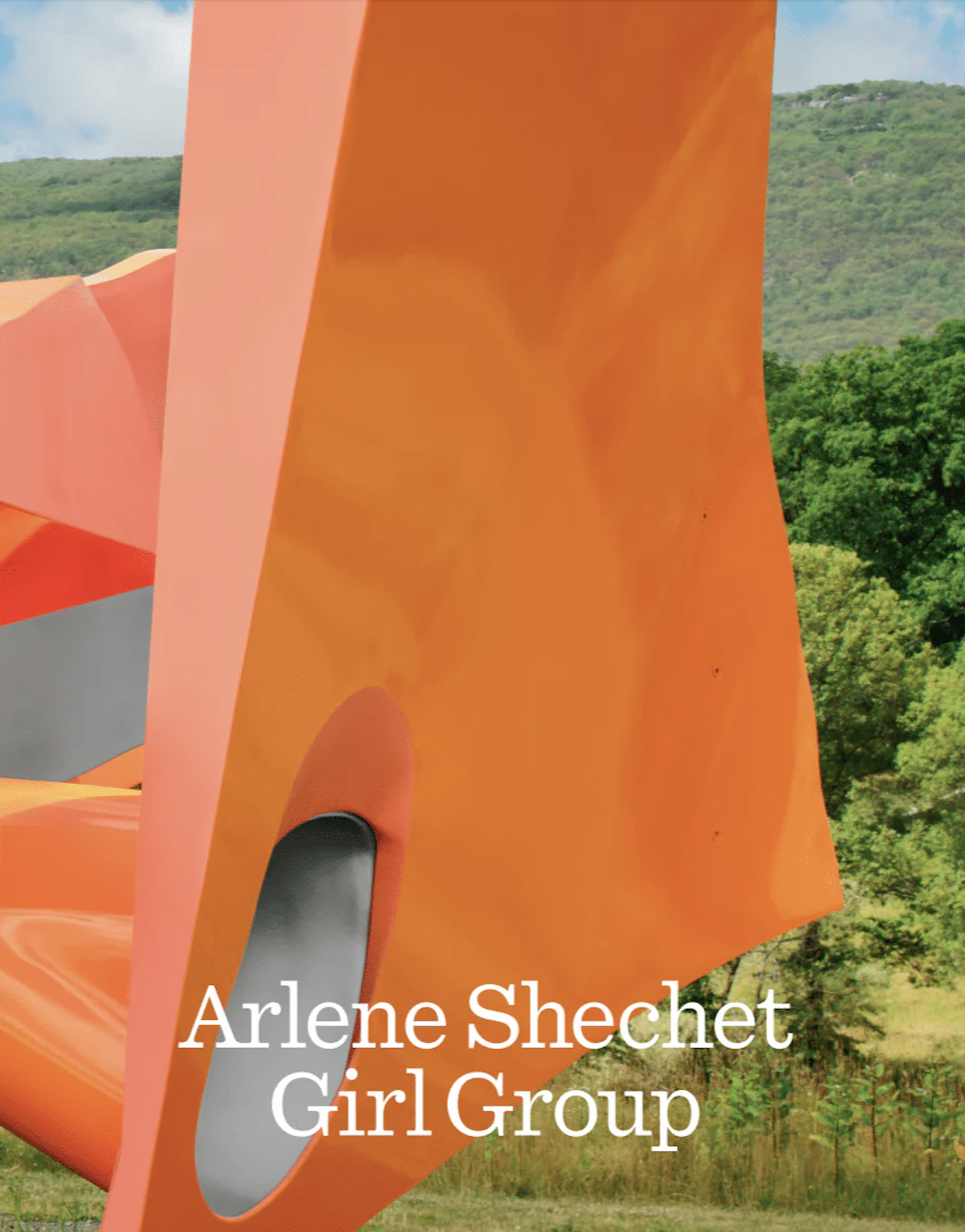
Shechet’s 2024 presentation at Storm King, titled Girl Group, stages an encounter where these various mysteries and histories collide. Six new large-scale sculptures punctuate the sprawling outdoor landscape of New York’s Hudson Valley, colorful beacons that jostle the collective ecosystem of Storm King into a new state of liveliness and syncopation. These outdoor works dialogue with an arrangement of older artworks in ceramic, wood, steel, and bronze that are displayed indoors. In addition, Shechet has created and staged benches throughout, marble, concrete, and sand-cast bronze “pleat” seats, which signal that she has considered us, the viewer, before we have arrived.
In approaching what is to-date the most extensive outdoor commission of her career, Shechet characteristically imposed a willful sort of blindness. Unlike much monumental sculpture, the artist did not wish to create molds from which multiple editions of any single work could be cast, and—while the works carry a shared language with the earlier ceramic grouping indoors, which she refers to as Together—she was insistent that the large outdoor sculpture not take existing concepts or maquettes and simply enlarge them. These were to be unique material imprints in the world, and the pursuit would ultimately call her partly out of her own studios and into a yearslong experimental process of bodily push/pull at an expansive new scale, wrangling the planar (metal) rather than the pliable (ceramic), in collaboration with several local metalwork foundries.
Though a more comprehensive “knowing” could arguably have been offered by, for example, available three-dimensional scanning technologies, Shechet grew these works from a synthesis of more active digital and analogue modes, utilizing Rhino drawing software (a tool that was new to the artist) to sketch initial concepts. These ideas then informed enlarged physical models, which were then manipulated, rearranged and examined to inform further digital drawing, and so on, in an upward-moving spiral. Color itself became a fundamental and physical material, and in each final artwork one can discern a unique fusion of patternmaking, collage, metalwork, design, painting, drawing, and color theory. As individual statements and as a collective, Girl Group has emerged as a constellation of magnetic entanglements: inside and outside; orthogonal and curved; convex and concave; raw, matte, and glossy.
At Storm King, the mystery Shechet traffics in and seeks is found in these entanglements, baked into process and form. These are works that refuse to flatten into any tidy argument, and instead open up to offer an experience of unfolding, expansive spaciousness. But the history is there too, as works such as Rapunzel and Bea Blue, both from 2024—with their riotous, feminized force–vie with both their natural surroundings and the surrounding work of canonical male artists of the twentieth century. Alexander Calder, Mark di Suvero, Anthony Caro, Richard Serra, David Smith: these are artist names that have stood sentry through the past half century, not only within the undulating grasslands and hillsides of Storm King’s Hudson Valley campus, but within the sweep of Eurocentric art his- tory. In this environment, the silver accents of Shechet’s green and glimmering Maiden May (2023) next to the brushed stainless surfaces of Smith’s nearby Cubi XXI (fig. 5) are a haptic quiver, an enlivening bombshell.
This is not, however, about overthrowing one’s neighbors. It is instead about holding our histories up to prod at any outmoded or withering spots, to place the idea of heroics in suspension, and to offer new viewfinders through which to complicate and enrich the stories we tell. This is sculpture as language, and it is fitting that the new large-scale works of Girl Group find their seedbed in the Together works, which Shechet began during the first flush of 2020 pandemic isolation. These smaller-scale objects were made by the artist in her studio, alone, while the world spun ferociously out of focus. These are the gestures that unfurled when she was forced to re-imagine how it might be possible to gather, to connect, to communicate.
Author Rachel Cusk posits that art’s communicative function doubles as a kind of investigative quest, that art serves “to confront habits of perception and to demolish the illusions that steadily amass and obstruct truth in the human regard of the world.”14 Shechet’s work, which the artist heaves and pushes, squeezes and pulls into the world, is here to remind us of what we might discover by getting lost. Mystery is not a harbinger of ignorance; enigma is not the opposite of truth. It is instead a deepening of experience, an opening to faith, to the uncontrolled and uncontrollable, the generous, the funny, the irrepressibly human. This is work built by and with room for its mysteries, intended to come alive in the exchange that alights when it is brought forth to contend with the world. What boundlessness might we find by seeking when we are forever shy of fulfillment? We can call it meditation or analysis, play or rest, poetry or praxis, we can liken the experience to walking through a Japanese garden. For those of us wanting to engage the mysterious histories Shechet sets alight, we are called to give over to a liberatory not-knowing—never fully satisfied, but never alone.