Arlene Shechet: Alive in the Making
by Eric Booker
Throughout her career, Arlene Shechet has maintained an unwavering commitment to process. For Shechet, process is a dance, a means of making that requires her to be alive in the moment. While the term “process” may evoke a prescribed method, Shechet’s is continually changing. Attuned to the nature of her materials and their capacity to be transformed, the artist forms a rapport with her works, coaxing them into being through an open-ended call-and-response. The artist imbues her sculpture with a sense of vitality, achieved through her persistent challenge of the technical and formal boundaries of making. Process, then, is the creative force that drives Shechet; an experimental and experiential language borne from her insatiable curiosity for new materials and methods. “It’s a process of constant discovery and that’s what I seek,” she has said.1
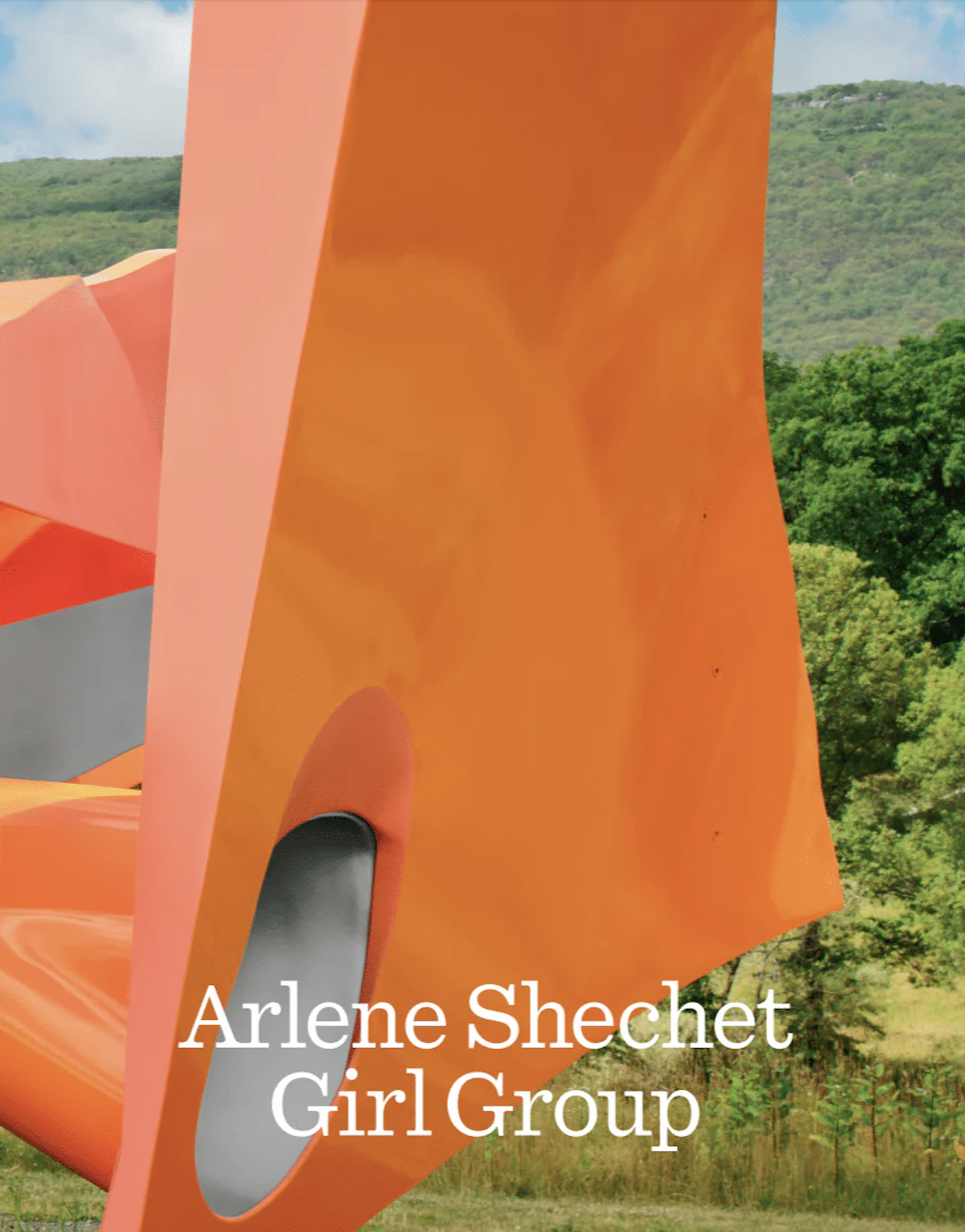
Girl Group marks Shechet’s latest, and most ambitious, invention to date: six monumental sculptures ranging in scale from ten to twenty feet high, and nearly thirty feet long, spread across Storm King Art Center. Constructed from welded aluminum and steel, and painted in a spectrum of vivid colors, they tower above the landscape but do not infringe upon it, instead relaxing into the surrounding hills and fields. The artist envisioned these works as an ensemble, a chorus of color and form. Sited so that one always remains in view of the other, they form a vocabulary across the landscape. Shechet worked with a team of fabricators throughout the Hudson Valley to realize her outdoor works. While the artist has engaged with industrial techniques throughout her career, the scale and methods for constructing with metal required her to imagine new ways of making. Drawing from decades of experience, she developed these sculptures over the course of three years, translating elements from her existing ceramics into large-scale metal constructions. This mode of working is emblematic of the artist’s experimental impulse, which she has cultivated by taking on traditional methods and making them her own. While such monumental sculptures may come as a surprise for an artist known for her work in a variety of mediums, especially ceramic, a lifetime of artistic exploration reveals them to be part of a larger continuum.
Composed of planar sheets of metal, the six outdoor works in Girl Group—As April (2024), Bea Blue (2024), Dawn (2024), Maiden May (2023), Midnight (2024), and Rapunzel (2024)—bend, swoop, and unfold into complex, lyrical forms, upending conventional notions of monumental sculpture. Each work incorporates nature through negative space, sculptural apertures, and surfaces that reflect and absorb light. Working alongside industrial painters, Shechet created a palette of shifting colors—from peach and lilac to sky blue and periwinkle—in glossy and matte paints, along with planes of unfinished metal, all of which anticipate the changing conditions of the environment. A sunny day or a passing cloud animates these tonal shifts, which continuously dance through shadow and light. Every facet of these prodigious forms has been shaped by the artist. Throughout the Museum Building, ceramic works from Shechet’s series titled Together (2020–ongoing) provide a visual roadmap to the sculptures outside. Viewed in relation to one another, the two groupings— indoors and out—render Shechet’s process visible. The works in Girl Group are monuments to making.
Shechet’s fascination with process arrived early on. Growing up, she would tell her parents that she wanted to be either a farmer or a factory worker. Later she recalled that “being an artist working in the studio, I had created both a farm and a factory, and when I thought about it, the essence of that desire was really wanting to know how things are made.”2 Like the farmer, the artist cultivates many of the materials that she then uses in her own work. Working with clay, Shechet often produces ceramic cast-offs, which she saves, along with pieces of found wood collected throughout the Hudson Valley, for future sculptures; similarly, the artist transforms found fragments into sculptural supports. Shechet’s practice also evokes that of a factory worker: continually constructing new forms from disparate parts—at once calling attention to individuated elements as well as the experience of them together as a whole.
Shechet’s interest in parts or segments stems from her time in graduate school at the Rhode Island School of Design (RISD) in Providence, an industrial town littered with shuttered factories that provided access to a wide range of mass-produced materials.3 This environment also spurred the artist’s initial interest in repetition, a method of making that goes against the singular object in favor of numerous experiments, allowing her to tease out the expressive capacity of a given material or form. Shechet’s recent mixed- media sculptures—constructed forms of glazed ceramic, steel, and painted or dyed hardwood—are one example. A blackened steel disc in Day in Day Out (fig. 1) later reappears in Mystery History (2022; pp. 140–42), then again in Truly (2023; pp. 150–53), Girlfriend (2024; pp. 144–48), and so on, creating a lineage of forms that in turn imparts an anthropomorphic quality to these sculptures. The name Relative, which Shechet began using in 2021 to loosely refer to such work, suggests recurrent traits passed on from one piece to the next, underscoring their kinship while evoking the artist’s continual pro- cess of association.
Shechet considers this approach to building as a form of draw- ing. Drawing is an automatic means of production, a direct expression of the body. Putting a pencil to paper results in a mark; one makes a line by drawing it. Referencing this provisional form of making, she states: “I sketch with real things and not on a piece of paper. I don’t want to draw a sculpture and then struggle to make it. I insist on working in real time with actual shapes and surrogates strapped together to sketch in true space. I have to feel it, dance with it, then ponder it over time.”5 To make these constructions, the artist holds up various components and temporarily straps them into place to envision her composition—an improvisatory method that vivifies her sculpture with movement. The overall effect is magnetic, as if dis- tinct pieces of matter have naturally come together to create a new life form. In Deep Dive (2020; p. 138), three ceramic pieces collide atop a segment of wood. The chartreuse glaze gives way to an electric blue on the interior. The wood, which has been split, is covered in steel on one side. The entire arrangement feels suspended in a state of flux. Though they may appear as if “on the precipice of possibly becoming undone,” in Shechet’s words, such works are in fact thoroughly engineered, their internal logic resulting in an outwardly effortless and organic appearance.6 This process of assembling smaller segments into a whole has led the artist to create ever-larger forms—totemic structures that contradict traditional presumptions of scale with a sense of nuance, gesture, and vivid color.
Shechet drew from her Together works to make the outdoor sculptures for Girl Group. She began the earlier series in 2020, during the isolation of the COVID-19 pandemic. The name gestures toward something that many yearned for during a time of great uncertainty, while also nodding to the ways in which Shechet assembles multi- ple forms to build her sculptural language. The artist scaled each work to her body, an unconscious yet practical decision that allowed her to load them into the kiln on her own. She also made each with- out a flat bottom, shaping the clay on top of a bed of foam so as to resist any one perspective or orientation (p. 96). Once fired, the art- ist set about determining how these fully dimensional forms might live in the world. She used pieces of metal and I-beams that she found around the studio to create makeshift sculptural supports. The resulting works bend, slump, and spill off enameled metal armatures, endowed with a corporeal presence. Their vibrantly glazed surfaces curdle and drip, pooling beneath the orifices and apertures within each work, leaving traces of their making visible (fig. 2). The entire process invites “a certain level of abandon,” according to the artist, that inspires a constant back-and-forth with the materials she works with.7 This has been true for much of Shechet’s career. As she said in a 2010 interview, “There’s a level of not-knowing and non-control that I can either be frustrated and upset about, or embrace.”8 The highly nuanced surfaces of the Together works are achieved through multiple firings. Despite numerous tests, the process ultimately hinges on an element of the unknown, as heat and chemical reactions transform liquid glaze into solid color inside the kiln.
Time plays an important role in the artist’s work, a medium that shapes her process and enlivens her sculptures. The Together works mark moments when time itself felt indeterminate. With titles such as Together: 9 a.m. (2020; p. 155) and Together Again: May Monday (2022; pp. 148–49), Shechet sought to orient herself and the viewer to the present moment, awakening the senses with brilliant colors and surprising forms, which slowly reveal themselves as one moves around the work. A master colorist, the artist sees color as a medium in its own right: a visceral language that transcends boundaries and ignites joy. Shechet considers clay, which she began experimenting with in 2006, to be a “time-based material,” a haptic medium that requires her to be in constant dialogue with the work.9 As clay dries it forms a self-supporting armature, allowing it to stand up on its own. The artist follows the clay as it becomes structurally sound, steadily building her forms up over time. Utilizing drying times to work on multiple pieces at once allows the artist to “keep the process alive” while taking a moment to pause and consider her next step.10 Shechet channels such fruitful methods of making throughout her practice by cultivating materials and forms that seem to spring forth from one another—a means of production driven by the process itself.
Shechet refers to the Together works as the “generative seeds” for her outdoor sculptures, alluding to the organic process she invented to achieve them.11 Undaunted by the complexities of realizing sculpture at this scale, she maintained her signature open-ended approach, drawing from the nature of her clay works to build entirely new forms in metal. Shechet has returned to this method of translation throughout her career, locating the essence of an existing form or material and transforming it, producing the wild and unexpected. Inspired by the rich topography of shapes, voids, and volumes that she had created over the years, Shechet turned to this formal vocabulary as a point of departure. Using images of these past works, she began to shape her new sculptures in digital space, drawing on specific marks which, in turn, evolved into hybrid compositions.12 She was interested in the freedom that such digital tools offered, but she also resisted the ease of the medium and its tendency to remove the artist’s hand. Working against traditional forms of digital production, such as scanning a model and enlarging it, Shechet took her computer drawings and translated them into handmade paper models, which allowed her to physically shape her sculptures in the round (p. 83).13 The artist continued to riff on these moquettes over several years, gradually cultivating a cadre of forms as she continuously moved between the analog and digital. The process echoes Shechet’s work in clay, as she tended to each model over long stretches of time, working on multiple at once, at times coalescing then breaking apart to form new works. In some cases, Shechet made eight or nine iterations of a single sculpture. The six that became Girl Group come from a family of nearly thirty mod- els, the beginning of an expansive new direction for the artist.
While some sculptures were conceptualized through paper mod- els, others such as Dawn, As April and Midnight (fig. 3) received inter- mediate maquettes in steel as well. One can trace the curved pink form of Together: 8 p.m. (2020) in the swooping aluminum panel of Dawn outside, (fig. 4) while the leaning structure of Together Again: May Monday gently informs the posture of Maiden May outdoors. Together: Midnight (2020) subtly corresponds to Midnight in its horizontality and palette, yet the outdoor work seems to both deconstruct and expand upon its ceramic relative—becoming a nearly thirty-foot- long cacophony of open intersecting planes. Janice (2024; pp. 160–64), a large-scale indoor sculpture that follows the same aluminum construction as the outdoor works, was first made in paper as well as a 3-D printed model. The work’s fluid yet muscular form and soft yellow palette nod to a ceramic that Shechet made two years earlier, Together Again: Fall (2022; pp. 162, 166). Despite the introduction of such digital tools, Shechet always returned to the handmade, finding her way into each form through intuition. “I had no plan or method, merely a curiosity about taking the mushy clay volumes saturated in colored glaze, and possibly translating some parts of them into planar steel constructions,” the artist has said. “I wanted to find new forms in a foreign language.”14
Before she began working in clay and metal, Shechet had started developing a different visual language in the 1990s using plaster. Pulled between raising children, teaching, and maintaining her studio practice, the artist found plaster almost out of necessity: a fast-set- ting material that allowed her to work in the moment. Using this wet medium, she started creating her forms without an armature, shaping them by hand. The resulting sculptures—blobs of plaster with acrylic paint skins—were determined by the amount of material that the artist used and the time that it took for them to dry (fig. 5). These were process pieces, indexing the time Shechet managed to spend in the studio as they grew. For the artist, who possesses an ability to see form in the formless, these blobs came to resemble the Buddha, an association that interested her for both the visual and philosophical possibilities that such a figure represented. In Shechet’s words, “Buddhism overlaps quite well with studio art because a lot of the ideas—of mindfulness, time and attention—are relevant to the state of mind essential for studio practice.”15 Buddhism encapsulates Shechet’s process-oriented approach. It has allowed her to develop a “meditative consciousness” within her practice, channeling the vital- ity of making through constant awareness, continual transformation, and an embrace of the unknown.16
This ethos of change and metamorphosis permeates the sculptures that comprise Girl Group. Working with a team of metal fabricators and industrial painters, Shechet managed to achieve a level of intimacy and immediacy rarely seen on an industrial scale. Once the physical models had been resolved, a highly improvisational pro- cess ensued between artist and fabricator. Mirroring how she has drawn on material libraries to construct other works, she selected industrial components to build her large-scale forms. Structural and aesthetic decisions were made as one so that each element, from concrete footings to bolt configurations, was intentionally designed. The artist chose aluminum for its lightweight yet sturdy nature, with steel providing additional structural support. Across the six outdoor sculptures, Shechet made changes in real time, responding to mechanical dilemmas and wresting control of the fabrication pro- cess. Once the metal had been cut for Dawn, the artist worked with fabricators to reconfigure the panels to achieve the work’s rhythmic quality (p. 33). With Midnight, she sliced down the aperture she had initially designed at the last minute, shortening the cone so that more light would shine through (p. 57). The delicate bands of aluminum that swirl around As April (p. 49) expose the process of shaping sheet metal with a bump bend, a tool that precisely bends metal through numerous crimps. Such marks are normally smoothed out in metal work, but in Shechet’s hands these industrial processes remain visible, retooled as a form of drawing or mark-making—a means of celebrating the making of the work itself.
Taking the language of constructed metal sculpture and making it her own recalls that of an earlier project. From 2012 to 2013 the artist took up residence in the renowned Meissen porcelain factory in Germany. The experience led her to create Meissen Recast, an expansive body of work that took the vocabulary of porcelain and turned it inside out.17 Recognized for the exquisite porcelain pieces that it has produced since 1710, the factory maintains its centuries-old craft to exacting standards, with each component of the porcelain process overseen by a dedicated craftsperson. As her title suggests, Shechet literally “recast” Meissen’s traditional methods, embracing errant ways of making with technical rigor. Drawn to the factory’s different methods of production, the artist cast porcelain versions of the mundane tools used to make these precious objects. She created molds of molds, combined disparate forms into hybrid objects, and incorporated cast-off porcelain into sculptures that reimagined the manufacturing of porcelain while challenging its rigidity. In a series of subsequent exhibitions across the RISD Museum, Frick Collection, and Harvard Art Museums, Shechet installed these works alongside porcelain pieces from each institution’s collection, inserting her own work into the history of this traditional art form.
While at Meissen, Shechet also made a series of porcelain plates that resembled miniature landscapes.Works like Pink Boat (fig. 6) and Garden Lion (2012) took decorative fragments from Meissen’s vocabulary including a feather and a lion’s paw, along with industrial components like a sprue, a channel for pouring liquid into a mold—and scattered them across porcelain “platescapes.”18 Referencing platters and decorative table settings, these works would eventually provide Shechet with the genesis for her first outdoor exhibition, Full Steam Ahead, which took place at Madison Square Park in New York in 2018– 19. Her platescapes became a model for thinking about the park as “an outdoor room” (fig. 7), one in which a family of sculptures could gather to “question the notion of the ‘monumental.’”19 In the lead up to this exhibition, Shechet had done another residency at the Kohler manufacturing facility in Wisconsin, which allowed her to take the domestically scaled forms she had begun in Meissen and dramatically scale them up using the same industrial means of production that Kohler uses for toilets and sinks. Across a reflecting pool in the center of the park, which the artist had drained, porcelain sprues sprouted like trees from armatures composed of steel, concrete, and kiln bricks, while the feather and lion’s paw assumed the scale of ancient ruins. Full Steam Ahead translated Shechet’s previous opus into a radically new form, taking elements often disregarded, along with porcelain—a domestic material traditionally considered “fragile and female”—and reinventing them on a monumental scale.20 The project illustrates the artist’s unique ability to envision new forms through known ways of making, animating her sculpture by pushing the limits of production.
Across the indoor and outdoor works in Girl Group, Shechet manifests lessons learned from years of exploratory making, faith- fully following her materials and forms to new ends, inspiriting them along the way. Shechet’s belief in process could be described as a belief in life itself. Her work celebrates the messy nature of becoming, a journey shaped through improvisation, experimentation, and discovery. In this sense, Shechet’s works are truly alive, bubbling and blossoming as the artist breathes life into each form, material, and history she touches. It’s no wonder, then, that in recent years the artist has moved outdoors, now realizing her work on a large scale at Storm King. Through the act of making, Shechet has continually reached for “the aliveness of the actual experience.”21 Her work is at home in the world, engaging earth, sky, and body. With Girl Group, Shechet has managed to imbue monumental metal sculpture with new life.