When Casting Is Dispersing, Emitting, Shedding, Sculpting
By Kate Nesin
To cast a shadow, to cast a spell, to cast seeds, to cast off, to cast about. Arlene Shechet conjures these idioms in her titles for numerous paper works from early 2024 (pp. 158–59). Such a list, in turn, summons many more. To cast light. To cast doubt. To cast aside or cast away. To cast the dice, to cast a net, to cast a vote, to cast a play. To cast a glance. To cast a sculpture. In the latter case especially, cast features as both verb and noun—to cast a cast.
Take Cast: Seeds, Red Clay (fig. 1). Any invocation of seeds scattered across rich spring earth proceeds in parallel with the artist’s disclosure of what this work constitutes: a cast—the mounted and framed paper sheet, so evocatively puckered I can almost hear the crackle it might issue if handled—made from, or by, or around a mass of red clay, long since withdrawn. Take Cast: Shadow, Brown Clay (2024; p. 158), with its prominent vertical striations, collapsing the perceptual distance between shadow as silhouette and cast as consolidation. Or take Cast: Off, Porcelain (2024; p. 158), pockmarked, lunar, within a ruffled rim of white, bearing on a single surface equally the marks of investment and divestment.
If I seem to treat Shechet’s slightest works with excessive seriousness, that is much to the point. These were not intentional art- works to start with, but rather byproducts of a core studio process: something the artist did not notice, until she did. As for the process, then. Rectilinear slabs of clay rolled out and waiting to be worked into sculptures. Piled, sandwiched between sheets of newsprint, and compressed under lengths of drywall. Together the dampness and heaviness of the clay give shape to the otherwise flat paper, which is absorptive, responsive. Peeled away, the paper often shows some color from the clay, but only what has soaked into its fibers, the two materials to this extent merged. “The slabs are so neutral,” Shechet explains, and yet they yield “all of these effects.”1 Still more, they serve as conduits for the contingencies of the studio: the clay could be wetter or dryer because of the temperature of the room that day, and because of the amount of time spent under makeshift weights while Shechet attends elsewhere.
All of this may sound closer to printing—impressing, indent- ing, or more broadly what scholar Jennifer Roberts calls “a con- tact event,” in Shechet’s case maybe a suite of accidental rubbings.2 Potent comparisons arise, like Michelle Stuart’s Ledger Series: Canyon de Chelley (fig. 2), for which the artist kneaded the soil of a specific place into paper with her fingertips. Or like Mona Hatoum’s Untitled (Milk Strainer), for which the artist pressed wax paper against—as if attempting to push it through—the titular kitchen tool. One key difference being that Shechet claims her slaim-printed sheets as casts. By electing this term, she either overrides or embraces (or both) the dual premise that paper is not a conventional sculptural material and that casting is a conventional sculptural process. I would add, a conventional yet also confounding sculptural process: neither quite additive nor quite subtractive, the resulting three-dimensional form defined by the very fact of a three- dimensional absence.
Casting—an ancient replicative technology whereby a molten material is poured into the hollows of a mold, h-rdening as it cools, ultimately arrested in the shape of said mold—normally requires a great deal of intentionality. Its procedures tend to oscillate between multiple positive and negative states and across varied material agents (as in the lost wax method, which progresses from clay form to rubber mold to wax form to clay mold to bronze form), but it can be more direct. For instance, Shechet finding an empty box in her garage, filling it with wet concrete, pulling away the sides to reveal a solid block: a container displaced by the last material it contained.3 Or, of course, the multitude of her Cast series, in which the paper element is like a molted skin nevertheless retained as the work, while the mold— the slab—will go on to take alternative, unrecognizable shape. In fact, by continuing to make clay sculptures, Shechet will automatically continue to make her Casts, too.
For roughly two decades Shechet has received due acclaim for her commitment to clay, insisting—against age-old disciplinary odds— that the histories of craft, industry, and the decorative arts are inextricable from histories of sculpture. More than clay, though, casting is the throughline most central to Shechet’s practice, one that similarly holds together histories of functional production and of sculpture’s memorial power. And while she has cast a striking range of other materials (concrete, plaster, Hydrocal, glass, wax, rubber, aluminum, bronze, iron, brass, resin), her turn to clay in the early 2000s emerged, notably, from working with—and casting in—paper.
As an artist-in-residence at Dieu Donné papermill in New York City beginning in 1997, Shechet used abacá fibers to make sheets of white paper embedded with radial compositions in blue, their vivid palette and their slight grain or blur resonant of architectural blueprints or flow blue transferware. Some of these paper sheets became, in her own studio the following year, the uppermost forms in Shechet’s installation Once Removed (fig. 3), a set of cast paper, stupa- inspired vases displayed atop their solid gypsum molds. The work is fruitfully literal, demonstrating the coincidence of fidelity and difference in casting—the one-to-one relationship as also one degree (or more) of removal; and revealing the vessel form as both fundamentally sculptural and fundamentally iterative.
Five years later still, Shechet produced the larger installation Building (see p. 84)—stacked vessel-like objects in slip cast porcelain, arrayed like a distant, grisaille skyline. Even more than Once Removed, this work deploys casting as not only a technical but also a thematic choice. Directing ceramics students at the University of Washington to create a “family of plaster molds,” Shechet then painted inside the molds with “grey and black glazes and stains,” cast- ing the porcelain in them “over and over until they turned white.”4 Insofar as a cast is a trace, evidence of a missing antecedent, there is something of the ghost about it, no matter how solid or hefty. A cast’s durability, by comparison with the form it replicates, is part of this ghostliness, remembering and outlasting what came before it, so to deliver a kind of afterlife. As well a cast hints at, and its mold promises, abundance—or else a more ambivalent brand of proliferation— which Shechet counters here by turning the mold into a device for individuation. This work looks abundant (swelling forms gathered in such volume) as much as it evokes the spectral (ashen surfaces, fad- ing in and out), a dichotomy that manifests the joint cumulativeness and attenuation of memory.
Shechet returned to Dieu Donné in 2012 provisioned with icy green rubber molds “of things that have happened in my studio as I’m working with the clay.”5 These molds were hand-scaled, shallow, floppy; cryptic shapes that transferred the evidence of activity on one tabletop to the arena of another, and she arranged them in new, imaginary topographies, casting low-relief paper sculptures for a series called Parallel Play (fig. 4). There is the “parallel play” between Shechet’s personal studio table and the shared, necessarily collaborative workspace of Dieu Donné, to be sure. But consider how the temporalities of clay and of casting play in parallel, too. Shechet describes the time that clay requires to dry as conducive to experimentation, letting one material rest while working another. Technically speak- ing, casting imposes a stricter chronology, even a narrative arc: original, mold, copy. Beginning, middle, end. Meanwhile, Shechet’s 2012 series establishes how casting can elaborate the middle (in this case, the being-in-the-midst particular to studio or workshop), over and against finality.
Likewise, Shechet regularly emphasizes ephemeral or unobserved midpoints of the casting process itself. A decade earlier, in 2003–04, she accepted an invitation to make work in a metal foundry for the first time. Drawn to hot vats of plum-red wax kept at the ready, the artist poured this typically intermediate material into tubs of cold water, attempting to cast from fluid surfaces. Attempting, that is, to cast without a mold, or to make of the water her mold, rendering solid from liquid twice over (fig. 5).6 Leaping forward again: in 2012 Shechet spent months in residence at the renowned porcelain manufactory in Meissen, Germany, where her primary project became casting sculptures not just in but of the company’s centuries-old molds—such that a piece mold’s arcane bodily fragment remains unseparated (is fundamentally inseparable) from the faceted field from which it projects, body and matrix maintained as materially one (fig. 6).7 In 2018, following a residency with the industrial foundry Kohler, Shechet produced three sculptures called Tilted Channels, exaggerated Y-shapes like arms outspread (p. 104, fig. 7).8 Her specific point of reference enlarges, and vaunts, the wax sprues—or channels—through which metal is poured into a mold. An ancillary aspect of sculptural process modeled as open-armed sculptural product.
All of these artworks are elaborations of the middle, yet cast- ing also enacts a sort of spatiotemporal collapse—seeming to invite a viewer to see two things simultaneously, or through one to another. Shechet’s Cast paper works almost permit this, in that they are so obviously all surface, only surface. But I’m put in mind of Lynda Benglis’s metal casts as prime examples, too. Untitled (Eat Meat) is her poured foam sculpture from 1969, cast as Eat Meat in bronze in 1974, then in aluminum in 1975 (fig. 7). The foam, once dry, preserves the image of its own viscosity, while both casts transmit a supple- ness, an ooze, that contradicts the resounding (as in ringing, practically clanging) rigidity of hardened metal. The casts also present this one doughy form in a different metallic hue and, presumably, in different weights, differently cool or smooth to the touch. Registering two materials at the same time—foam and bronze, foam and tin, etc.—can thus mean that both materials are equally illegible, or mutually elusive.
Legibility and illegibility concern Shechet across the board, including in non-cast works. Certain titles alone indicate this: Everything Seems to Be Something Else (2007–08) and Is and Is Not (fig. 8) are two primarily ceramic works that by their titles under- score the artists’s interest in the perception of a sculptural form as unfolding and unfixed, as when a person approaches a work from dif- ferent angles, or circles around it. In my view, however, Shechet’s casts raise this concern most poignantly, given how a cast surface is valued as an interface: a medium, in the sense of mediating between one or more prior materials and its own, the eventual and extant one.
I am stubbornly avoiding the language of alchemical transformation—frequently invoked around Shechet’s penchant for materials that transition from liquid to dry (like paper, clay, and anything cast)—in order to emphasize that casting can obscure, or fail to translate, its precursory states as much as it can reveal them. Both the replicative capacities and the shortcomings of casts accrue on their surfaces, and those surfaces obtain boundaries that signal a conceptual porousness, or a once-mutuality. This is remarkable in part because casts also tend to signal, tonally, their degrees of remove from any previous form. Which brings me to bronze, considered for millennia the consummate casting material: ductile, durable, dilating as it cools to fill in the most detailed of molds. Shechet’s use of bronze has been sparing (it is expensive, and burdened by tradition), and her use of it has usually involved, first, the deployment of paper, as membrane, as intercession, as casting agent in its own right.
One purposefully enigmatic example: the artist’s small, curious, wall-hung sculpture Origins (fig. 9) looks like an organ removed from a body—a tender interior, something brought outside, into the air and light—yet there is nothing fleshy about it. Shechet’s bronze replicates a clay form that she had swathed in paper, like a bandage or car- apace, wrapping paper, or butcher paper.9
Two purposefully emphatic examples: in the related works Pallet and Prophet (2021; p. 11) and Grow and Glow (2023–24; p. 12), the corresponding blocky mounds gleam, so explicitly bronze that they appear gilded, and entirely counter to the softness—creasing, crumpling, stress—they index. Shechet assembled both forms first from box and brick shapes with things she had around, then made paper—again, at Dieu Donné—carrying it back to her studio wet. She then seamed the paper together, over and around her block piles, and it shrank to fit as it dried, torquing slightly, declaring itself. Finally, foundry technicians determined how to construct another mold for casting this paper shell. Shechet even mounted Grow and Glow on a slender steel stem, which means that viewers might angle their heads to peer beneath the lofted cast, observing its hollowness, the bronze— as thin (or thick) as was the handmade paper—draped over air.
One reasonable assertion, at this stage: casts are more substantial and long-lasting than the forms from which they are cast. Shechet’s recurrent casting of paper (indeed, rhythmically recurring, from Once Removed in 1997, to the Parallel Play series in 2012, to the Cast series in 2024), is the exception that proves the rule. So let’s return, in the end, to Shechet’s paper Casts, which do not look like conventionally cast sculptures—still almost two-dimensional, they barely register as sculptures at all. Do not “look like” and also are not conventional casts: they record the traces of a transient array of conditions as much as they record the traces of erstwhile clay slabs; for a long time they happened by accident, or were always happening, as part of Shechet’s clay-working process, regardless of her attention to them. Yet considering them closely brings into focus where the operations that designate casting dictate—and where they are importantly distinct from—a cast’s operativeness.
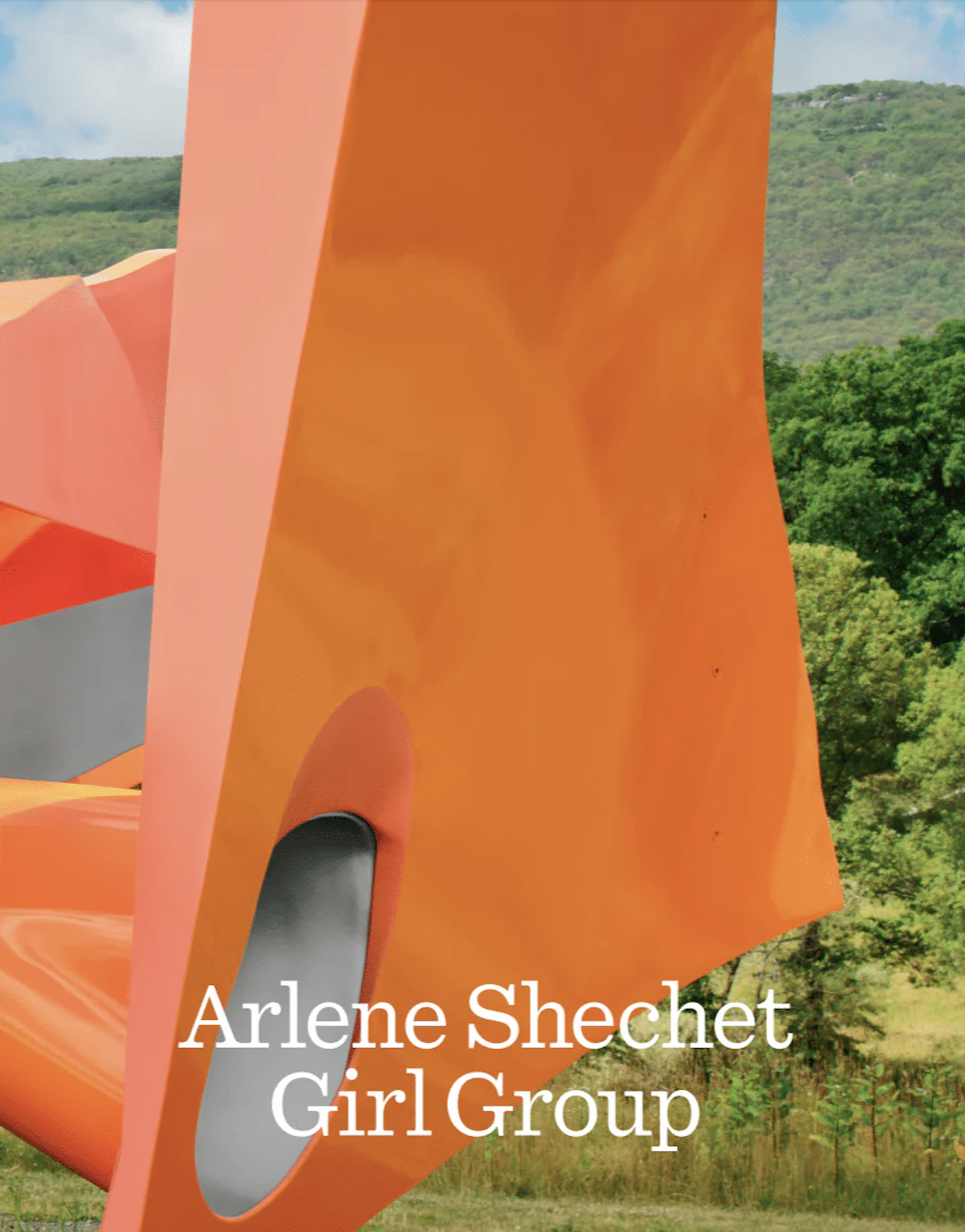
Another summative assertion being that casts encode the ideas of multiplicity and dispersal. To some extent this has underwritten my desire to enumerate as many instances of Shechet’s cast sculptures as possible, especially given what a robust, overlooked thread they comprise across her decades of work. Multiplicity and dispersal are meaningful terms, as well, for engaging one more recent body of casts. For Shechet’s presentation of Girl Group at Storm King, the artist made six new large-scale (non-cast) sculptures, on view outdoors; selected and framed eight of her paper Casts for the first time; and created eighteen modular benches, together titled Pleat Seats (pp. 30, 117). The benches—cast concrete rectangles, cubes, and L-shapes—preserve, on their stock gray surfaces, the occasional knot or passage of grain from the plywood molds within which they’d hardened.10 Roseate bronze supplements—like fragmented drapery attached to the concrete sides—also preserve, more obliquely, the corrugated cardboard used to make their molds. Shechet distributed the benches singly and in groupings across acres of landscape, sometimes in evident dialogue with one of her large sculptures; sometimes clustered more in conversation with each other, or with the base of a tree; consistently in conversation with the earth, tipping upward or downward according to the subtlest of shifts underfoot.
While this essay began as an effort to contextualize Shechet’s paper Casts, which could seem like marginal components of an exhibition dominated by massive outdoor sculptures, it closes with the benches, contemporaneous cast works that may also seem peripheral by design. Put another way, casting is one method among many, for Shechet, but also a kind of key to experiencing her other methods more fully, whether the paper Casts—fortuitous consequences of making non-cast clay works—or the Pleat Seats— devised for sitting among her immense, non-cast aluminum works. To wit, the benches are less sculptures to look at than they are perches from which to look. At a sculpture, perhaps, or at the sky, the ground, one’s lap; at another person or people; at little or nothing. What these casts empower, by facing unmistakably outward, is the conviction that looking at any sculpture entails all these other incidents and accidents of looking elsewhere or nowhere, too; of seeing and not seeing, of presence of mind and absence of mind, of lingering in the middle wherever either space or time allows.