Arlene Shechet: A Vibrant Nature
Nora Lawrence
In the Hudson Valley, the slow-moving timeline of the early pandemic in 2020 matched the blossoming of spring. Each bud was a vision.
The frosty ground became deeply toned mud, then sprouted soft beds of new grass; this grass then popped with dandelions that in turn grew white and wispy. Trees with bare limbs soon bore reddish buds of leaves, then the ever-surprising array of flowers across dogwoods and cherry blossoms in white, pale pink, and magenta. It was in this context that artist Arlene Shechet created her Together series (pp. 138-67)—the ceramics on view in Storm King Art Center's galleries as part of her exhibition Arlene Shechet: Girl Group, and the germ of her new outdoor sculptures that comprise the exhibition's complementary other half (pp. 33-80). She followed nature's rhythms as she created works titled for different times of day and moments in a year, objects she considers offerings to cherished, absent audiences, known and unknown. Shechet has termed these sculptures "markers for my existence in the quiet of my studio," and likened them to medieval books of hours: ornate volumes that charted the hours of the day through prayer, embellished with painstaking and beautiful illustra-tions. As our distances became more pronounced and weighty during the pandemic, Shechet's hope was that her Together sculptures-emblems of human inspiration, thoughtfulness, and vision-would connect us across space and time, and serve as reminders of the generosity and creativity of humankind.
Soon after, Shechet began to experiment with an idea to translate some of these ceramic works into large-scale sculptures composed of welded sheet metal." As she did, the potential display of the works in outdoor space-and specifically at Storm King-was always an important aesthetic and philosophical aspect. She spent more than a year walking the park, always thinking of sightlines between the works and within the gently undulating hills. Included early in her plans for these large works was a deep consideration of siting:
Shechet superimposed her digital renderings onto photographs of Storm King's landscape, using augmented reality to aid her design process. From the start, Shechet recognized that a symbiosis of sculpture and nature would create a powerful vibrancy. She was also interested in responding to the modernist sculptural practice of constructed metal sculptures, one on full view at Storm King in works by artists including David Smith, Louise Nevelson, and Alexander Calder. Further, Shechet was determined to bring her unparalleled talent and expertise in working with color to the sphere of large-scale outdoor sculpture: an arena that has not embraced riotous coloration.
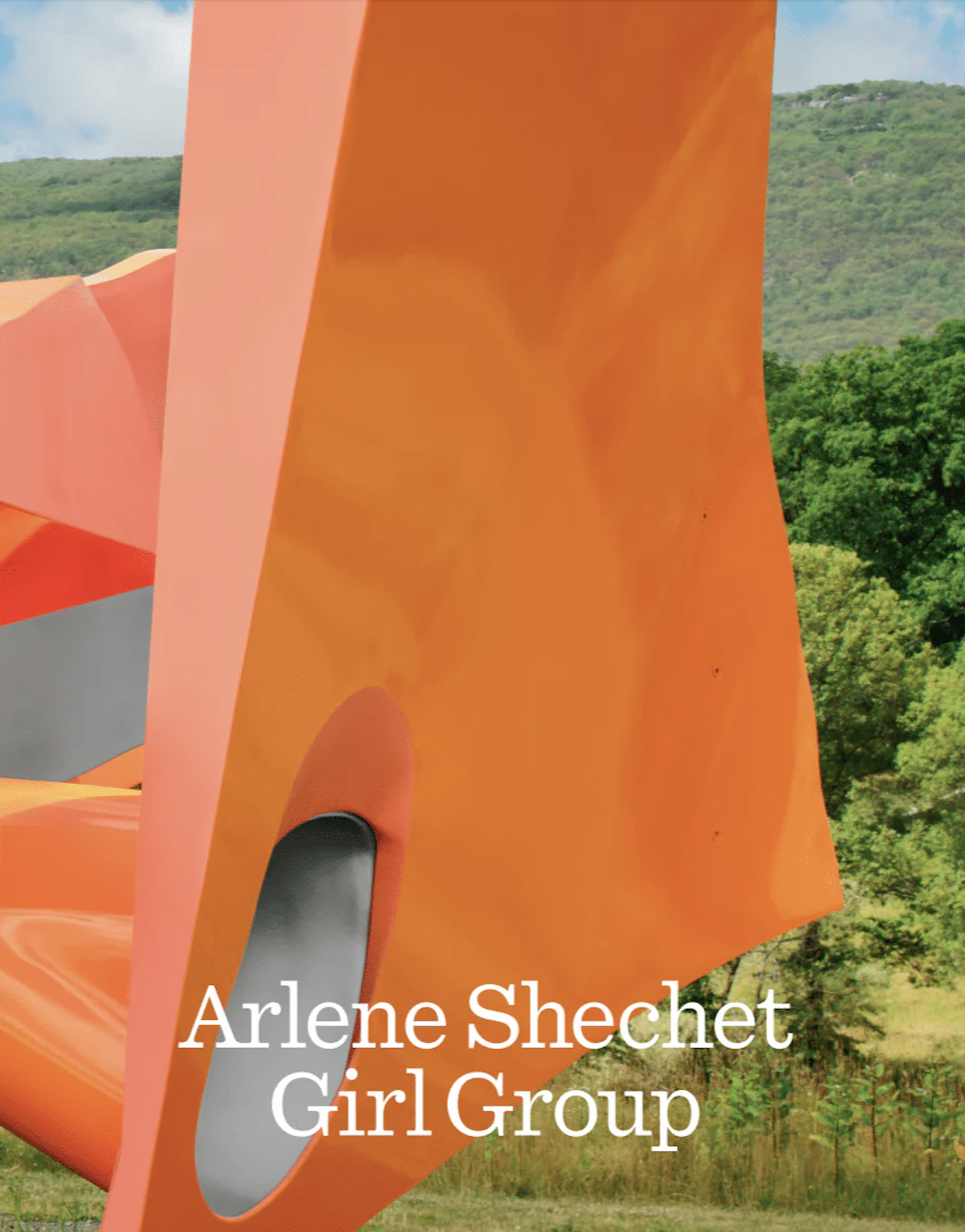
The result is Girl Group, an expansive exhibition that connects Shechet's indoor and outdoor work while also unveiling her ambitious new direction in metal. Six monumental outdoor sculptures-As April (2024), Bea Blue (2024), Dawn (2024), Maiden May (2023), Midnight (2024), and Rapunzel (2024)-find each other across great distances, completing a circuit of color, as well as bold and varied forms, across Storm King Art Center's South Fields. They are by far the largest sculptures the artist has created, and the first intended to be displayed as a group in an open, rural landscape. One important consideration for Shechet was a desire to knit together the works across sometimes great distances-and to bring nature inside the gallery space. As Shechet has explained: "Girl Group weaves together the landscape, near and far. I very specifically thought about creating a situation that encourages the visitors to explore and consider the different landscapes of Storm King: the hills, the meadows, the expanses of grasses, the cloisters made by trees, the all-important spine of the allée of trees, and the paths."
Shechet has designed each metal sculpture to have a surface of matte color, shiny color, and bare metal, with shifting, rather than contrasting, colors: salmon and orange sherbet; violet and periwinkle; cotton candy and watermelon; emerald and forest green; citrus and pear; sky and ice blue. A talented colorist, Shechet knew that each hue would change contingent on the natural conditions around it, and anticipated and invited momentary and seasonal transformations on the sculptures' surfaces.
A linchpin within the exhibition, the sculpture Bea Blue is situated in a meadow from which sight lines provide views, across more than a kilometer's distance, of As April, Midnight, Rapunzel, Dawn, and Maiden May. An experience with Bea Blue encourages one's eye to connect the full spectrum of color across the six outdoor works of the exhibition. Biomorphic shapes burst upward and out from two inverted, rounded pyramids that form stubby legs in the grass. At fourteen feet across, the sculpture is wider than it is tall. Bea Blue transforms dramatically depending on one's vantage point. One side includes both a large, flat surface of pale blue (onto which the play of light and shadow creates dramatic, shifting colors and shapes), as well as a half-cylinder in bare metal, its curve created through bump bends. The machined curve of the cylinder is contradicted by a thin, expressive cut across its rational form. A small sliver of air present between two metal surfaces allows sun and greenery to penetrate the sculpture. What on one side presents as a massive whole, from the other appears as an elegant inward passage. The bump bends that create curves throughout also suggest gradients of color thanks to the shadows they cast.
I have had the privilege of learning about Shechet's work directly from her, through repeated visits to her studios in New York City, in the Catskills, and in Kingston, New York, over the course of ten years.
Her body of work is cohesive, yet ever-inventive; her process is intuitive but also deeply researched and considered. She has an aesthetic language that is completely her own, consisting of bold and wonder-ous forms, colors, and surfaces. Unlike the white walls of a museum, the backdrop at Storm King consists of grasses, hills, woodlands, and sky. Each work of art displayed in this context resonates for its own internal merits, but also bonds with this distinct and beautiful five-hundred-acre landscape. Shechet's interest in nature manifested in an ideal opportunity: translating her habitually human-scale sculpture into completely new work created for outdoor display. The work she has brought to the public in Girl Group harnesses Storm King's landscape in an innovative way: these sculptures are completed, as well as affirmed, by the site's participatory audiences.
Natural space has long appealed to Shechet as a place of healing and slowed time. A native New Yorker, she frequently opted to walk home to Tribeca over the Brooklyn Bridge after dropping her children at school, seeing it as a rare opportunity among New York's tall buildings to find oneself under a fully open sky. This practice was interrupted in horrific form when the bridge afforded her a view of two airplanes hitting the World Trade Center on September 11, 2001. The newly altered horizon took on an emotional force for her. Her sculptural installation Building (fig. 1), a "skyline" created out of more than one hundred ceramic funerary vessels, shows Shechet paying homage to the transformation of that clear view into a symbol of unfathom-able grief. In 2002 Shechet and her husband, Mark Epstein, bought a house in the Catskill Mountains in upstate New York, which they began to use as a weekend retreat with their children. (As they did for many New Yorkers, the September 11 attacks created the impetus for Shechet and her family to seek solace outside of New York City.) About seven years after purchasing the house, Shechet constructed an attached, light-filled art studio (fig. 2). Ultimately, she acquired a second upstate studio in Kingston, with twenty-foot ceilings to accommodate large-scale work.
This installation at Storm King follows a number of forays into outdoor work. The earliest was when Shechet was asked to organize an exhibition at the Frick Collection, in 2016-the first artist to be invited to do so. There she worked with the institution's Arnhold Collection of eighteenth-century porcelain created at the Meissen factory in Germany, and placed her own porcelain work-also created at Meissen, over two years in residency there in 2012 and 2013-in dialogue with it. The Meissen factory was the first in Europe to master ancient Chinese porcelain techniques; prior to Meissen, porcelain was an expensive rarity in Europe, owned only by the aristocracy. Shechet also brought some of the Frick's collection of porcelain animals out to the institution's garden, referencing the practice of similar displays in royal gardens in Northern Europe—a flagrant demonstration of hedonistic riches (fig. 3).
For an installation in Madison Square Park, Full Steam Ahead (fig. 4), Shechet eschewed the green on which many artists have displayed their work, instead turning to the area in and around the shallow fountain at the north end of the park, where, she has remarked, people tend to congregate and stay a while (fig. 5). Here she installed works primarily in porcelain, steel, cast iron, and wood. After requesting that the water in the fountain be drained, Shechet used the recessed, empty pool as exhibition space, removing and replacing one hundred cobblestones in the fountain for sand-cast tiles inspired by the last puddles left after a rainstorm. In addition to several large sculptures that formed encounters for visitors in and around the pool area, Shechet also created a large, carved-wood sculpture of a female figure, Forward, which sat at the base of an 1880 monument to Admiral David Glasgow Farragut of the Union Army. Forward suggested an alternate path for the future of public art, which historically has focused on heroic male battlefield figures. Shechet also created a series of resin seats scattered about the park: invitations for New Yorkers-who often cross the park in this busy section of Manhattan at a brisk pace-to linger and look.
For Shechet, siting her work outdoors allows for spontaneity, sur-prise, and wonder. She has remarked that the Madison Square Park setting teed up her work for "encounters with random humanity."6 It also intensified Shechet's commitment to continue working outdoors in different settings. In 2022, at 'T' Space-a thirty-acre site created and designed by architect Stephen Holl in Rhinebeck, New York-the artist created Spot Light using white porcelain (fig. 6). She found a rocky outcropping with a concavity at the middle, a bit up the hill from a rugged nature path. The site was located deep in the woods, and the experience of arriving at it was inextricable from the experience of viewing it. From the viewpoint of the path, two small trees framed the site, marking it for viewers as they entered the area. As Shechet has described, "We mapped the site and the crevice three-dimensionally with strings and sticks, and back in the studio made a sturdy framework that had the space of the crevice as its negative, basically building the inside of the rock." She then created a porcelain form that could nestle directly into the rock, even if precariously and unusually perched. "The opportunity to be in the woods and have art," Shechet has remarked, "that's the next frontier."8
Artistic practice and the natural world are, for Shechet, connected through a desire for meaning beyond the bounds of oneself. She has said, "I believe in the oneness of things."' Shechet became interested in Eastern philosophy in the 1980s, and its teachings are compatible with and underscore her approach to art-making. She has spoken of the connection between the making of a glass vessel (as she did early in her career) (fig. 7) and our necessary exhalation of breath-these are artworks created through a process that is a critical, life-giving
reflex. Similarly, to be safely fired in a kiln, a ceramic sculpture must be hollow and hold air. Shechet's artistic process has been an act of embodiment: "I wanted to make things that were more about what it was like to be alive and breathing." 10
Energy and movement are intrinsic within Shechet's eleven-foot-tall Dawn (pp. 33-40), which balances on a circular concrete pedestal from a small support. The sculpture appears as though in constant motion: the organic curves of its sheet metal surfaces appear as though mid-twist through a breeze. One can follow the sinuous line of a delicate pipe around the sculpture as it lifts and lowers the viewer's eye. The surfaces of the work are subtle enough to invite the many other colors present in a changing outdoor environment: diffuse areas of pink are infused with diaphanous greens or blues, or bright white-the result of passing clouds or beams of sunlight. The layers of pink have an iciness to them and, indeed, the manner in which they absorb and reflect color and light is akin to that of snow and ice atop the crest of a mountain.
In the means of their creation, the works of Shechet's Girl Group nod to the history of modern and contemporary sculpture, yet they also revisit and reimagine tenets of outdoor sculpture once held to be sacred. In creating on such a grand scale for the first time-with sculptures up to twenty feet tall or twenty-five feet wide-Shechet worked in the tradition of modern constructive sculpture developed by the Spanish sculptor Julio González, from whom Pablo Picasso adapted techniques early in the twentieth century (fig. 8). Storm King's outdoor collection began in 1967 with thirteen welded constructive sculptures by David Smith, whose work Shechet deeply considered as she created Girl Group. By adhering- often welding— disparate industrial metal parts together that themselves had no inherent aesthetic virtue, these earlier artists created unified, innovative compositions: volumes out of flat metal planes. Appreciation of these works required of their viewers a new type of looking, a new system of values.
Shechet, in her own right, "wanted to use the language of constructed and welded steel and aluminum. That is the classic language of modernism. David Smith, Picasso.... That is the language of Storm King, because it's not just siting [a sculpturel and having it sit on the land, it's having it sit within the sculptures that are nestled into the landscape so beautifully."1? Shechet's welded outdoor works incorporate finely keyed juxtapositions of color that resonate with the dexterous and innovative palettes of her smaller sculptures intended for indoor display. They also commandeer new technological innova-tions, allowing for new types of bends in the metal and significantly advanced renderings, across digital and hand-made versions. This results in rounded and unusual volumes, sculptures that transform the flat planes from which they originate. Shechet's As April (pp. 49-56) nods to the lessons of modernist art and art-making, while moving forward in a direction all its own. The sculpture includes generous apertures within its welded construction that harness the surrounding landscape as an integral aspect of its own composition. Thin ribbons of raw aluminum appear as though caught in a breeze as they encircle the boldly colored, rhythmic shapes of cut metal of the sculpture's top half. These ribbons draw one's eye up the sculpture from its smaller base to the wide, open blossom of citrus and sunflower hues above. Other works displayed indoors, such as Mystery History (pp. 140-42), effortlessly incorporate disparate pieces of wood, ceramic, and steel into cohesive sculptures that are far more than the sum of their parts. "The construction process is very attractive to me because I'm always putting things together," the artist has said. Shechet chose to site her sculpture Maiden May (pp. 41-48) at the edge of a lawn where Storm King has a permanent display of outdoor works by David Smith, all from the late 1950s and early 1960s. The crescent curve of Maiden May forms a frame for the Smith works beyond it (p. 45). It is Smith who created one of the most unusually colored works in Storm King's collection, Study in Arcs (fig. 9), which he painted salmon pink. Shechet has commented about this work, "Years ago, when first I spotted it at Storm King, I hadn't known of his painted works and was smitten, intrigued. It seemed a radical move." Shechet was so enticed by Smith's use of this color that she matched it as one of the three colors used in Dawn, which is on view in the sight line of Study in Arcs. Shechet's use of twisting metals, off-kilter colors, and complicated visual arrangements are uniquely her own, and the artist had decidedly contemporary tools at her disposal. During installation, Shechet was able to lean on intricate preparatory renderings of her outdoor sculptures created on an iPad, which could be superimposed into an augmented reality imaging of Storm King's space, to know that every angle would be visually rich (fig. 10) For a work installed at Storm King there is generally no primary viewpoint; the grounds are vast, with few specific paths. The landscape allows Shechet's works to be seen in the round-ideal for this artist, whose works lack a front or back. It also presents an active backdrop. As Shechet has said, the metal surfaces of her works merge harmonically with the nature around them: "I've had the experience already of looking up through, for instance, Rapunzel. It feels like I'm looking through branches. I am aligning the 'drawn' lines of the sculptures with those of the trees."15 (pp. 65-72) Even more, the largest work in the exhibition, Midnight, sits upright between the peaks of mountains on two sides of it-like an element of the landscape in itself. "As the horizontal aspects of the work break and split apart into more vertical elements, the mountains are called in," Shechet has explained. Midnight is vivid atop one of Storm King's tallest hills, and creates compelling vistas for visitors walking the entire south side of the property. It catches the light of sunset, the moon rises behind it.
For Shechet, there is a life-affirming quality to the placement of her large works outdoors. Focusing on joy and communion, she offers these works to a public perhaps less primed for them than they would be inside the walls of a museum. In "the randomness of the outdoors" people don't expect to encounter sculpture, "so they're not seekers, they're getting in through the back door: I feel like that's special." 17 Her works-dispersed across a yawning landscape-become sources of surprise and enchantment. Shechet has spoken of her interest in "that eighteenth-century notion of delight and discovery." l8 In turn, to Shechet, outdoor viewers bring a life force to sculptures they see: "It creates an interactivity with the viewer if there's a sense that there are things to find. It promotes the idea that people have to walk around or look from underneath or move. They become participants in the sculpture... and it brings out the sense of aliveness that I'm trying to get at." In this way, her sculptures help to choreograph human movement.
The entanglement of these sculptures with teeming life, ever present around them, is serenely affirming. Shechet has said: "The reason to do outdoor sculpture is to speak to the landscape, it's as simple as that. The opportunity to have light, shadow, sun, wind ... all of those things that one does not get in indoor space." The locks of Rapunzel, the celestial haloes of Dawn and As April capture not just neutral space but air, protecting the space and volume within them. Shechet's outdoor works change each time a cloud moves before the sun, each time a reflected leaf turns from green to orange. The works of Girl Group encourage viewers to appreciate not only the sculptures them-selves, but the world for which they are singing.