Arlene Shechet: Shapes of Time
by Sheena Wagstaff
On a winter visit to Arlene Shechet’s woodland studio in the Catskill Mountains in early 2023, my eye was caught by an exhibition preview card from 2009 pinned to her office wall. Printed vertically across the middle were the sentences:
Actuality is when the lighthouse is dark between flashes: it is the instant between the ticks of the watch: it is a void interval slipping forever through time: the rupture between past and future: the gap at the poles of the revolving magnetic field infinitesimally small but ultimately real. It is the interchronic pause when nothing is happening. It is the void between events.1
These same words, written by the pre-Colombian specialist George Kubler in his notable 1962 book The Shape of Time: Remarks on the History of Things, had been painstakingly copied by Shechet in pencil directly onto the surface of her wall nearby.
We paused to talk about Kubler’s text and his philosophical idea that art shapes time. Never timorous about delving into the extensive realm of ideas that informs her work, Shechet explained why she was struck by this quote. Arising from his expansive knowledge of ancient cultures and modern philosophy, Kubler proposed an understand- ing of the history of human culture as a vast flow or universe of time in which art—through the creativity of an artist—leaves an imprint on time itself.
Kubler calls our attention to a world filled with objects made by the human hand, from the first tentative explorations at the beginning of human time to the myriad artifacts and objects created across all world cultures. His slim volume emerged at a moment of shake-up not only for American intellectual history, but also in contemporary artistic practice.2 He was particularly “fascinated [by] the emergence of sculpture at the expense of painting. ... The history of things is about material presences that are far more tangible than the ghostly evocations of civil history.”3 Kubler’s contention was that objects can be seen as distillations of time. Anachronous, out of time.
It was with his radical thesis in mind that we turned the corner into Shechet’s studio, a spacious, naturally lit workroom. A dazzling throng of vividly colored clay sculptures, a group collectively titled Together (figs. 1–3), filled the space; each strange, radiant form had a different saturated chromatic combination and voluptuously fractured surface. Every object in this dense gathering was also body-high, perched precariously on a tall, constructed metal stand or four-legged stool. The work that Shechet identified as the first “breakthrough” is called 7 a.m. (2020). “I was learning I could merge color with form,” she recalled. “It shows the chartreuse becoming the orange—there’s even a little purple in it. In the marriage of color and form come the revelations. I decided to push it even further and color the supports, creating another kind of conversation between the sup- port and the sculpture, and among different colors.”4
Shechet began her Together series in 2020, during the early days of the Covid-19 pandemic, when people in every region of the world were experiencing or witnessing in real time the fatal consequences of the coronavirus epidemic. The artist was of course not alone in contemplating the nature of time with respect to the magnitude of universal death and personal mortality. She reflected:
There’s a mushiness in our lives right now that is making us slip and slide through the day, not knowing what day it is, what time it is. I see time as both very concrete and very elusive. It’s an objective fact and a subjective experience. Sculpture is subject to these same contradictions. On the one hand, what could be more concrete than a sculpture sit- ting in a room? You feel it, you touch it. It demands time. But on the other hand, it’s in flux. It’s an experience, and it changes in relation to the world around it, through time and movement. You don’t know it and you may never know where you stand in relationship to it.5
Rather than focusing on her own feelings in that shared trauma, Shechet decided to make new work that was an antidote—as well as a reassuring material analogy—to the uncertainty and instability of that moment. “One thing I felt we all certainly needed was joy, and one of the things that gives me joy, is color,” she explained.6 “It’s a language that goes right to the body and bypasses the mind. And it’s also a language that can make us more awake.”7
Appearing at first glance like a mini forest of ancient rock formations or a gathering of small entities clad in bright coverings, these objects offer the pleasure of discovery and astonishment that deep- ens with looking. Not one of them proposes a single facet, or prima- ry “face,” to the world: each sculpture has been created completely in the round, presenting constantly shifting visual aspects, resisting the impulse to coalesce into a single or frontal view. Moving around each sculpted body, you come to understand that color completely embodies the form. Describing the function of glaze within her work, Shechet has said, “The essence of the material is that the skin can become part of the form.”8 Moreover, it defines each object while simultaneously denying—or deforming—it.
By designing each sculpture’s means of support at torso height, Shechet wanted to encourage a physical encounter with the work, a body-to-body experience (“the sculpture being the body plus me”) that would vary in height depending on the nature of the object.9 Each piece, therefore, comprises a blend of sculpture and its base, “visiting materials that are in conversation with the materials of the sculpture.”10 Concomitantly, each of the sculptures is ingeniously devised to be seen to be at an absolute point of balance in relation to the pedestal on which it sits, in a liminal state of stability and collapse—yet holding the potential of entropy at bay. It was this state of uncertain equilibrium, both global and personal, that Shechet felt in the con- fines of her studio: a “sheltering in place” during which the creative connection between the present and the future was at its highest pitch. She lit upon a means of responding materially to the struggle of humankind to come to terms with the precarity of that time: “That moment made me decide to deal with each sculpture as a kind of clock, or prayer, or a way of paying attention that I found comforting and that led me to the next one.”11
As an undergraduate, Shechet’s study of medieval art led her to focus on illustrated manuscripts. She has recalled that “the Book of Hours was one of my favorite references because of its relation- ship to time.”12 As a prayer book for ordinary people in late medieval Europe, a Book of Hours is richly ornamented with colorful miniature paintings depicting episodes in the lives of saints, along with devotional texts divided into hourly segments to be read at regular intervals, thereby giving structure and meaning to the reader during the course of each day. “That sort of structure was what I was seek- ing. I was thinking during this catastrophic time that we needed the joy of color, and each one of these [Together works] could be a kind of prayer. So the sculptures are named related to the times of day and the months that I made them or thought about them.”13 Shechet has also recounted how the jewellike tones of the diminutive illuminations had directed her selection of colors. “Then I realized in making glazes, one is grinding stone, grinding pigments, in very much the same way using some of the very same stones and pigments for glazes as [medieval artists] were using for painting.”14
Each of Shechet’s sculptures is slathered in brilliantly luminous glazes, the result of the artist’s exhaustive experiments with count- less variations of chemical formulas and colorants. The glazes seem to both submit to and resist their firings, resulting in velvety irides- cent or intensely bright, desiccated surface presentations. The folds and fall of clay topographies flow through apertures to interior spaces partially demarcated by contrasting rich colors or differently textured surfaces. A trickle of glaze occasionally seeps from the inner recesses of a work or oozes through its surface fissures, like a bodily emission whose path has congealed, its process of transformation from fluid to solid forever arrested by time.
The works in this group of brilliantly hued sculptures are akin yet also distinct from one another: each is unique in appearance, scale, form, color, surface, and support to the next. Each object seems full of a sense of its own thing-ness. Together, they illustrate the formidable extent of human imagination and creation. As the art historian T. J. Clark once described the nature of sculptures, “They are all about the eternal war between possibility and resistant material fact.”15
A distinguishing feature of art by major contemporary figures like Shechet whose sculpture finds a way to survive the test of time is the revelation that historical art is not only critical to their work, but also vitally alive and wholly relevant to the present. In Shechet’s case, the marking of time and splendidly embellished illustration of a medieval Book of Hours is important not only for being a silent witness to another era, an aesthetic, and a way of life that in 2020 had startling new consequence, but also for informing her work both visually and conceptually. Kubler stated that “the most significant of all the mechanisms of cultural continuity [is] when the visible work of an extinct generation still can issue powerful stimuli. ... Now and in the past. ... the fabric is being undone and a new one is woven to replace the old, while from time to time the whole pattern shakes and quivers, settling into new shapes and figures.”16 The internalization of time’s cadence in Shechet’s resultant sculptures—recalling Kubler’s text she wrote on her wall, “Actuality is when the lighthouse is dark between flashes: it is the instant between the ticks of the watch”—attests to the depth of the artist’s enquiry as well as her facility to create works that naturally and authoritatively expand the story of art. As Richard Serra, who admired Kubler’s proposition to establish a new order, comment- ed, “If you make sculpture, you have to find an entrance into its history, and you have to invent something that’s not anticipated.”17
Being confronted on that cold wintry day by a blazing multitude of lustrously colored objects in her studio, I felt the power with which Shechet’s Together sculptures emanated a sense of visual joy, a uni- son of different visceral beings, a community. Shechet has always felt that “color is a language that transcends a lot of the tough and divisive languages we’re involved in.”18 As an artist dealing with the urgencies of our present world, Shechet acts as a conduit between old and new—not in a direct one-to-one correspondence between ancient and modern, but instead upholding the creative values of the past she has reimagined and embodied in a new form.
Having manifested as independent objects that exist in the world through Shechet’s well-honed facility and material intelligence, an odd, electrifying energy radiates between the Together sculptures. They impress themselves upon the viewer with an authoritative presence that insists on their own place in the world.
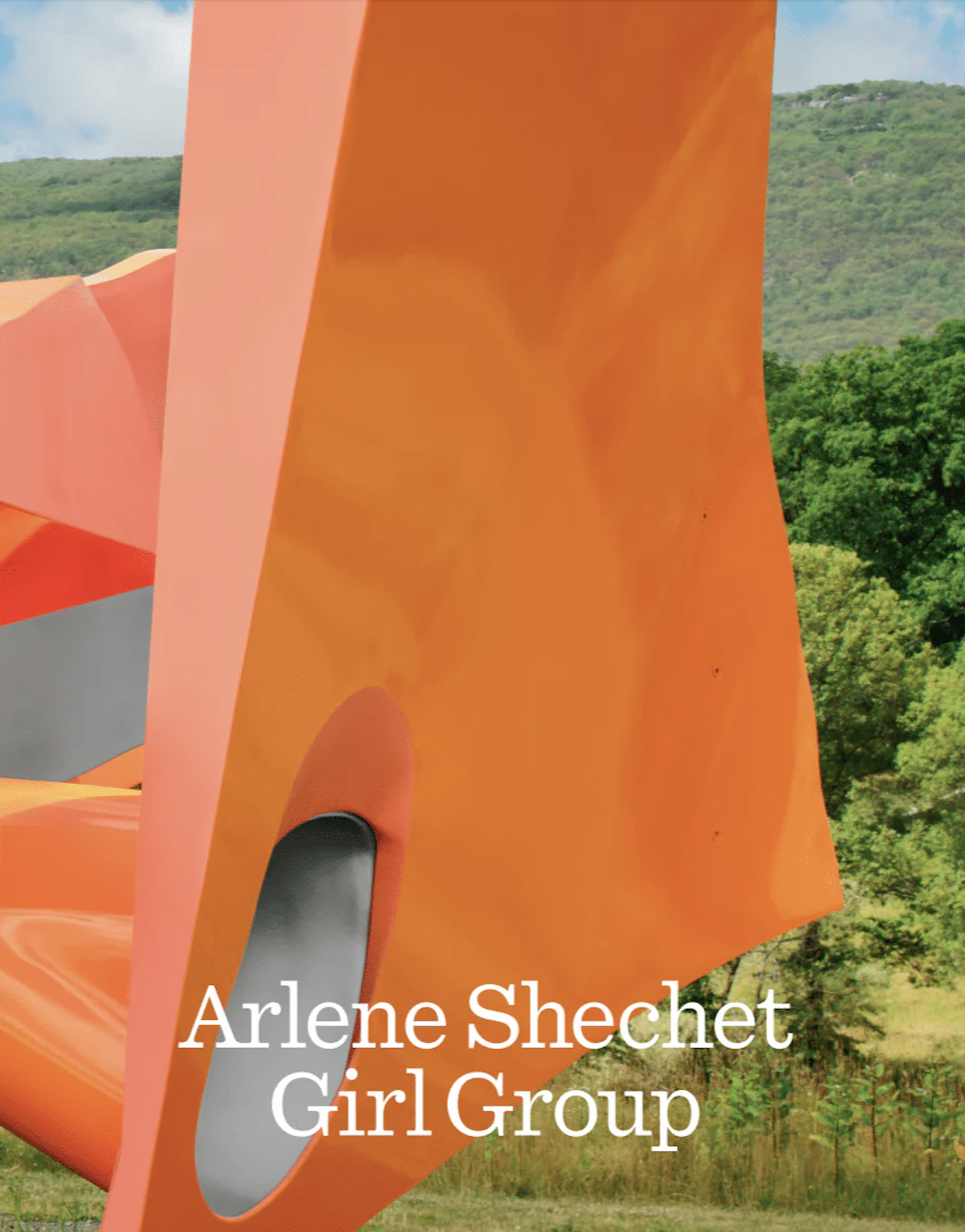
In many respects, it is no surprise, then, that their sense of relevance and pivotal importance for these times, along with their potential for greater material dimensionality, was the harbinger for subsequent expansive possibilities in the artist’s oeuvre. The magisterial chorus of Girl Group, Shechet’s six huge sculptures at Storm King, is testament to this:
These smaller-scaled intimate works became the ‘generative seeds’ for the larger outdoor sculptures. I did not merely ‘enlarge’ the smaller works....That’s just a construction process, that’s not a process of making art. I want to feel alive with the work the entire time, and so I used an iterative approach to translate the Together series into large-scale work, maintaining a slow method open-ended and receptive as the larger sculptures took shape.19
There are few sculptors who can make the leap from domestic- or human-scale works to creating monumental, three-dimensional, abstract forms. In their distant affinity with the late Middle Ages, when sculpture was not independent from architecture, the works of Girl Group speak to Shechet’s spatial intelligence in construct- ing the magisterial forms that flare their colors across Storm King. Transformed by creative effort into large-scale sculptures that are simultaneously different and ordinary, irreducibly other and the same, they obdurately occupy our world. Yet the glint and gleam of these singular works also mark the natural landscape to signal creative portals to our collective cultural past, their complex physical constructions a metaphor for manifold shapes of deep time. The colossal objects that populate Girl Group sing song after song, poking the dead spirits awake. In the words of humanist Kubler, both Together and Girl Group do perfect “justice both to meaning and being, both to the plan and to the fullness of existence.”20