Twin
“Heavy Duty”
Artist Arlene Shechet on Material Expansion
Words By Kate Neave
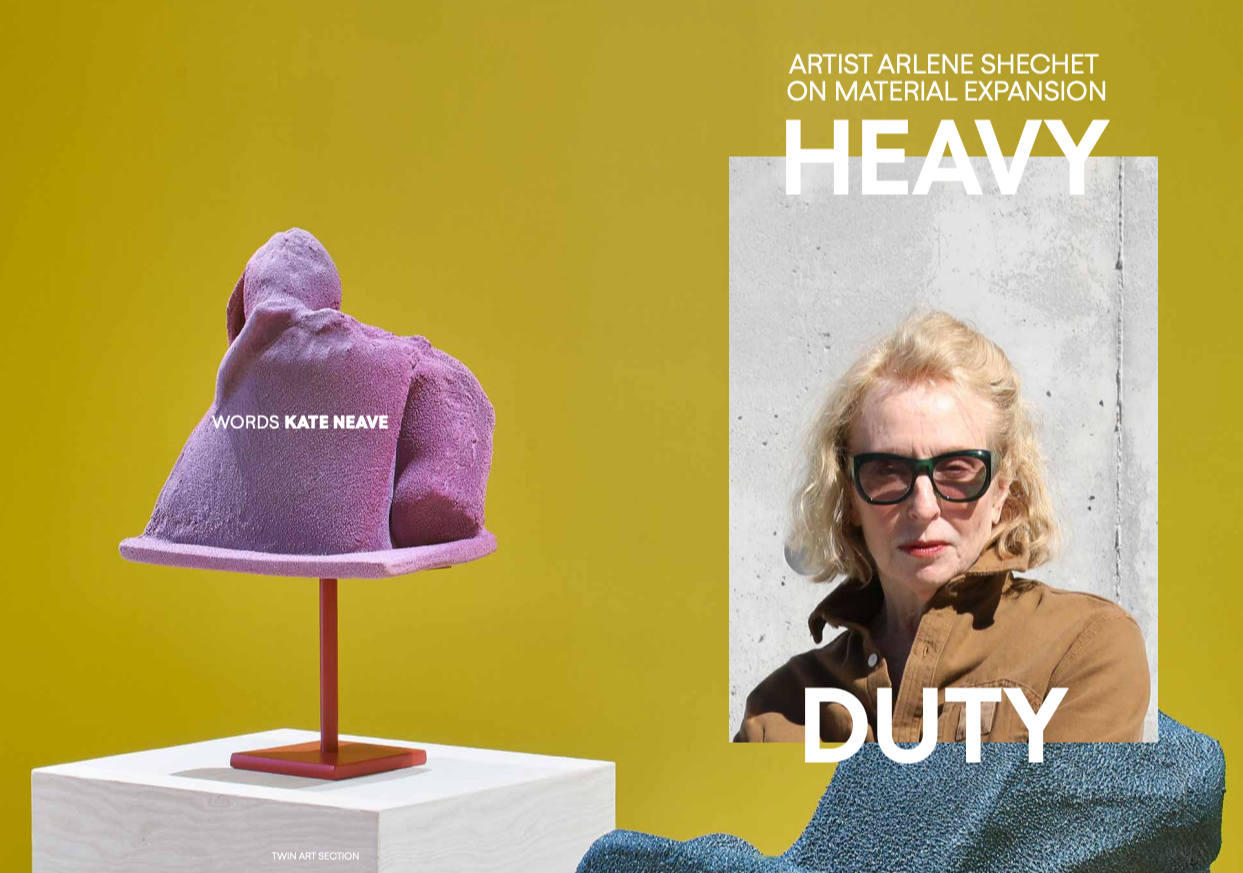
Artist Arlene Shechet joins me from her architecturally impressive studio in Kingston, New York – a space completely redesigned to accommodate her ambitious sculptural practice. To accommodate works which grow in scale year on year, she has knocked through an entire upper floor to create a space with a twenty foot ceiling. Outside, an old parking lot has been transformed into a courtyard workshop where she and her team work with steel and other heavy duty materials in all weathers. Shechet’s passion for sculptural form shines through as she talks to me about her inventive and disruptive practice that explores the point at which the organic meets the abstract.
Arlene Shechet’s studio is littered with works in progress, found objects, materials and tools. She prefers to work on six or seven pieces at a time, incrementally adding and subtracting elements, juggling thoughts and actions and waiting for parts to dry. “I really prefer to work in a way that allows me to not be under pressure to resolve something,” she explains. “So that most of the things that I make end up taking a couple of years.” Shechet’s process allows her to step back and maintain a playful conversation with her sculptures which retain a unique liveliness and inventiveness.

Her work is not preconceived. Instead the artist sees herself as working in tandem with her materials. She starts a conversation and looks for that point when the sculpture begins to speak back. Shechet evidently enjoys the process of sculptural creation and she learns as she goes. “If you’re going to have a long career, you’d better have it be fun,” she tells me. “It has to be fun in that it is challenging intellectually, challenging physically and engaging on every level. You are figuring out what you don’t know, rather than repeating what you do know.” It’s a premise which has served her well.
Shechet has enjoyed a long, successful and extremely varied career to date. She studied for her MFA at Rhode Island School of Design (RISD) back in the late 1970s and remembers Providence as a small, funky city and a great place to spread her wings. Even in these early days, her work already explored diverse materials and themes, refusing to be pinned down to one particular style. Shechet remembers her professors were not always encouraging of this approach. “Even when I was in school, I didn’t want to be focused on a single thing,” she recalls. “My professors would sometimes get really down on me for not just trying to make the perfected object in a chosen material, but I just had to taste all this stuff. There were all these toys around and I had to figure out how to work with them all.”
Even though her expansive approach attracted criticism from teaching staff, Shechet’s broad knowledge of a range of sculptural techniques landed her a teaching position at the institution immediately after graduation. Shechet stayed on at RISD for an additional five years, using her teaching practice, and their art historical resources to supplement her own art education. Altogether she spent fifteen years of her career teaching full time including her subsequent teaching position at Parsons after moving to New York. She remembers it as a learning opportunity, as much as a career, and enjoyed the opportunity to create her own work alongside her responsibilities without the pressure of commercial considerations.
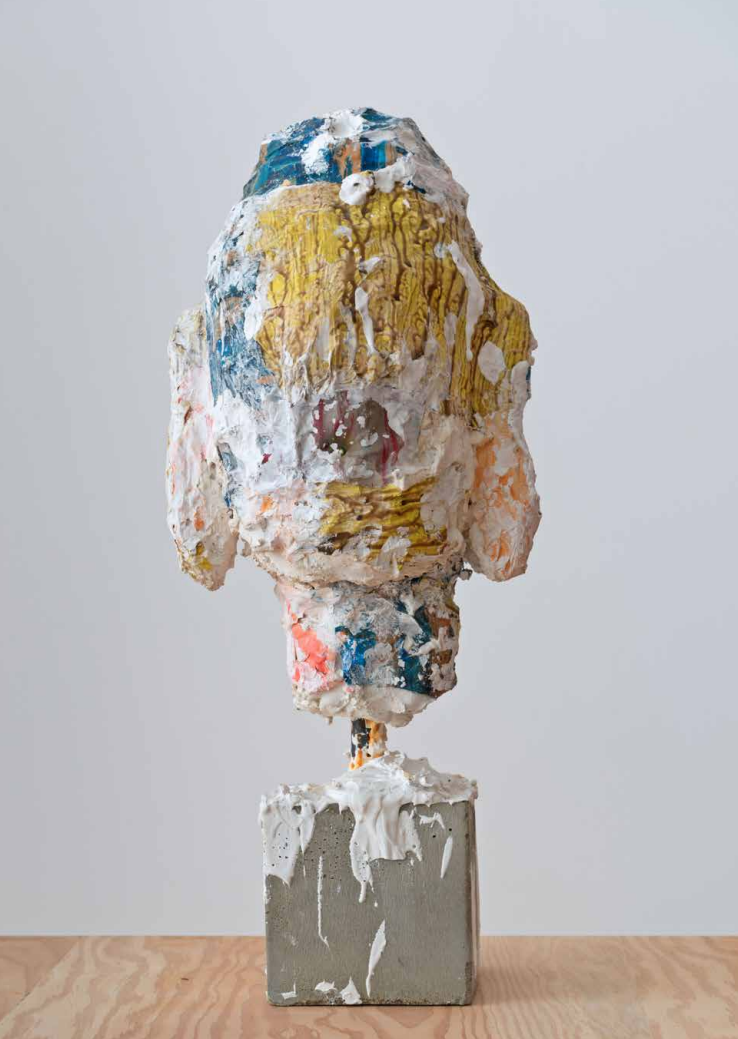
When she arrived in New York in the 1990s, Shechet felt excluded from the established contemporary art scene dominated by male Neo-Expressionist painters. Women artists were generally left out from both the social scene and the gallery shows to the point where it was an accepted practice. A shining light was the artist Elizabeth Murray who Shechet remembers, when giving a talk, made a point of mentioning where her child had spilled something over her work. She admired her candidness in hinting at her family life which Shechet herself had felt under pressure to hide. “Especially for women, life can get complicated,” she tells me. “We might as well acknowledge that we have lives and we need to address them.” In this period, the artist was looking after young children as well as teaching on top of her creative practice. She didn’t have time to attend a single art opening for seven years and made art piecemeal at night in her basement after teaching during the day and taking care of her kids. Not long after her graduation, RISD invited Shechet back to give a talk to their students. Reflecting on this period of her practice she told her audience, “The thing that we don’t get taught is that you’re still an artist when you’re not making work.” It’s a principle she stands by today. “I realised, incorporating real life into art making really did mean that I had to believe in myself when I had to stop and build a studio or have a child, or move from one city to the next. Instead of trying to take up where I left off, I came up with a strategy, which was, don’t just erase that time in between, work with it to leap over what you were doing not go back to it.” Shechet’s determination and appetite for change have brought so much freshness to her practice that, despite periods where she struggled to engage with the contemporary art world, there has been a continuous interest in her work. Wider recognition for her practice took off in the early 2000s as she started receiving attention for her work exploring Eastern philosophies.“I never actually intended to make a Buddha,” Shechet tells me. “I had a very early reckoning with death as my former roommate passed away quite suddenly. It was during the period when my children were babies, so I was dealing with some very primal issues.” Shechet wanted to be more present in life, and in her studio practice, and so she searched for a material that could harness her attention. She came upon plaster. “It’s a great timekeeping material because it changes from a powder to a liquid and then a solid within minutes,” she explains. “I also had paintings that I was working with and I would just rip them apart and take the paint skins off them and embed them in the plaster. One day one of them looked a little like a Buddha’. The idea of using semifigurative imagery in her work was alien to an artist that was for the most part interested in abstract form. A couple of friends visiting her studio were so disapproving of the fact that she was dealing with sacred imagery that her rebellious nature was spurred on by their alarm. The language seemed to make sense for her and open up new avenues.
Today her works continue to have figurative elements which jostle alongside abstract ones. Her sculptures explore the concept of balance with artworks that contort, bend and tilt. They continue to refuse to take themselves too seriously, remaining playful as well as tapping in to the lived human experience. Over the entire period, Shechet’s art practice has undergone continuous transformation. Maintaining her resistance to working in one single mode, she has worked with found materials, porcelain, paper making, iron, steel and clay. What links her sculptures in these various mediums is a commitment to exploration, a talent for evoking associations and a sophisticated understanding of sculptural language. Her impressive appetite for reinvention and experimentation has been rewarded with many major solo exhibitions in recent times from a survey at The Institute of Contemporary Art in Boston in 2015 to her large-scale public project in Madison Square Park in 2018.
Over the last fifteen years, Shechet has led a resurgence of interest in ceramic work, pushing this modest material to new limits. She recalls being drawn to clay because of the lack of inherent beauty in the material itself. “It is ugly,” she tells me. “I love the abject, slightly grotesque nature of the material in its raw state. It’s almost vulgar, this wet mushy brown stuff. It is very other,” she explains. “I don’t want to make anything that starts out good looking. Transformation is my business.” Knowing Shechet’s rebellious nature, it’s likely that she was also attracted to working with the material precisely because it has been disregarded and under appreciated for some time. Marginalised for its association with craft rather than fine art, Shechet has breathed new life into this ancient material.
Today in her studio, Shechet is busy working on her most ambitious project to date, a new commission by outdoor museum Storm King Art Centre in New York’s Hudson Valley. It’s a location at which visitors have the opportunity to experience large-scale sculpture within the hills, meadows and forests of their huge natural site. From Spring 2024, Shechet’s work will appear alongside permanent works by Martin Puryear, Maya Lin and Isamu Noguchi amongst other greats. Taking a huge leap of faith in her practice, Storm King has for the first time commissioned new and unseen work from an artist they admire. To realise the commission, Shechet is working in collaboration with three different steel shops to fabricate six sculptures measuring between 10 and 25 feet constructed from welded steel. Unusually in the sculptural traditions, her sculptures will be coloured and will stand out in the landscape. Even after fifty years of practice, the art world can expect more challenges, more disruption and more invention from this extraordinary artist in this exhibition and in the years to come.