Negative Is the New Positive- The Mold Transformed
By Elizabeth A. Williams
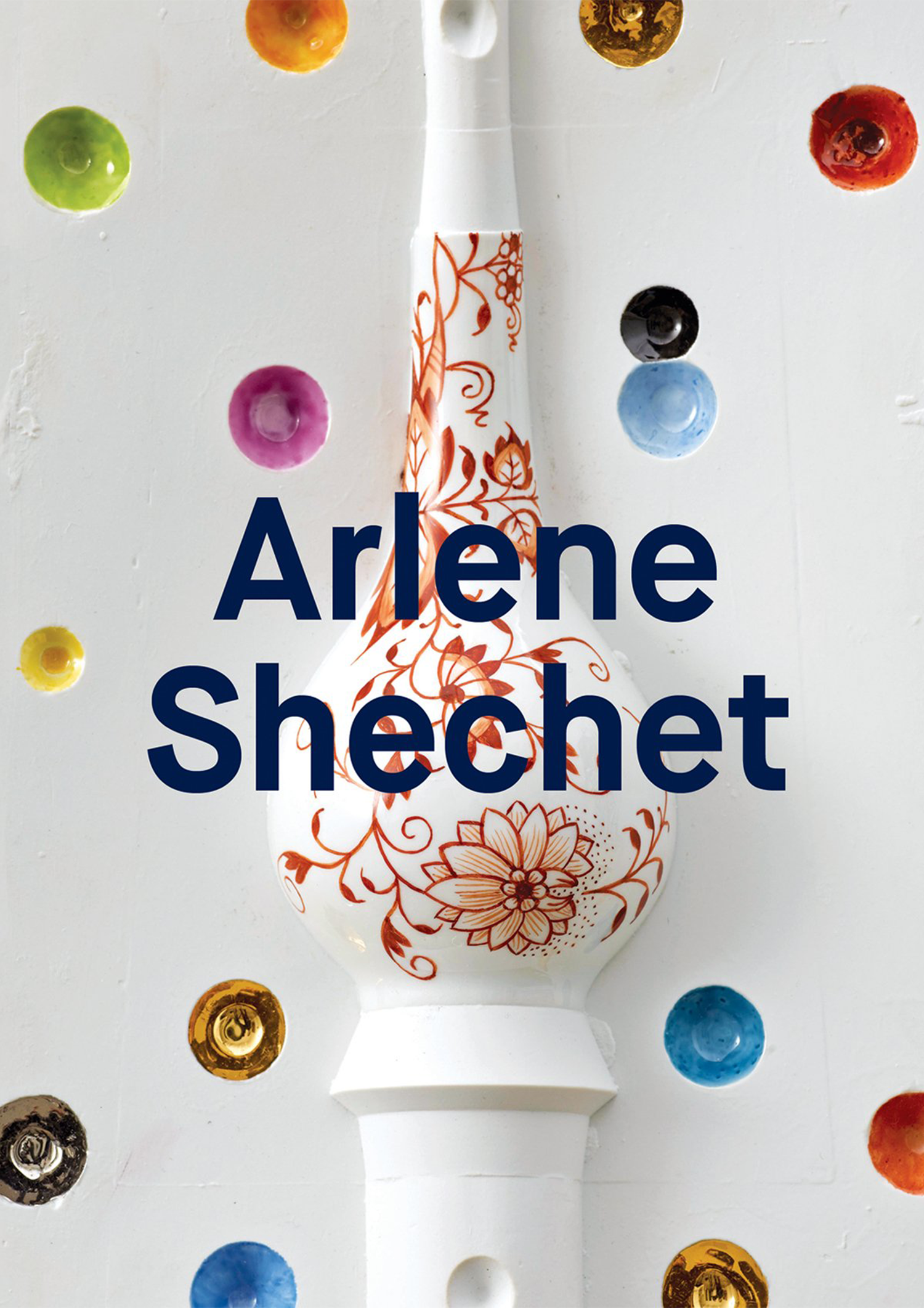
When the alchemist Johann Friedrich Böttger boldly claimed, around the turn of the eighteenth century, that he could transform base metal into precious metal, he set in motion a series of events that ultimately achieved the first hard-paste porcelain produced in the Western world. The shift in media from metal to clay might seem to be a devaluation of materials, but by Böttger’s time, Europeans thought of porcelain as “white gold.” The secret to its production had been known to the Chinese for at least a millennium and well guarded by them and their neighbors in Japan and Korea ever since. The story of porcelain and the race among European countries to produce it is a tale of intrigue, enterprise, and passion. These characteristics also aptly describe the sculptural practice of Arlene Shechet, whose 2012–13 residency at the Porzellan-Manufaktur Meissen (Meissen Porcelain Manufactory) resulted in a singular body of work and, in spring 2014, an arresting exhibition at the RISD Museum in Providence, Rhode Island. Following the irreverent trajectory of Shechet’s work at Meissen, the installation was innovatively executed by the artist and the RISD staff, bearing little evidence of a traditional museum exhibition. In addition to more than one hundred vessels and sculptures by Shechet, every one of the nearly two hundred pieces of Meissen porcelain in the museum’s collection was on view, mixed together in unconventional configurations.
The interaction between Shechet’s works and the original Meissen porcelains mirrors, in some ways, the dynamics at work in the Meissen manufactory in the eighteenth century. Böttger’s alchemical claims attracted the attention of Augustus the Strong, elector of Saxony and king of Poland, who was determined to acquire the formula for “white gold.” In 1709, under Augustus’s patronage, Böttger discovered the process for making porcelain, including the importance of white kaolin clay to the formula, and in 1710, Augustus founded Meissen, Europe’s first porcelain manufactory. The formula and the method had been achieved, the ideal had been realized, and Augustus set out to aggressively control the European porcelain market. To realize the lucrative aspects of his monopoly, he merely needed to choose among the many pieces of East Asian porcelain in his collection and direct his artists to copy them in form and decoration. Indeed, exact duplicates of Asian wares were produced by Meissen, but inevitably, the artists in the manufactory found their own aesthetic, transforming the Eastern models into original designs that would firmly establish Meissen as one of the world’s leading porcelain manufacturers from the eighteenth century to the present day.
By 1720, the porcelain painter Johann Gregorius Höroldt had joined the manufactory, bringing with him great advances in the range and palette of overglaze enamels and developing many enamel colors still in use today. Höroldt and the painters he trained looked to the glossy white porcelain as a canvas on which to render intricately detailed, Asian-inspired decorations, known as chinoiserie. This two-dimensional approach would soon be challenged, however, by the arrival of Johann Joachim Kändler, whom Augustus appointed court sculptor and, in 1733, master modeler at Meissen. Kändler approached porcelain as a medium for sculpting bold forms rather than as a surface for painted decoration.
Presciently and unreservedly declaring the capacity of porcelain to take on innovative forms not yet imagined, Kändler asserted, “Anything can be made in porcelain; whatever one desires; if it is too big, make it in two pieces, which no-one can understand as well as he who makes the moulds. . . . In this way everything, even the impossible, can be done in its own way. . . and to this I candidly and truthfully attest.”1 Like Kändler, Arlene Shechet appreciates the importance of the mold in the production of functional and decorative porcelains, yet she has also taken the mold far from its utilitarian purpose of generating the object and reinvented it as a work in itself. Thus, the model established by the venerable porcelain manufactory, refined over centuries and idealized throughout the world, has again been transformed. Arriving at Meissen in 2012 with a strong respect for its time-honored legacy, a complete embrace of traditional materials, and plans for close collaboration with Meissen artists — many from families of multigenerational workers — Shechet created a significant body of work characterized by considered affinities and confident originality, contemporary impulses and past conventions, individualistic vision and collective synergy.
Access to Meissen’s slip-cast molds quickly kindled Shechet’s standing interest in incorporating or converting elements of production into the final artistic result. Still fabricating objects from the molds employed over the manufactory’s more than three-hundred-year existence, Meissen continues the sculptural tradition launched by Kändler. Considering that each figure or teapot is made up of parts fashioned from multiple molds, it is not difficult to imagine the nearly innumerable cadre of molds marked with identifying numbers and lined up on shelves at the manufactory (see p. 163), standing at the ready for the next iteration of a segment that will be molded and unified with others to create a prescribed whole. Shechet’s work explores and exploits not only the power of molds as forms unto themselves but also the myriad possibilities afforded by making unexpected assemblages of the molds’ products.
Rarely, if ever, seen outside the environs of the manufactory, Meissen’s molds have unarticulated and unadorned exteriors that hide within their interiors the three-dimensional negative of the desired form. Shechet’s Hex Vase 50039 (below), for example, is clearly a vessel, but with a thick-walled mass and abstracted boldness not present in traditional Meissen wares—for the very reason that the intended Meissen vessel would actually have emerged from the inside of the form seen here. On Hex Vase, as well as on Jar 50130 (opposite) and other works, Shechet emblazoned the identifying number of the mold with gilding, calling attention to the utilitarian nature of the prototype. Further confounding norms, she incongruously decorated the vessels with the brilliantly hued overglaze enamels typically reserved for finished pieces, elevating the mold into a more precious realm. Just as the nature of Shechet’s and Meissen’s production seems to diverge irretrievably, both Hex Vase’s and Jar’s rose and green imbrications and bright blue hexagonal lattice accented with orange stars, taken from a covered cup owned by the RISD Museum (see p. 78), allow for connections to be discerned.
Visitors to “Arlene Shechet: Meissen Recast” at RISD in 2014 were invited to view directly the conversation between Shechet’s Jar and the museum’s cup, in addition to many other such dialogues. The exhibition was presented in two of the museum’s galleries, the Upper Farago Gallery and the Lucy Truman Aldrich Porcelain Gallery: the former is a contemporary white-box environment; the latter, an eighteenth-century English pine-paneled room constructed for the express purpose of displaying Miss Aldrich’s collection of eighteenthcentury European porcelain, which includes more than fifty Meissen figures. The dichotomy of the settings in their ordinary state is palpable, but they, too, were transformed by Shechet in the course of conceiving and installing the exhibition.
RISD’s Porcelain Gallery incorporates three niches lined with golden silk as well as three standing and two wall-hung eighteenthcentury mahogany cabinets with fretwork doors. The cabinets and paneling are themselves accessioned collection objects, affording inflexible challenges and few opportunities for physical intervention, logistical reconfiguration, or technological enhancements, but this did not hinder Shechet’s imagination. She succeeded at turning symmetrical serenity into a dynamic scene, drawing unexpected, provocative, and witty connections between the present and the past. Mirrored surfaces and objects revealed the fully rendered three-dimensionality of the Meissen figures, which were displayed not in the usual cadenced rows but rather facing backward, toppled over, or placed upon Shechet’s porcelain casts from molds of kiln bricks and blocks of extruded waste clay—additional inclusions of elements from the manufacturing process. Porcelain figures also surveyed the installation from atop overturned bowls, and teacups were precariously stacked (with curatorial consent, and secured with ample amounts of wax), creating a seemingly unstable atmosphere in what is typically an ordered environment. Commanding all from his demilune shell-topped niche (opposite), a Meissen figure of a Buddha with articulated hands, head, and tongue was accompanied by Shechet’s Asian Vase, a relief based on one half of a mold for a vase, decorated with the same yellow-and-gold diamond pattern that covers the Buddha’s protruding round belly; the pattern was further echoed by the mirrored disco ball to the right of the Buddha. Here and elsewhere, mirrors gave both the functional and the decorative works additional presence, bringing awareness to them as sculptures.
Contemplating the way porcelains were prized and consequently displayed in the eighteenth century, Shechet conceived an equally clever and playful design for the Upper Farago Gallery. The gallery was painted a rich, deep charcoal gray that shifted in tone with the space’s natural lighting. Spatial organization shifted as well—an acrylic case housing the museum’s Meissen Monkey Band (Affenkapelle), positioned in a freestanding wall, appeared to have rotated of its own accord to rest at a perilous angle, jauntily jutting out from the space in which one would expect it to be contained (see p. 85). A favorite at the museum, Monkey Band epitomizes the eighteenth-century interest in role reversal. With outstretched arms, the band’s conductor exuberantly holds one hand aloft, conducting his nineteen musicians and singers, while his other hand clutches a rolled-up piece of sheet music. The conductor is appropriately dressed in fine clothes, sporting an elaborate powdered wig, but he is not human. He is a monkey, as are all the members of his band. Designed by the Meissen manufactory in about 1753, Monkey Band was marketed to a French audience familiar with this simian twist on mid-eighteenth-century aesthetics. Monkeys dressed as humans and engaged in human activities are known as singeries, from the French word singe, meaning “monkey.” Despite the somewhat comical appearance of monkeys dressed as humans, the figures are typically displayed at RISD in a regimented semicircle with the musicians lined up two deep, focused on the conductor, and standing at “Meissen Recast,” however, Shechet envisioned a raucous party in which the monkey musicians had broken free of their requisite posi-tions, joyfully making music while dancing with abandon among bits of mirror, kiln bricks, and extruded blocks.
The installation in the long, rectangular gallery also challenged visual perspectives while recalling the eighteenth-century practice of displaying copious amounts of porcelain vertiginously on walls. One end of the gallery featured a sideboard-like piece containing Shechet’s pair of works derived from the molds used to create a large covered tureen, an original, finished example of which is in RISD’s collection and was exhibited alongside the mold-based works. Above the sideboard, shelves held historical Meissen figures, plates ornamented in relief with dismembered molded parts originally used to form human figures and animals, and a platter bearing a painted rendering of the Meissen manufactory as it appears today (below). Shechet recounts that the Meissen artists found it very curious that she would depict the manufactory, as they did not find the subject worthy of decorating a piece of Meissen porcelain. Just as the molds were considered utilitarian, so, too, was the edifice in which the works were produced. Shechet’s elevation of it is yet another example of her valorization of things that are typically overlooked.
At the other end of the gallery, the inverse was presented. Rather than protruding from the wall like a piece of furniture, the sideboard’s volume and form were inset into the wall, demarcated by a profile matching exactly that of the piece’s base and feet. What had been projecting shelves were stepped into the wall, creating a concave arrangement— a negative of the opposing wall, akin to the relationship between a mold and the final porcelain product. Within the sideboard-shaped cavity, the remains of a riotous party’s dessert course were strewn in disarray. Upturned teacups littered the tiers of a latticed-edged, enameled-andgilded étagère, and male and female figures from the museum’s exuberant Meissen centerpiece had seemingly dislodged themselves from their customarily secured positions to partake in the festivities. Some, as if recovering from the evening’s revelries, rested on small pillows that Shechet included in the installation.
Originally meant to ensure consistent replication and complete compliance with industrial and aesthetic standards, molds take on a new purpose in the body of work Arlene Shechet created during her time at the Meissen manufactory, seizing a new position of power and agency. Her works and the RISD installation not only transformed the traditional Meissen model but also subverted and destabilized it. Just as Böttger, Kändler, and Höroldt ultimately challenged the supremacy of Asian porcelain with their own inventions, Shechet extended the legacy of “white gold” in unexpected directions by elevating the tools of production in ways never envisioned by either Asian or Meissen ceramicists. Shechet’s sculptures are fully endowed with the resonance of their bold, experimental creation—a result of her determination to exploit the precious white material to its fullest potential in the interdependent realms of artistic imagination and technical innovation.