Interview with Arlene Shechet
Judith Tannenbaum
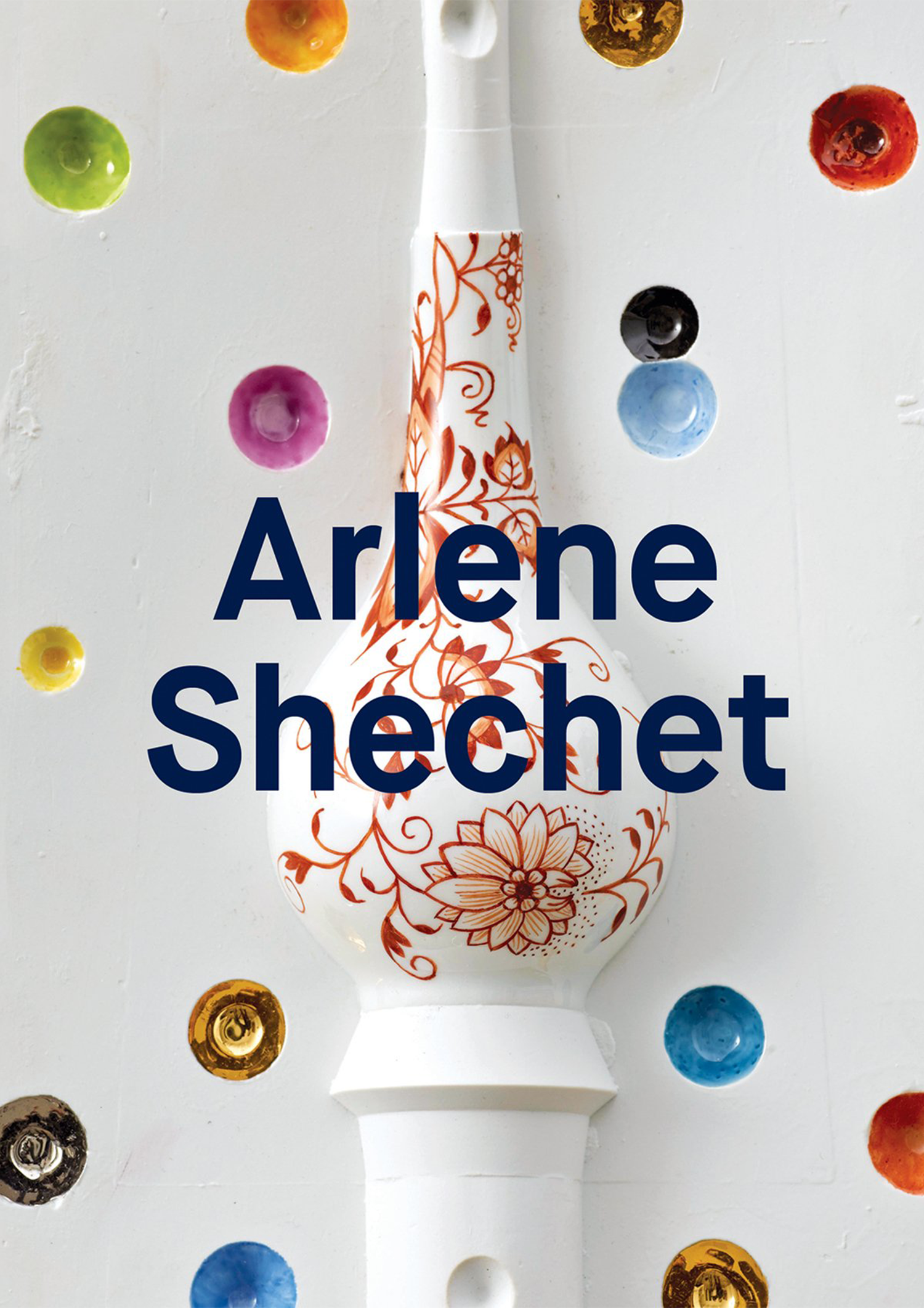
This interview was conducted in August 2013, several months before “Arlene Shechet: Meissen Recast” opened at the RISD Museum in Providence, Rhode Island.
Judith Tannenbaum Meissen porcelain seems very different from the ceramic sculpture for which you’ve become well known in the past few years. Meissen looks delicate and refined, whereas your work is much more raw, organic, and seemingly intuitive. It’s generally abstract, rather than representational. How did you become interested in Meissen porcelain?
Arlene Shechet I’m very interested in everything related to the decorative arts, and anything that is marginalized. I’m sort of a geek about all that stuff. In terms of Meissen, the opportunity to work there fell into my lap.
About two years ago, Meissen decided that it was going to do what many industrial factories are doing or have done—invite artists who experiment to work within the confines of the factory production. In many factories, artists are commissioned to make something specific. In this situation, they were just going to give me a studio and let me explore. Once I had been in the factory and understood it, I could see that almost nobody knew the whole production. So Meissen was excited by the idea that I might actually get my hands dirty. Of course, they unleashed the maniac in me. It’s become more ambitious than they could have imagined.
JT How long were you supposed to be there?
AS There were very loose parameters around the whole project. I think I originally signed on for a couple of months, but we’re still wrapping it up, and now it’s been almost two years. I was dipping my hand into every different kind of production— soft-paste hand-building, slip casting, mold making. Ceramics is one of those mediums where things have to dry, so there were lots of reasons to begin and pause.
JT Tell us about this factory.
AS Meissen is in a little sixteenth-century town twenty minutes from Dresden, which was leveled in World War II, but Meissen is intact and gorgeous. In 1710, Meissen became the first place in the West where porcelain was brought into being. Alchemists locked up in the church figured out how to make it. The Meissen factory is an early twentiethcentury industrial building, and my heart was just palpitating going in there. I thought the whole thing was beautiful. Six hundred fifty people work there, closeted away in weird anonymous spaces. It’s a factory in the most religious sense of the word—complete fragmentation of duties. I spoke to people who had been there for forty years who knew nothing about porcelain.
JT What do they do?
AS Just what they do. “I’m a fruit painter—no, I’m not really a fruit painter. I just paint cherries.” So specific.
JT Did your experience at the factory meet your expectations? Was it different from what you had anticipated?
AS My fantasies about working in a factory are deep and very old. When I was a kid, growing up in New York City, I used to say that I wanted to be a factory worker or a farmer. My parents brushed me off. I had never been to a farm or inside a factory. But I was fascinated. We would drive past the Nabisco factory and I’d say, “Can’t we go in?”
JT Why did you love factories?
AS I always wanted to know how things were made, how things were put together, the magic of the machines. It was the beginning sculptor in me. Growing up in New York, you always see things postproduction, but I was interested in the beginning. Being an artist is, in a way, like being a farmer or a factory worker—you’re growing things. There’s some kind of mysterious vision you’re pushing forward. Of course, I was thinking of industry in its brightest, most sparkling version, bringing new and wonderful things into the world.
JT I recently saw part of Charlie Chaplin’s Modern Times, and his vision of the factory is not at all like what you’re describing. It’s about new technology, and the poor worker—who’s desperately trying to keep up—gets sucked into the machine. It sounds like the factory at Meissen is different.
AS The repetition is there, and it can be deadening. Everything Meissen makes is handmade, but there are people who just dip the same bowl in glaze over and over again, all day. Signing is a really big thing there—everything is hand-signed with Meissen’s signature swords. There are two or three people in the factory whose only job is signing. They sit with their arms propped up all day and make those swords. Our agreement was that for everything I made, I had to sign and they had to sign.
JT Is there somebody who is considered the designer in the Meissen factory?
AS Up until the last couple of years, the pieces have looked like they looked in the eighteenth century. People still want things that were made in the eighteenth century, or look like they were.
JT Now we’re conscious of distinctions between art and craft. In the eighteenth century, did people distinguish between the sculptural figures and the functional dinnerware?
AS The Meissen dinnerware—the teapots, the plates—was not used as dinnerware. That stuff was hanging on the walls, used as another layer of wallpaper, as the most opulent, fabulous, color-coded versions of how you can hang things and appreciate shapes. In the eighteenth century, they treated it as art but were still calling it dinnerware, without separating it in the way we do. I took my cue from that.
JT Were the figures shown the same way? AS No. The figures were mostly shown as something called the “dessert,” which would be on the table. It was a complete reversal: dinnerware on the walls, figures on this fabulous table, as part of a centerpiece. I think originally some of the stuff was made of sugar. It’s still called the “dessert.”
JT The whole idea of feasting with your eyes, maybe.
AS This became my understanding, and very much an inspiration for me. In making new things, I used the functional forms—teacups, plates, teapots—and I mashed them up with figures. I combined them.
JT One of the reasons the exhibition “Arlene Shechet: Meissen Recast” came to be is because the RISD Museum has a lot of Meissen as well as porcelain from other European factories, and we’re always interested in making connections between the past and the present. Presentation is very important. How are you adapting some of what you saw in Europe, the way they’ve displayed it, with what you can do in the museum?
AS I want to take the whole vocabulary of porcelain out of what is expected. I had the experience of going into the Lucy Truman Aldrich Porcelain Gallery as a RISD student and not paying attention. JT Right. Those tchotchkes, the sort of things your grandparents had.
AS Yeah, who cares? But now I see how the conceptual conceits that are the underpinnings of many of those forms—like Monkey Band [see pp. 20–27]— are crazy. Contemporary artists, including myself, think they’re doing things that are out there, and these things are out there in a way that hasn’t been appreciated. It certainly wasn’t appreciated by me.
JT In the twentieth century, there was this move away from ornate style to the pared-down utilitarianism of the Bauhaus. Our generation was brought up with modernism, so looking back at things from before that age can be very curious.
AS Yes—the Baroque, the Rococo. I’m excited to take over the whole [Lucy Truman Aldrich] Porcelain Gallery. We’ve discovered that the museum has an even better Meissen collection than was previously thought. It will all be Meissen, and that in itself will change the vibe. We’re going to mix in some of the dinnerware, which has never been shown in that room, and show every piece of Meissen in the collection, many of which have only recently been identified as a result of this project.
JT Right. We’ve only shown the figures there.
AS Yes. Instead of the polite figure/space/figure/ space way of putting the cases together, my goal is to install the works with a much more contemporary eye, grouping things in unlikely ways. Many of the pieces in the collection, seen from the back, are, to my eye, beautiful abstract sculptures. They are certainly as seriously modeled from the back, and the craftsmen who made those pieces painted them all around. But they’ve never been shown in the round here. We may use mirrors and show some pieces from the back.
I am also interested in showing the undersides, because that’s another aspect that became part of my production. Who signed these? How did they sign it? What do the bottoms look like? We never get to see any of those, and again, from a formal point of view, they are interesting shapes.
JT You’re going to be juxtaposing some of the pieces you made at Meissen with the authentic Meissen, right?
AS The biggest conceptual part of my work there has been to take the plaster molds used at the factory for three hundred years and make molds of them, and then recast them in porcelain, turning the industrial object into fine porcelain. I’ve also cast into the finished product the signatures, the carvings, the offhand marks and dates of the mold makers.
JT And your own signature, too?
AS My own signature becomes part of it, with the Meissen signature, at the end.
JT With the painted part?
AS Yes, and I’ve cast into them [her works] the drips of plaster that came about in the process of making the mold. So each mold contains two kinds of worker: the fine artisan, who carved the initial bowl or vase in plaster or clay, and the next level of artisan, who made the mold of that thing in order to put it into production. In my pieces, I combine the work of both of those people into one object and add my own layer on top of it. It’s the combination of three.
JT Right.
AS I want to celebrate the worker, the fact of the factory, and what’s really happening there. In my work, I’m always trying to get to what is essential about either the material I’m using or the situation I’m in. I was at Meissen for a couple of weeks and I thought, “What is the essence of this factory?” The most elemental part of the factory is the molds. It’s both the most obvious thing and the most hidden thing, the thing that nobody sees. A small figure, for instance, will very often be made from twenty different molds.
JT And each one somebody made.
AS Each one. Because every pleat would be an undercut and would require a different mold. The bowls, the vases—all of those things are made with multiple molds.
JT This piece I’m looking at [Bowl with Keys, opposite, far right]—is this a mold?
AS It’s a porcelain version of a plaster mold. The plaster mold was originally used to make the lid of a porcelain casserole. Now, I’ve transformed it into a bowl. The Meissen casserole is in the RISD collection.
JT These pieces have a distinctive look. The work is so much thicker and heavier than porcelain, which you usually think of as fine, thin, and delicate.
AS I’m introducing a twenty-first- or twentiethcentury language linking the factory strictness to Baroque objects. I also liked the idea of taking industrial objects—the molds—and making functional objects from them. Here [below] is one I sort of bashed. This was a mold of a mold of a flat “platelet” used as a stand for firing something else, so it never even was an object, but the thing itself is so gorgeous. I just loved it. I went picking through all the areas of production to find forms. And here are drips of slip from the pouring, which is also showing how this object [Amost Plate, below] was made. Cast in are the numbers that represent how Meissen identifies its objects. So, this model is number 18353, and the number of the pattern is 56. I put all of that information in. And then I do what they do: fire it and put 24-karat gold on it and do the whole Baroque thing right on top. The layering of the old and the new is something that’s pretty inspiring. The other thing is that they never let anything out of the factory unless it’s covered with clear glaze, and I left a lot of it in what they call “bisque,” without the clear glaze.
JT What if somebody saw one of your non-Meissen abstract sculptures with this work? What do you think the connections are?
AS A couple of things. First, I’m always attempting to get at what is essential in any situation or material. And then, more particularly, I now realize that I have been working with molds as part of my finished work since 1997. I think yesterday you were looking at one of my paper pieces from that year?
JT Right.
AS Molds were part of that piece—plaster molds, in fact. Those pieces were made out of paper, but molds were central. I have been using firebrick—the bricks that are used to build the kiln—for the last couple of years, as part of my finished pieces. Instead of glazing the ceramics, sometimes I’ve been glazing the things that make up the inside of the kiln. Turning the factory inside out is the same as turning my studio inside out is the same as turning these pieces inside out.
Looking for what is overlooked is how I work. At Meissen, what is overlooked is a lot of the stuff that gets thrown out—the screws, the casting things, all of those are part of my finished pieces. All the seam lines, all the marks, the numbers—all of that I find very beautiful and also thrilling, because it shows how these things were made. Not just the finished product, but the original thought that went into making them. I never tried to wipe up the drips or get rid of the fingerprints or brush marks.
JT Are there things you would still like to do at Meissen?
AS I could be there my whole life. There are so many different ways I could work there.
JT How is Meissen going to use your work?
AS They own some of it, and they’re at the beginning of thinking what they’ll do with it. Meissen wasn’t interested in changing before, but now they are. I got in there and asked all these questions. After our first glazing, they invited the painters up and said, “Look at this.” But because this changes their production, and any change is slow, it’s complicated; they don’t know exactly how to enact it. It’s the former East Germany!
JT Also look at their goals. This work is so different from what they’ve done before. Do you think it will impact future production?
AS Some of the mold-of-the-mold forms are sneaking into the vocabulary of their new dinnerware.
JT Interesting! The whole point of having an artist come in is to shake things up a bit. You’ve worked with a lot of materials. How did you get started with clay? Did you ever throw on the wheel? Were you a traditional potter?
AS For two seconds. Mostly because I saw somebody doing it. If you see anybody doing it, it’s completely magic. I have learned that I’m pretty good with materials and they’re all sort of the same. I’ve worked in glass—you have those molds again, and you have this liquid that turns to solid. I’m always attracted to that. For me, liquid set in form has a particularly poignant feel to it. It’s like stopping time, or creating a pause, or creating a unique way to look at things. The artist can offer that to the world, whereas we don’t have many other vehicles for that, unless you’re somebody who spends a lot of time in nature.
To me, art and nature are the same thing. With nature, you have the release of being in an environment that makes you come alive in a different way, and I feel that art has the potential to do that. I always say that museums are the nature of New York. If you want to have that experience of free floating, museums are the place to do it. But honestly, the most important thing to me is time in the studio. What you make is less important than how you are spending your life.
JT Because we get so invested in the output, the result.
AS One of the reasons that now, for the last seven years, I’ve been working with clay is that clay has the potential of creating an unmediated experience with the material.
JT You’re physically manipulating it.
AS Physically manipulating it. Physically, it’s talking back. I’m always trying to hear what it’s saying, listen to what’s happening. I’m definitely battling it out sometimes, but it’s a conversation with the thing, body to body. I always say, “Oh, clay is the perfect three-dimensional drawing material because you don’t even have to use a tool.” Most of the time, it’s just me. Me, the hands, the material. Sometimes it’s so primal, I have to take a break.
JT I know you’ve spent a lot of time with Eastern thought and Buddhism. Do you think that’s part of what you’re describing?
AS Yes, it is. About twenty years ago, I was also going through something of a life crisis in terms of having babies and having my best friend die. Various things, in a very short period of time, put into relief a lot of questions about what I was doing and why I should or shouldn’t be doing it.
I decided I needed to have a kind of meaning to sustain me. Every time I went to the studio, I could use the process as a practice in developing awareness— the word “meditation,” that’s not exactly it, but what meditation is about. Working with awareness, with an ability to move with what is happening. After I developed an awareness, I had new appreciation for things I had been ignoring.
JT Did you stop working when you had children?
AS I always worked, but during the first year of each of my kids’ lives, I didn’t try to make sculpture, I just did drawing. It was pretty much impossible to make sculpture and nurse.
JT These are the realities people don’t talk about.
AS Yeah, I know. People also don’t talk about how part of being an artist is not working all the time. The reality of being alive and in a body and in a complicated life is that I had to stop working to find a studio, I had to stop working to build a studio, I had to stop working at different times in my pregnancies, I had to stop working because I had an academic job that was taking up so much of my time. I had to stop working because my kids had chicken pox. You have to stop at various times. Art school doesn’t prepare you for this. I love being in the studio but the reality is that it’s not possible all the time. And that has to be okay.
The one device I have used is not to pick up where I left off—to acknowledge that there has been a break. When you start again, you’re not that same person. If you try to cram yourself and your desires into that same place, it’s not going to be fun, it’s not going to be real. It was crazy hard a lot of times, but I would try to find the place I was at, and start from there. In that way, I managed to feel that it was okay to take a break. You’re still an artist when you’re not working.
JT You should feel no guilt.
AS It’s amazing, the guilt one can have about anything.
JT Is there anything else you’d like to say about the show?
AS Installation is important to the entire concept of this show. I want the viewer to experience a strong connection with the [Lucy Truman Aldrich] Porcelain Gallery. Because the show will be in two galleries, the goal is to get people to look at both parts and make connections between them. And if we don’t want to have a sea of pedestals with bonnets, we’ll need to create some cabinets and other things that will be fun to design.
I also want this sense of discovery. I think that with the Rococo vocabulary of the figures, Meissen is trying to create miniature worlds to look into. I want a little of that Kunstkammer feel to come into the gallery, like magic is coming out of anywhere you can imagine.