Open Shelves
By Nancy Princenthal
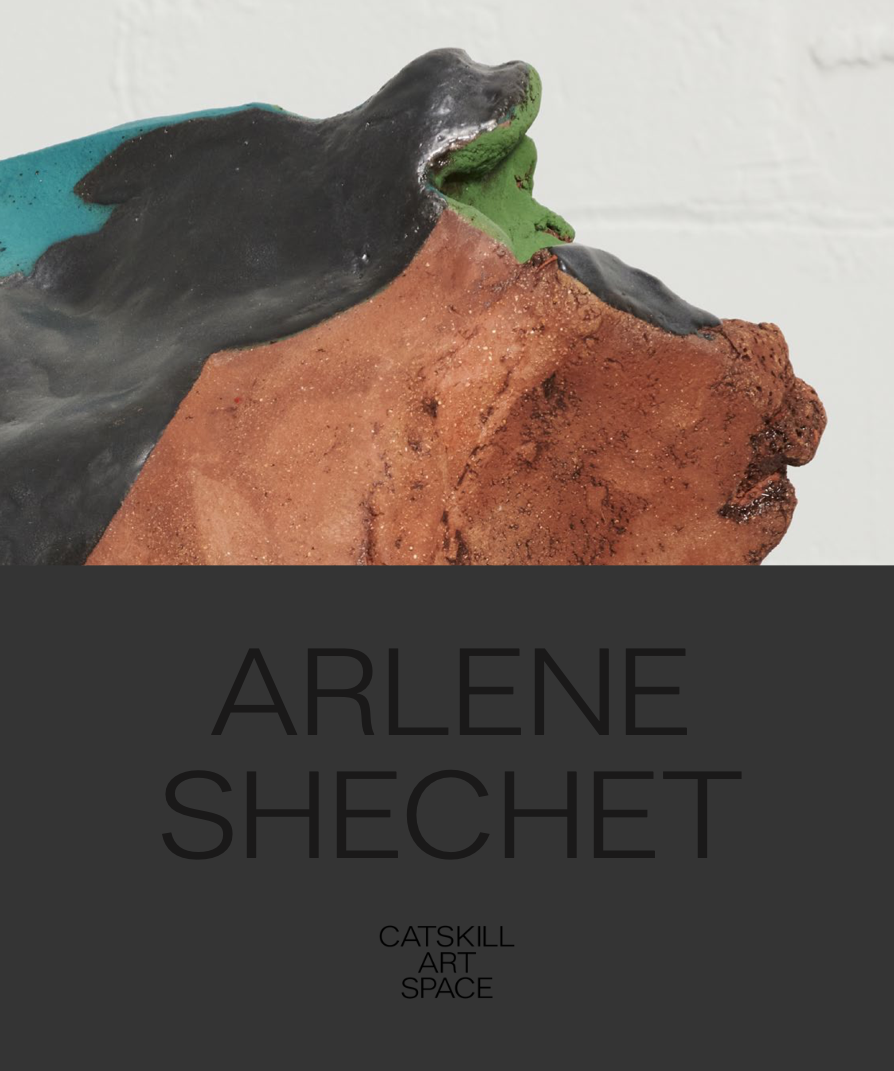
In the late 1990s, Arlene Shechet gathered an assembly of Buddhas in her Tribeca studio. Seated peacefully and modestly scaled, no two alike, they were made of plaster and paint skins. The hush they created proved memorable. So did a lurking sense of humor, quiet but not gentle—a Zen master’s brain-breaking joke.
Things have grown progressively unsettled ever since.
Shechet soon began working at the papermaking workshop Dieu Donné, where she made a series of blueprint-like images derived from Buddhist temple plans. Wrapping these images around plaster vases, she grafted sacred architecture onto domestic (and allusively figure-based) forms. The blue-and-white color combination, Shechet points out, is common to porcelain traditions around the world, though she realized the connection only later. Her use of clay, starting around 2006, was followed in turn by wood, steel, and much more. Increasingly over the years, Shechet’s work has presented opposing injunctions—on the one hand, to be alert to the smallest details of color and texture, weight and shape, line and form, each element chosen with consummate precision, and on the other to relish the unruliness of seemingly contrary elements and precarious stances.
Hers are sculptures that have long since refused to sit still. Tipping back and forth between safely joyful disorder and what looks like imminent peril, they keep viewers off balance, too. In an interview with artist Janine Antoni, Shechet explained that instability and flux have always inhered in her process: “fluid material becoming solid catches time, creating a map of a moment,”she said of working with clay. And both artists described the possibility of failure as foundational. Talking about tightrope walking, a literal of aspect of Antoni’s work that applies metaphorically to Shechet’s, Antoni observed, “you can’t move forward unless you’re falling.” When the writer Deborah Solomon asked Shechet why she’d titled an exhibition of her work Skirts, Shechet replied, “skirting the edge, being on a precipice.”
A New Yorker by birth and a longtime resident of the City, Shechet moved her studio (and home and family) to Woodstock more than twenty years ago, in the early aughts; more recently, she added a studio in Kingston. The relocation was followed by the use of an increasingly broad range of materials, and of scale. Having had several residencies at Dieu Donné since her first in 1997, she has continued to use handmade paper. Following a series of residencies at the Meissen porcelain manufactory in Germany in 2012–13, she was invited to infiltrate the Frick museum’s Arnhold porcelain collection with the sculptures she had made in Meissen, which were cast from recombined elements of the manufactory’s original rococo molds. The sixteen wryly elegant works are titled “Meissen Monuments,” although none are over two feet high. A major survey of Shechet’s work in 2015 at the ICA in Boston was followed by a 2016 exhibition at the Phillips Collection in Washington, DC. There she interspersed her sculpture across five galleries, creating conversations between work she selected from the museum’s collection and her own. In 2018, Shechet’s first commission for large- scale outdoor work—at Madison Square Park in New York—yielded an explosion of mediums and forms she had not previously used, including some that were explicitly figurative.
Six years later, she presented a series of painted aluminum sculptures on the grounds of the Storm King Art Center. Together called Girl Group, they are truly monumental: the tallest is a commanding twenty-eight feet high. Conceived both digitally and with physical maquettes made of heavy paper (which in turn reflect rough clay sketches unrecognizable in the final results), the Girl Group sculptures are a triumph of volume, shape, line and color held in dynamic poise, not only individually but also in relationship to each other and to Storm King’s glorious landscape. Inside its museum, there were smaller sculptures made of ceramics, wood and metal. In works at both scales, there are textures that beg to be touched and colors so vibrant you could almost taste them.
The heterodoxy of Shechet’s practice is well represented at Catskill Art Space (CAS). In Three There and Now Now (both 2024) and Close to Music (2022), ceramic clouds of stippled color, with surfaces that evoke flocking, or fleece, or maybe velvet, swirl atop steel supports that seem spindly, compositions that are at once top-heavy and weightless. Both relatively luxurious hardwood and workaday plywood contribute to Speaking of Drawing (2022), in which components that look like disassembled tables—or work stands, or sculpture supports—climb up and down a totemic form, creating a sculpture that is simultaneously linear, planar and fully volumetric. All these materials and more appear in Portal (2023), a large floor piece that combines a ceramic element with a reticulated surface that is brassy yellow with black roots; a sizable section of a tree trunk, warm-toned and almost fleshy—a massive thigh, perhaps; and a blank-faced circular platter of black steel. A rectangular steel plate juts out below, serving as a kind of internal platform. These disparate forms wedge, jostle, support and illuminate each other.
In addition to freestanding sculpture, Shechet lately has introduced wall-hung work. The lichen and moss that are sometimes suggested by her glazing are also evoked in Answer Adventure (2019), a large tapestry enhanced with hand embroidery. Its varied textures, which evoke organic growth and decay, are countered by sharply unnatural shades of pink and red. Also on view are framed works in which small amounts of clay are applied to paper, causing the paper to contract and ripple. The result is a species of featureless self-portraiture: an earthen medium picturing itself.
Offering formal and literal repose, a trio of Pleat Seats (2025)—gray marble cubes cornered by striated cones that resemble pleated skirts—offer viewers backless seats. Trim, sedate and unshakable (if a little flirty), they stand in perfect opposition to Origins (2019), a small work of bronze and steel that seems to defy sculptural definition altogether. In a 2024 conversation with sculptor Rebecca Smith that touched on work Shechet was making during the pandemic, she explained, “One parameter was to make the clay works without flat bottoms and then decide after firing what their final orientations would be.” Soft and bloated but irresistibly appealing, a little like a baby on its back, Origins is a related form. Unable to find its own footing, it is held snug in a metal support; tiny protruberances flail like helpless limbs. Origins finds company in Louise Bourgeois’s provokingly amorphous sculptures of the 1960s, eccentric abstractions (to borrow the title of a landmark exhibition organized by Lucy Lippard in 1966) that positively refuse to hold still or sit comfortably.
Other artists whose work has been compared to Shechet’s include Gian Lorenzo Bernini, for the dynamism of his sensual figurative sculptures, perpetually in movement, and Auguste Rodin, for rippling surfaces that, catching changes of light, also appear to be in constant motion. Relevant, too, is Constantin Brancusi, who constructed bases for his sculptures that double as freestanding artworks, and vice versa; and Franz West, who similarly mixes up utility (as in furniture) and abstract form. Not least, particularly in Shechet’s recent work, there is the example of David Smith, for the saturated colors he painted onto the flat surfaces of abstract steel sculpture in the 1950s and 1960s.
What unites these artists across the centuries is their ability to cause solid form to shapeshift, thus destabilizing it. Cultural critic David Levi-Strauss has observed of Shechet’s sculptures, “They lean and slump and struggle to stand. Their utter exigency becomes a driving force.” It is a force that is grounded in the process of its creation. Shechet is busy with half a dozen sculptures at any given time and likes the disruption that moving from one to the other produces. She never makes preparatory sketches: the work’s form, Shechet says, is “discovered in the making.” Decision-making involves cross wiring independent qualities: she has described color as “a physical thing,” and thinks of “clay as a three-dimensional drawing material.” A key step in the process is “finding out how this thing is going to live in the world,” how it will be situated in relationship to its support. “The steel elements,” she insists, “are just as essential as the ceramic and wood ones.” As with all artists who use glazed ceramic, the resulting surface color and pattern, even after years of patient experiment, “is sort of out of control.” “It’s a dance,” she says, adding, “My job is to listen and play.” But of course, it’s a very exacting form of listening and a demanding kind of play. She hopes viewers will engage in it, too. “I try to invite the focus required for figuring things out,” Shechet says. “I want to be in the middle of a demanding conversation.”
A final work in the CAS exhibition represents yet another departure. Wood Library (2025) emerged from the conditions of her Kingston studio, which was very raw when she acquired it, and is bigger and more flexible than her Woodstock studio, where a kiln commands considerable space. Taking out most of one floor in Kingston yielded 20-foot ceilings. Like most artists, Shechet keeps leftover and unused material around her when she works. In the new studio there was room to make tall shelves for sorting and storing a wide variety of wood cast-offs and off-cuts. (In Woodstock, there is a library for ceramics). These storage systems facilitate experimentation and also organize the units of her sculptural language, its vocabulary and semantic structure. “There’s not a day that goes by when the libraries aren’t used,” she says.
In the wood library’s representation as sculpture, the solemnity of libraries is both evoked and undermined. True, the shelves are stabilizing, as are the books that the wood samples symbolize: if the mind of a reader floats away from the physical world, bound volumes bring it down to earth. Moreover, Wood Library speaks, sensibly, of the origin of paper in wood pulp. But in its compendium of more or less unclassifiable material, it also defies the boundaries that written language places on knowledge. In doing so, it calls to a range of other sculptors, among them Carol Bove, whose early assemblages included scanty but intriguing assortments of books on shelves; Rachel Whiteread, whose haunting Holocaust memorial in Vienna is a silenced, white ghost of a library, its nameable contents—presumably given on the books’ spines—turned inward; and Theaster Gates, whose commitment to archives and libraries of historical Black publications have taken a variety of forms.
All can be said to descend, in some way, from art historian Aby Warburg’s legendary Bilderatlas Mnemosyne, an archive of images on which he embarked in 1927 (and never completed), and which like his mind produced unlikely and even irrational associative leaps and defensive sequestrations. Warburg’s idiosyncratic organizational scheme, writes art historian Joseph Leo Koerner, presumes that “thought proceeds thanks to protective walls that thought itself constructs.” For better or worse, such walls are inherently provisional. I picked up Koerner’s book, titled Art in a State of Siege, for perhaps obvious reasons, although it was written before the current political upheaval took hold. While any library promotes coherence and promises to safeguard knowledge, it can also harbor the wildest upheavals.
In Shechet’s interview with Rebecca Smith, the two artists touched on the productive disruption caused by working in several places at once and the relief from established habits it permits. Said Shechet, “If I just keep banging on with my ego, it becomes very hard to go beyond what’s merely good. (laughter) What’s good, what works, what’s beautiful is not what I want from my studio life. The Buddha talked about how change is a constant, and I’m trying to enact that.”