The Attended Moment
Arlene Shechet’s Mindful Installation at The Phillips Collection
By Klaus Ottmann
Sati is literally “memory,” but is used with reference to the constantly repeated phrase “mindful and thoughtful” (sato sampagâno); and means that activity of mind and constant presence of mind which is one of the duties most frequently inculcated on the good Buddhist.
—T. W. Rhys Davids1
Clay, from its plastic nature, lends itself to the idea of modeling, and gives scope alike to the liveliest flights of imagination and the most persevering efforts of industry. Abundant in its variety, easily procured, and, consequently, devoid of intrinsic worth, it derives its value solely from the elegance of form imposed upon it by the potter, or from the richness of decoration given to it by the artist.
—Albert Jacquemart2
There are several parts to Shechet’s exhibition, From Here On Now, at the Phillips: choosing from her studio, select- ing from the museum collection, and creating an installation that combines both. Invited to delve into the Phil- lips’s full inventory, Shechet’s “intersection”3 of her own sculptures with works from the Phillips, spread across five galleries of the museum, creates a mindfulness presence that mimics both the artist’s Buddhist studio practice of “being alert and alive” and Duncan Phillips’s emphasis on “Open-mindedness”4 and wellness.5 Mindfulness has been described as “naked, or bare, attention”6 that is “in itself, healing.”7
In conversation with Phong Bui, Shechet characterized her engagement with Buddhism as providing “an essential insight for how to behave in the studio”:
It’s not that I was committed to being a practicing Buddhist or promoting its philosophy. Rather, I was using it as a record for my experience.8
Shechet’s approach to engaging with the museum’s collection reminds me of Rilke’s inability to read Buddha’s speeches his wife Clara sent to him (“... a shudder engulfed me,” he wrote to her after reading the first words) while writing his famous three poems on Buddha. He did not need to read the book because he had encountered an Indonesian statue of Buddha “in tremendous silence ... imparting the inexpressible unity of his gestures under all the skies of day and night”9 in Rodin’s garden in Meudon.
One of the works selected by Shechet became the touch- stone for her entire installation: a photograph of an Af- rican sculpture taken by Walker Evans at the request of Alfred H. Barr when the sculpture was exhibited as part of a groundbreaking exhibition of African art at the Museum of Modern Art in 1935. Shechet explains:
Evans photographing this sculpture from the back has so much to do with my ideas about sculpture. Not only is the form related to my sculptures, but choosing to show the back rather than the front shows the beauty of that view, the complexity of the sculpture, the power of it, and his respect for the entire form. He used his craft to light the sculpture and have its dimensionality become pronounced. I find the whole work really moving, as he demonstrates his reverence for the object.
Like Rilke’s mindful decline of Buddha’s words in favor of the quiet reticence of a statue of the Buddha and Evans’s gesture of turning his creative attention to the back of a sculpture, Shechet’s thoughtful installation invites us to pay attention to the Buddhist imperative (“Pay precise attention, moment for moment, to exactly what you are experiencing, right now, separating out your reactions from the raw events.”10) without evoking Buddhism directly. There is only one overt reference to Buddhism in the installation: Shechet’s series of pigmented cast-paper objects, Once Removed (1998) that are paired with Henri Matisse’s Interior with Egyptian Curtain (1948). The blue patterns embedded in Shechet’s objects are floorplans of ancient Buddhist temples; they refer to both the existing Delft tiles on the room’s fireplace and the Asian influences in Matisse’s painting.
Throughout the museum, the serendipitous nature of Arlene Shechet’s sculptures responds to specific works, rooms, and feelings in order “to keep people moving and surprised.” Shechet’s highly original sculptures combine experimental expressiveness with whimsical subversion: “It has that quality of being almost banal and at the same time very abstract and mysterious.” Shechet makes sensual objects that playfully straddle abstraction and representation while expanding the medium of drawing and painting into sculpture, which is mirrored also in her installation at the Phillips. Shechet has said that she “prefer[s] to think of clay as a three-dimensional drawing material.”11 For one of the salons in the original Phillips house, the artist creates a highly engaging installation whose theme is astutely introduced by a graceful glazed ceramic and platinum sculpture, with the tongue-in-cheek title Go Figure (2016), precariously placed on a tall steel base. Shechet’s salon-style, interrelational arrangement pairs figure drawings by Richard Diebenkorn, Frank Lobdell, and Auguste Rodin with painted portraits by Walt Kuhn, John Graham, Piet Mondrian, Chaim Soutine, Milton Avery, and Paul Cézanne.
For another room, Shechet cast in concrete a negative of the inside of the fireplace to serve as a base for an existing sculpture, The Possibility of Ghosts (2013): “This piece was always meant to be called ‘the possibility of ghosts,’ but now I also have the ghost of the fireplace.” It is joined by only one work, Francis Bacon’s Study of Figure in a Landscape (1952), which depicts a blurred and ghostly figure sitting in a field of long waving grass.
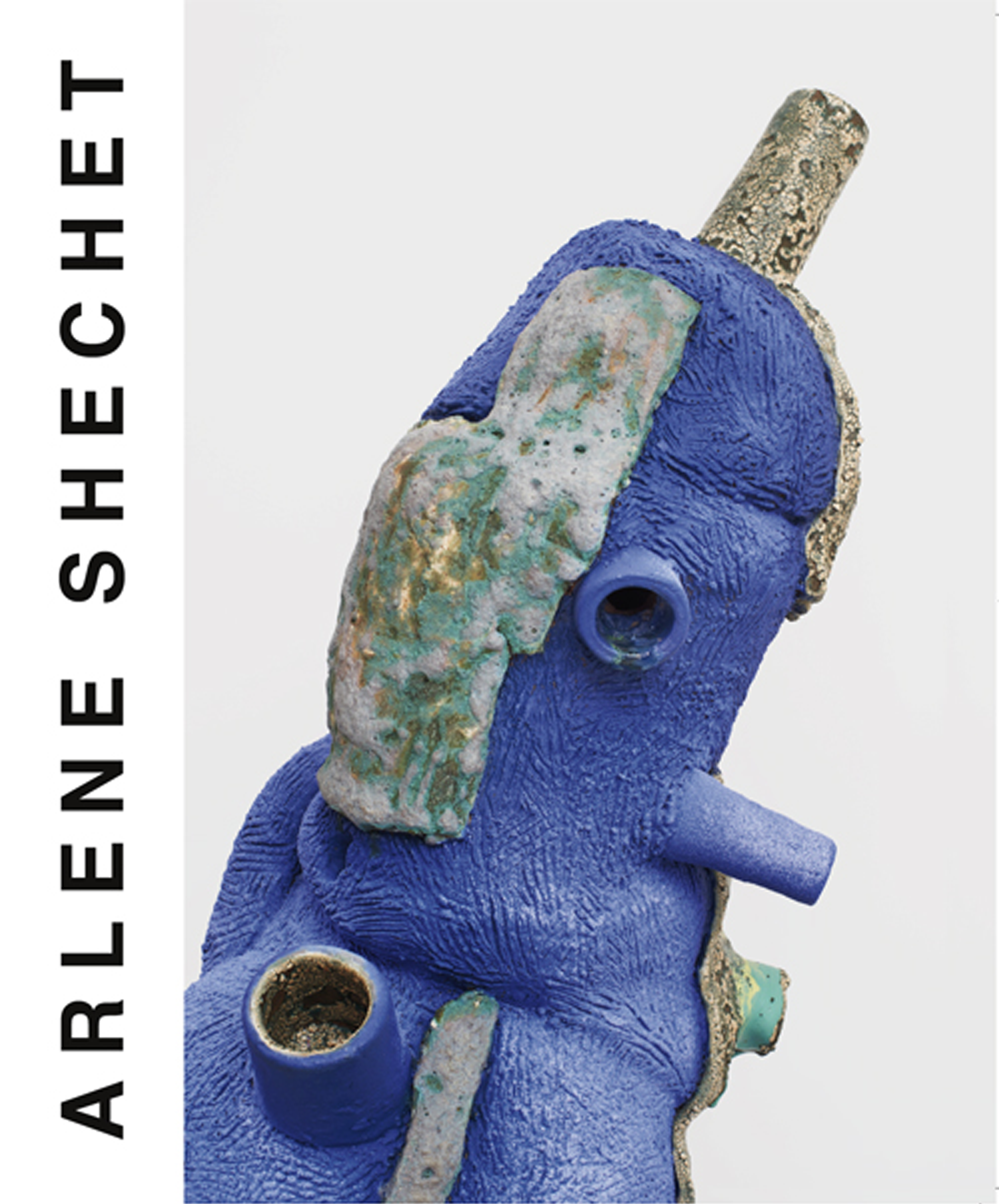
Shechet’s installation features several recent acquisitions, many on view for the first time, including seven paintings by Forrest Bess. Bess was a solitary artist who lived and worked his entire life in his family’s shack near Bay City, Texas, on a strip of land accessible only by boat. Bess’s four small paintings, The Asteroids (1946), were based on a dream he had, sections of which he typed on paper and attached to the back of each painting. Previously owned by eminent art historian Meyer Schapiro, who was an early champion and collector of the artist, they were given to the Phillips by his daughter, Miriam Schapiro Grosof. Bess’s paintings inspired Shechet to create a new sculpture for her installation, Seeing Asteroids (2016), whose bright blue glaze is covered with patches of a milky mass of green and gray that echo Bess’s dream of green continents in the heavens, in which he described “a darkness [that] had separated itself from space and had formed into cloudlike masses.”
Shechet’s sculptures are at once imaginative and “noumenal,” in the Kantian sense of hinting at something un- knowable by the senses alone. The inherent unpredictability of working with fired clay and dazzling glazes often lends Shechet’s work a comical mixture of spontaneity and judiciousness mirrored in her installation at the Phil- lips. Of this unusual combination, Shechet says,
I feel like humor and beauty are sometimes set aside in opposition to intellect and greatness. I don’t believe in that. I believe that life is lived with humor and pathos and that those two sides coexist strongly.
Irony and humor are very much on display in Shechet’s two small porcelain pieces, Straight Ahead Bear Head and Turned Away Bear Head (both 2012), that are hang- ing to the left and right of a grouping of Alfred Stieglitz’s Equivalents, which were given to the Phillips in 1949 by Georgia O’Keeffe.
Created during a residence at the Meissen porcelain manufactory in Dresden, Shechet’s porcelain pieces pro- vide only a partial view of the heads of the porcelain polar bear first produced by Meissen. They were inspired by the industrial character of the molds used to create Meis- sen’s highly refined porcelain figures:
I realized that the molds were the core of all these porcelain works—almost like the DNA ... I took their three- hundred-year-old refined plaster mold forms and made molds of them and then recast them in porcelain.12
The fragmented and obstructed views of serially produced Meissen porcelain bears, contrasted with the serial nature of Stieglitz’s “abstract” cloud photographs, sub- vert the modernist idea of equivalence with subtle irony and humor.
It is in those intersections of gravitas and humor, of timelessness and time, whose apprehension is “an occupation for the saint,” as the poet says,13 that Shechet’s installation affords us an apprehension of the attended moment, just as the Buddha statue in Rodin’s garden imparted its “inexpressible unity” on Rilke.