In Conversation Charlotte Vignon, Arlene Shechet and Henry Arnhold
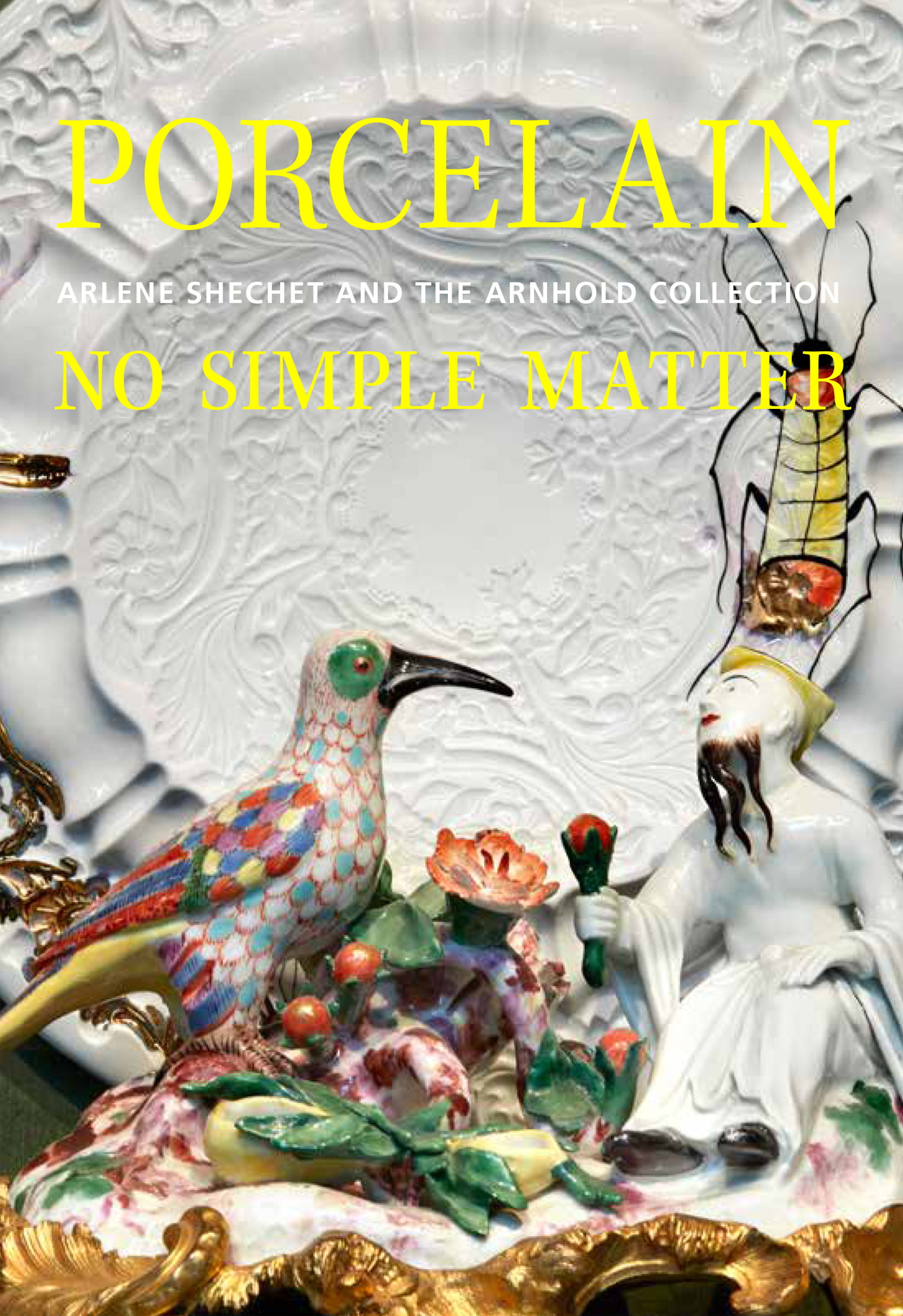
On the occasion of the exhibition Porcelain, No Simple Matter: Arlene Shechet and the Arnhold Collection, Charlotte Vignon, curator of the exhibition and Curator of Decorative Arts at The Frick Collection, sat down with Henry Arnhold, the renowned collector of early eighteenth-century Meissen porcelain, and New York–based artist Arlene Shechet, who designed the exhibition, integrating sixteen of her own sculptures into a selection of about one hundred porcelains from the Arnhold Collection. These are edited excerpts from the conversation.
Charlotte Vignon: Henry, when did you start collecting Meissen?
Henry Arnhold: Well, in addition to other collections, my parents had a collection of early Meissen porcelain, and by the time we left Germany [in 1937], the collection was quite substantial. Shortly after I came back from the army after World War II, I got married and started to set up a home. By then, my mother had moved to an apartment in New York, and she was quite happy to share things with both me and one of my sisters who also had moved to New York. I made myself a little collection at home, and when professionals—whether artists, collectors, or museum people—came to see my mother’s collection, they also came over to see mine. In the late 1980s, the art historian Maureen Cassidy-Geiger came up with the idea of publishing a catalogue of my collection; and at that point, I became very involved again, a real activist in terms of my collecting. I also took Maureen on trips to what was called Leningrad at the time and to Prague, Florence, Paris, Dresden, and Munich—everywhere. Well, l’appetit vient en mangeant [appetite comes with eating]—that’s what the French taught me.
Vignon: You have a great appetite!
Arnhold: I think I have a good eye.
Arlene Shechet: It’s more than just an eye. I think it’s actually a curiosity.
Arnhold: That too.
Vignon: Henry, what do you look for in a piece of Meissen?
Arnhold: My eye is either attracted to it or not.
Vignon: Is this what guided your acquisition of the pieces in your collection, your eye?
Arnhold: Yes. Each piece has something special about it. For example, I always wanted to have the foolish court jester, and now I have the best one around.
Vignon: Arlene, when did you first become interested in Meissen? What is your story?
Shechet: Several years ago, the opportunity to work at the Meissen manufactory fell into my lap through the curator and art dealer Peter Nagy. Peter had seen earlier cast-paper work of mine that dealt with the language of blue and white porcelain conflated with blueprints of Buddhist temples. He knew I was interested in historical decorative arts material and thought of me when a Meissen consultant asked him to recommend an artist for a residency there. I had no real experience working in porcelain, but the residency didn’t involve my designing something for their production but rather offered me a studio and the opportunity to make whatever I pleased while exploring this very technical material. That I would spend almost two years going back and forth to a tiny sixteenth-century town in Eastern Germany is, now, astonishing, but the allure of spending time inside a functioning factory had been extremely compelling. As a child in New York, I used to tell my parents there were two things I wanted to be when I grew up: a farmer or a factory worker. Thinking about that in recent years as I work in my studio, I realize that being an artist is in many ways like being both a farmer and a factory worker. I’m growing things and generating a vision. I’m not completely in control and am always aware of a process that’s bigger than me. As a child, I always wanted to know how things were made or came into being. It was the beginning of figuring out that I needed to be an artist. I’m still deeply interested in the process of how things grow. I grow things in my studio and also in my gardens. I believe art and nature are very aligned.
Vignon: Isn’t that the theme of the exhibition?
Shechet: Yes it is. Artists often look to nature for answers. When we first started talking about the show, I looked at the Portico Gallery [where the exhibition is installed], which faces the garden, and I thought let’s bring the garden inside, let’s not ignore the most obvious thing about the architecture and site of that gallery. I also thought about what was important to the painters and sculptors at the Meissen factory. Very often, their main theme was the natural world. Henry’s collection is so interesting and takes so many different directions that I felt we needed an organizing theme but one that wasn’t too tight, one that could embrace many pieces.
Vignon: How do you view the difference between your sculptures, which are unique works of art, and Meissen made in multiples for production?
Shechet: At Meissen, each and every piece is cast and painted by hand but made as an unlimited multiple. The people who make the work are making only minor decisions about what the finished piece looks like. The final form is predetermined using molds and learned painting techniques. My works were each conceived and formed by me. Each is unique even though I often made use of the historical molds to create some of the parts. For a six-inch piece like the central part of Mix and Match, there were maybe fifteen molds because every undercut in the sculptured form requires a different mold. After my first couple of weeks at Meissen, I realized that the molds were the core of all of these porcelain works—almost like the DNA. I wanted to communicate that fact in the works I made, linking the molds’ industrial imagery with a very refined porcelain aesthetic. I took their three-hundredyear- old plaster mold forms and made molds of them and then recast them in porcelain, turning their industrial objects into fine porcelain. In fact, I cast in every working detail of the molds: the dates, the catalogue numbers, the plaster drips, all the evidence of their use in the factory. In this exhibition, even if you don’t see a piece as a mold of a mold, you should understand that most every work of mine has some part of an actual Meissen mold that I then made into porcelain. In Dancing Girl [p.26], for instance, you’ll see a very rippled bottom layer. That is a porcelain version of one of their plate molds.
Arnhold: You know, in the 1990s I had a bird made for me, which was obviously made using K.ndler’s 1732 molds.
Shechet: There’s a funny fact—some part of the original mold is interestingly called the “mother mold.” It helps hold things together.
Vignon: This is basically how your work relates to eighteenth-century Meissen porcelain.
Shechet: I searched deeply into eighteenth- century Meissen works and processes to discover what I could use and make my own. This exhibition includes what I call Henry’s lotus bowl— because I believe the form originates with the lotus flower—paired with my Scallop Bowl, a mold work that literally came from casting the lotus bowl plaster mold into porcelain. Then I adopted Meissen glazes, their imagery and language of painting to suit my own art-making needs. These are hybrid works but the earliest eighteenth-century Meissen works were also hybrids linking Asian technique and imagery with European desires and discoveries.
Vignon: I just want to underscore that your work in the show was all made at Meissen in 2012−13. It is Meissen porcelain of the twenty-first century.
Shechet: Not only is it Meissen porcelain of the twenty-first century, Meissen insisted on signing each piece with those crossed swords [the mark of the Meissen factory since the eighteenth century]!
Arnhold: Arlene, do you think that the Meissen factory still has something unique to offer?
Shechet: That manufactory is not only the locus of so much important information about European decorative arts and German history, it is also a place with hundreds and hundreds of people trained in methods and techniques that would be lost if Meissen ceased to exist. The town of Meissen has grown up around this porcelain, and the place holds generations of skilled workers currently dependent on the leadership and a more expansive artistic vision to help it thrive through modest reinvention. One of the reasons I went there was because it was the first place in the West to make porcelain in the style of the East. That was very important to me because earlier works of mine have also been about the link between the West and the East. I also found it very moving that Meissen has been in continuous production since 1710.
Vignon: I understand you were called a magician at the Meissen factory. Can you explain?
Shechet: At Meissen, everyone is trained to do just one thing. They can spend their whole lives painting cherries— not fruit, just cherries. While I could make a mold, I could also paint and sculpt. I could do all these different things. They would ask, “How is that possible?” They do one thing, and they do it absolutely perfectly. I’m more interested in imperfection. Exposing every seam and imperfect process as a reflection of humanity.
Vignon: Henry, how was your parents’ collection of Meissen displayed when you were growing up? And how do you display your collection?
Arnhold: In my parents’ house in Dresden, the porcelains were almost all in vitrines. Most of them were in the very formal middle room on the ground floor. There were also two vitrines in my mother’s room. Then a few pieces like the major vases stood on top of a white commode. In my New York home, I have a lot of space. I thought it made sense to keep all the brown B.ttgers [a type of stoneware created by Johann Friedrich B.ttger, in 1708, before he succeeded the following year in producing white porcelain] together and all the Hausmaler pieces [those painted by independent artists, outside the factory] mostly together. The blue and white are also all together; that parade of blue and white vases looks very nice with a mirror behind it. There’s the problem presented by certain pieces that have interesting decoration on both sides; a mirror makes them so much easier to display. Most of the porcelains are in vitrines, some chargers on the walls, and I have quite a bit standing freely and on window sills.
Vignon: Arlene, tell me about the installation you’ve created for the Frick.
Shechet: I began with trying to get at the most basic thing, the location of the show: at the Frick, the house of a collector, a house museum. It reflects a domestic setting, and the displays in most of the existing rooms are a wonderful mix of objects and paintings and tapestries, all kinds of materials. I wanted to bring that rich mix into the Portico Gallery in a way that is both continuous but very different.
Vignon: Can you give us a few examples?
Shechet: I’ve used some aspects of the Frick furnishings to design the display cases. For example, the legs are inspired by an eighteenth-century French table in The Frick Collection. The green damask behind the cases comes from seeing fabric on the walls and knowing that it would show off the porcelain in a very beautiful way. I also wanted the view of the garden unimpeded, so we used Plexiglas for two display tables at the glass wall. The porcelain speaks to the outside garden, and the natural world is invited inside.
Vignon: What about the grouping of the pieces in each case? How was that determined?
Shechet: The cases relate to my numerous experiences visiting the spectacular porcelain collections in Dresden and to the historical display of porcelain at the Japanese Palace, where Augustus the Strong arranged his vast collection according to color. So the four main cases are roughly grouped by color: yellow/gold, green/turquoise, orange/pink, and blue and white.
Vignon: The two groupings of the plates on the wall in the rotunda also have an historical reference. Beginning in the Renaissance, plates were often displayed on walls, as they are at Henry’s house. Although here your groupings are very different, less vertical and geometric, more organic. It seems that you’re using the form and the colors of the Meissen porcelain like paint. Somehow this installation seems to be a big mural; you don’t use paint, you don’t use clay, you use both together in an already existing form—porcelain—to compose something new.
Shechet: Exactly. I wanted to grow the groupings of plates as if they were grand bouquets. These constellations push to incorporate Diana, who is floating in the middle of the rotunda. There, I installed a gold mirror in order to have this space glow and to have the garden reflected within the room. The gold mirror was fabricated in block size to be continuous with the stone walls that surround it. The viewer can experience stone turn to gold and back again. The story of porcelain is written here: the stones transform as a reference to the origin of the Meissen factory, created after a scientist and an alchemist successfully produced white porcelain while looking for gold.
Vignon: And for a long time, porcelain was referred to as “white gold.” The installation includes many surprises!
Shechet: Yes, we have birds hanging at the archway and large porcelain animals outside in the garden. The installation is about delight—delight and discovery in the unexpected.
Vignon: Henry, this exhibition is very different from previous installations of your collection at the Frick, from how it was displayed in your parent’s home, and from how it is displayed in your home. What interested you in this collaboration with Arlene?
Arnhold: Let me put it this way, Charlotte—you surprised me. It was an intriguing idea, number one. Number two, the artist being the one to create the display rather than a curator is also a change. In other words, the artist is not bound by the same reasoning. So I thought, “Why, not?”
Shechet: Henry is an adventurer.
Vignon: Lastly, Arlene, what does your title for the show—Porcelain, No Simple Matter—mean?
Shechet: I started with the word matter—matter being both material and idea. That’s the way I see the porcelain, and that’s the way I went about configuring the show. Matter is an interesting word for me, one that takes away some of the more frivolous or obvious ways that porcelain has been referred to. I want to take the vocabulary of porcelain and the display of porcelain into the realm of the unexpected so that viewers and other artists can learn from it as I have. The title is an entreaty to the audience to look closer and get ready to be surprised. These objects are not simply dishes or figures or painted plates, they are carefully considered complex works of art. Perhaps this is what has driven Henry to collect, and what you have been doing in your curatorial job: reevaluating and reexamining things that we take for granted. The title also hints at the threeway conversation among artist, museum, and collector. Enjoyable and challenging but not simple!