Bomb
“Arlene Shechet by Rebecca Smith”
The “proudly impure” sculptor of inventive forms discusses her process, the persistence of materials, and the qualities that make sculpture “ridiculously risky.”
By Rebecca Smith
June 14, 2024
Arlene Shechet is a sculptor who works with ceramics, wood, and steel, among other materials, and employs multiple strategies of making three-dimensional forms that transcend expectations of contemporary sculpture. No appropriator of ready-mades, Shechet uses her skills as a modeler, carver, joiner, welder, and colorist to create emotionally evocative pieces that surprise from every perspective. I first saw Shechet’s ceramics in 2008 and later discovered how widely she has experimented, from creating novel incarnations of the Buddha in the 1990s to initiating a deeply inventive artistic conversation with Meissen porcelain in 2015. Her sculptures evince a finesse with color, the force of gravity, and disparate materials combined within a single “body.” To view one of Shechet’s sculptures is to eavesdrop on a conversation between partners who at times sing in unison and at others engage in passionate debate.
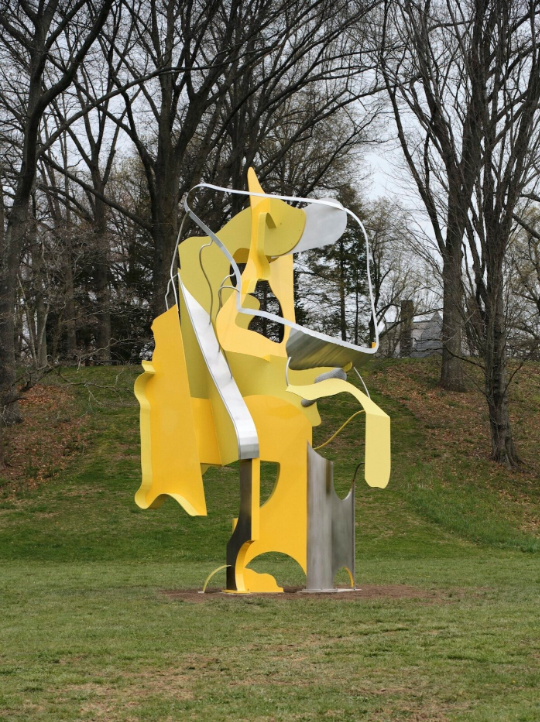
She and I spoke prior to the installation of her exhibition Girl Group at Storm King Art Center in New Windsor, New York. Comprised of six steel-and-aluminum sculptures painted in highly specific colors, the show is Shechet’s first foray into “big sculpture”—the tallest work is twenty-eight feet, the longest thirty. Accompanying the sculptures sited in the Storm King landscape is a group of recent ceramics arranged in the institution’s Museum Building. Our conversation developed as we roamed through Shechet’s studio warehouse in Kingston, New York. There, a courtyard accommodates outdoor works and kilns for drying clay and the tree trunks Shechet incorporates into sculptures of many scales and orientations. Inside, Shechet keeps libraries of both wood and ceramic parts—elements of sculptures to come that she continuously reworks—as well as spaces for creating both paper and digital models. Her studio made apparent her process for making the sculptures, which were gathered throughout, in various stages of completion.
Women by Women, a series of interviews between women visual artists, is supported in part by the Deborah Buck Foundation with additional funding from the Judith Whitney Godwin Foundation.
Rebecca SmithWhat’s the scale of these new pieces for Storm King?
Arlene ShechetThe smallest one is ten feet tall, and the largest is thirty feet long. I’ll show you the models . . . Here’s Girl Group, in living color. (laughter) This small one to the side, that’s Janice, and this is Maiden May. I worked on about twenty or thirty ideas, choosing and refining one at a time over the course of years. One piece became another piece, and then that piece became another. The finished sculptures reflect all these changes. That’s part of the narrative.
Throughout that process, I went back and forth between analog and digital models, analog to digital to analog, in a chain of call-and-response. I was leaping between drawings made on the computer and models made in the studio. A digital model can never tell you what a sculpture is going to be like, so I made them out of heavy paper too. Here’s the model for Maiden May that I finished. You can see how many changes I made. I was using the ceramics as a starting point, riffing on them in digital space, not trying to line one thing up with the other, but using the ceramic sculptures as seeds to invent the new form. Finally, they grew into the enormous, grounded sculptures now being set into the landscape.
At the beginning of the pandemic, I was very concerned about keeping my studio going. (laughter) I had just opened a show in late February 2020, and the show got shut down, which was the least of it. I was depressed from not knowing what we were doing. Where are my kids? Where are we? Why are we washing groceries? It was really consuming. I didn’t work for about six weeks. I felt, I’ve made a lot of stuff, maybe I’m done. But my family, who has always accused me of being a workaholic, was in a total panic that I wasn’t working. (laughter) They were rejecting the idea that I was moving on, like, “You can’t just be reading the news and gardening.”
I went into the studio and started playing, making clay pieces that I could get in and out of the kiln by myself. They were at a smaller scale than most other things. Torso-sized. I set a couple of parameters, subconsciously at first but later with awareness. One parameter was to make the clay works without flat bottoms and then decide after firing what their final orientations would be. The second was to have the finished ceramics be held by some sort of steel support but then to have them slump or bleed off at the same time as being held. These are stories from the studio that I never thought would make it out because I honestly didn’t expect that the sculptures would finally be “in the world.”
RSThat’s interesting. Suddenly you were in this whole other place, and you had all this work—
AS—hostage at Pace Gallery on Twenty-Fifth Street.
RSBut you were sort of liberated to work in this different way.
ASI just was making things. I always try to stay in a liberated state, to work intuitively, because if I start thinking about an audience, then what’s the point? The quiet of the lockdown was profound. It was just me and what I had left in the studio: scraps of metal, I beams, and this and that. After the ceramic pieces were fired without defined bottoms, I juggled them around. They became new to me.
RSSince sculpture deals with gravity, how did the pieces not have bottoms? Were you supporting them in some improvisational way?
ASFoam. Foam is my friend. Clay is hollow and mushy, and you can use its hollowness to let air in and dry it from the inside out, so it hardens. It’s the rare material that forms its own self-supporting armature as it dries. I let the clay set up just enough, maybe from morning till night, so I could add something else, then I turned the pieces upside down on the foam and kept working on them. That’s how I make all of the ceramic pieces: I wait for the right minute to continue to build because sometimes I can only add an inch or a couple of pieces of clay at a time before they become too mushy again. Waiting means I can work on multiple pieces at once.
RSIn the models you showed me, I can see moves that are like clay moves, ones that have an organic feeling. How did you scale up the ceramic pieces to the larger works for Girl Group? Is it all steel?
ASThe larger pieces would be unnecessarily heavy if they were all steel, so there’s also aluminum and stainless steel where they need support. The advantage of having shown for a long time is I know how things are going to be installed and moved around when they leave the studio. I wanted Girl Group to be as carefree as possible—no gigantic earthmover to install them, no cranes. I actually calibrated the whole thing so each piece can travel on a truck. They’re not so heavy, less than half a ton. They travel well.
The forms are no joke to paint, so they can come apart, which I ultimately like. So now all of Girl Group is either painted or sealed. Every work has a shiny colored surface contrasted with a matte surface. Both are set off by some part of the sculpture that is bare metal but sealed. One of the most complicated things to achieve has been coating the sculptures in a way so that they still feel fresh. I hadn’t initially anticipated the technical issues of long-term color on very large metal constructions. I wanted surfaces that would be durable outside for at least ten to fifteen years. It’s a rare thing. The ceramics have extremely saturated glaze colors, which was a response to seeking joy during the pandemic. I knew I wanted to transfer those color ideas from the ceramics to these big things. I noticed, too, that Storm King has very little color, which is just generally true of large sculpture. I wanted to use specific colors, not colors “from the tube,” and we’ve done a ton of research on the custom colors in Girl Group. The paint, finally, is gorgeous.
Color is a language that transcends a lot of the tough and divisive languages we’re involved in. I’m a color person, you’re a color person. How do you identify with the desire to use color?
RSFor me, a full range of color indicates a completeness and the wish to have everything. When I was growing up, I moved to a new place and a wonderful new school. I felt like my life had gone from black and white to color. Color is the greatest metaphor for things being various; there’s so much emotion and room for association in color. I think every artist eventually finds their palette, their own particular family of colors.
ASWhat’s yours?
RSThere’s a lot of green.
ASMe too, we’re green people. (laughter) I love greens. Somebody once wrote that green is the most emotional color, which I had never thought but I can understand.
RSA Buddhist friend said that green was the color of growth and change. In a way, I don’t even like it the best. I think the prettiest color is red. Yellow is very interesting because it’s so naive. It allows openness. It’s very positive, and it’s also the color that we think sunlight is.
ASI never think of yellow as naive. I do think about it as positive.
RSYellow, at its most tender, is the most naive, but it can be corrupted. Your colors are really tough, though not always—every time I make a generalization, I have to equivocate because it won’t stick.
ASWell, thanks, Becca. (laughter) That’s the biggest compliment ever! I read about your father, the sculptor David Smith, wanting raw colors, and I identified with that. When I saw the painted sculptures, I thought that he was using color like a painter, because it wasn’t just straight out of anything. He really played around with color, whether it was each color by itself or the colors in relationship to one another. They’re finely tuned to rub up against each other just so. His sculptures are more modestly scaled than what I’m doing here. He could hand paint them without worrying about all of the commercial and environmental concerns for longevity.
Making sculpture requires various skill sets that are very easy to fail at getting right, and sculpture isn’t as seductive as, say, a framed watercolor. That’s one of the reasons why I’m thinking about color in these pieces: I didn’t want to give up all of my seductions.
— Arlene Shechet
RSThe best technology available at the time was car paint, and he used multiple layers, but the hand-painted pieces can’t be considered outdoor pieces at this point.
ASHis piece Study in Arcs, at Storm King, reads to me as having warm and cool peachy pinks, which I’m using. Years ago, when I first spotted it at Storm King, I hadn’t known of his painted works and was smitten, intrigued. It seemed a radical move. It’s one of the inspirations for Dawn from Girl Group. You’ll be able to see Study in Arcs in my siting. That’s a stand-alone—it’s a radical move in the Storm King vocabulary.
RSThe painted pieces were most definitely a radical departure. David first painted sculpture in the 1940s, and the large, multicolored painted sculptures of the 1950s were totally groundbreaking and controversial when they were made. His last large color sculptures, which were shown in No One Thing at Hauser & Wirth in 2024, were his boldest color statements yet. Even now, few sculptors have really exploited chromatic color. A sculpture occupies real space, so some people feel encroached on and threatened.
ASI think you’re right. Great observation. People make paintings and photographs that are completely fugitive, but folks expect us to be making things that are as durable as buildings. We’re outsiders in the art business. When I was teaching, I was shocked at how almost every student told me at some point during the semester that they were scared to take a sculpture class. I thought, Wait a minute, painting is playing in the realm of illusion, it’s much further from the literal truth. (laughter) We are three-dimensional, we live in three-dimensional space, and everything we know and understand is three-dimensional. I wanted them to make friends with sculpture. To share the space.
RSPaintings and photographs are ubiquitous and containable, but sculpture asks to be a real thing, so the ante is upped.
ASSculpture is more audacious. The ante is definitely upped. I’m excited about how sculpture is ridiculously risky on every level. There’s a history of questioning its very existence. Michelangelo, Bernini, they got by, but everything after them has always been a possible problem. Making sculpture requires various skill sets that are very easy to fail at getting right, and sculpture isn’t as seductive as, say, a framed watercolor. That’s one of the reasons why I’m thinking about color in these pieces: I didn’t want to give up all of my seductions. Like using color in big sculpture.
RSFranz West made big sculpture that’s still playful. His materials are so crinkly and familiar, and you can tell the big pieces are hollow.
ASThat hollowness is very attractive because it shows some kind of humor. (laughter) It feels like he was having a good time making them, and I love that.
Siting the large sculptures is a lot of what will make my exhibition work… or not work. I’ve spent so much time thinking about all of that but it’s truly frightening to not be able to easily move things around during installation. We had to pour foundations before January.
I have three works at the very top of a hill, near the Museum Building, and then one really far afield, near Richard Serra’s Schunnemunk Fork, and then another one over the edge of a hill, facing the allée, and finally, a pale blue one beyond the Calders. As April, the sculpture “off the cliff” and in line with the allée, can be seen from above. I’m trying to take note of all of the possible vantage points only available in this rolling-hill paradise. I’ve been working on these from every possible viewpoint, so I wanted to take on that possibility in their siting.
My studio and I used augmented reality to place the sculptures in space in the fall so that the foundations for them could be dug and poured before January. The whole thing is counter to what I usually like to do, which is install on the fly, move things around. Working in museums, I’ve done this more methodical thing before, but I still prefer to be able to move things. With AR, we saw that you could actually see the yellow from up top without seeing the whole piece, which is the goal.
RSThat’s really cool. It’s unusual to view a sculpture from above, even though it’s meant to be seen from different vantage points. You have said that a sculpture is always hiding something and offering surprises, because there is always a view of it that is hidden from where one is standing. I just took a lot of pictures of the Bernini sculptures in Rome—
ASOh my god, I loved your Bernini photographs.
RSI couldn’t believe—
AS—how he did that.
RSHow every view—
AS—is perfect. It’s so shocking that they’re human forms. You know what these forms are about to do, and it’s still a surprise.
RSIt’s interesting that Pluto has that three-headed dog in The Rape of Proserpina, because it plays with the idea of sculpture being a three-headed dog, and therefore being magical or uncanny, in solid marble. The story is really about the abduction of Proserpina by Pluto in order to take her to the underworld. In the context of the Galleria Borghese, which was the product of immense wealth, the sculpture seems to celebrate the powerful overwhelming the weak. Yet Bernini shows Proserpina fighting back.
ASI saw Titian: Women, Myth, and Power at the Isabella Stewart Gardner Museum a few years ago, and it was really getting at the questions: “What is it about these paintings and raping women? Are they still about raping women?” We know it’s mythology, but it’s really frightening. As you were saying before, because the Bernini sculpture is in real space, it’s even more terrifying. He twisted the female body so perfectly. The Borgheses, who commissioned it, were seasoned in these kinds of aggressive seizures of power, and because the rape is shown through mythology, it’s made acceptable under the guise of classicism. I’m interested in the three-headed dog being about sculpture, it’s a more compelling form to me than the figures.
I have a thing about doubles. Duplication is unnatural, maybe in a good way. It’s like the double has been granted special powers and can grant them in return. It’s all more, more. Multiplicity is in the siting of the Girl Group pieces, so wherever you are, you can see many pieces in conversation, in a group. When Storm King asked me to do a show, I immediately knew I wanted to take on this bigger language of the landscape, not just put some things around the Museum Building.
RSIt’s interesting how sculpture appears from a distance. Of course, some sculptures you need to see close up, like a Rodin.
ASDifferent things happen at different distances. I can appreciate Rodin’s hand in the work up close, but I actually love the outlines, just seeing the unarticulated blob from a distance. I’m a big blob person. Seeing the thing become just shape is exciting to me. Same for seeing something from the back. With The River, the Aristide Maillol above the garden pool at the Museum of Modern Art, you see the form and then you see the form reflected in the water. I’ve heard people say, “Look at that fish,” and then they get close. His figure has multiple readings, and I think Maillol wouldn’t be upset about that. Paintings can do that to an extent, but they mostly remain flat.
RSI did a wall sculpture, Noctilucent Clouds, for the Virginia Museum of Fine Arts, that’s seven feet high by fourteen feet wide and fourteen inches from the wall. It’s installed in the atrium, fourteen feet in the air. I realized that a painting couldn’t work there because you’re meant to look at a painting straight on. If you get ten degrees off, it’s not as good. That seemed to me very limited. A sculpture can really operate across the space.
ASInteresting. So what did you do with that piece?
RSIt’s a relief sculpture. It’s made up of different bars of steel that I painted with interference paint. Each one is a slightly different shade of blue, grayish blue. From one viewpoint, the color is flat and dull, and from another, it’s a different color and bright and reflective. People tell me that when the sun travels across this huge wall the piece just blazes. The design is based on patterns present in these special clouds, themselves a result of climate change.
ASOh, I love that. Ellsworth Kelly is kind of the exception among painters, and he overlapped with sculpture a lot. Austin, the chapel he did in Texas, is about color moving inside architectural space. It’s quite great. There are black and white panels on the interior walls of the chapel. He claimed the space. In the future, nobody can put anything else there. He has the final word.
All of these materials, as I work with them, I feel how they’re alive. Clay and wood are obvious in that way, but all of the metals have lives of their own too. In everything I make, I’m trying to broadcast some aspect of a material, but maybe not the aspect that you might first think of.
— Arlene Shechet
RSBack to Rome, I saw something that reminded me of your work: new buildings built on to existing classical ruins.
ASThat’s exactly the way I make my sculptures. The wood, ceramic, and steel things are all glommed together.
RSYou’ve always mixed different materials, not found objects, and that’s very unusual in sculpture. I think it goes back to this medieval idea of noble metals and nonnoble metals.
ASI love the term noble metal.
RSTraditionally it was discouraged to mix noble metals that resist corrosion, like gold, silver and bronze, with metals that aren’t noble and so are subject to corrosion, like steel. It is technically problematic to join noble and nonnoble metals. David mixed steel and bronze, and sometimes silver, in the same sculpture. He wrote that he was against the idea of purity. There has historically been a value set on purity over impurity, and you’re a big advocate for impurity throughout your work.
ASSo true, proudly impure. One of the reasons I chose to work in clay years ago was because it was so gendered. I wanted to take that on and show people that clay is gendered but tough.
I have a library of wood now and a special kiln for drying it. All of the pieces in the library were part of a sculpture at one point but taken out. (pulls wood from library) Isn’t this gorgeous? I’ve been dreaming about this piece. It’s telling its story, the persistence of this material. This is all about healing; it just healed into this form. It’s so grand that it’s going to be very hard for me to think of what to do with it. I stood it up so I could see what it would do, and I think I have an idea. It’s so alive, but you know, steel is alive too. All of these materials, as I work with them, I feel how they’re alive. Clay and wood are obvious in that way, but all of the metals have lives of their own too. In everything I make, I’m trying to broadcast some aspect of a material, but maybe not the aspect that you might first think of. I always want to leave some wildness in the material while I control it. People have said that I’m camouflaging the materials, but I’m not. I don’t know what to make of it, but I’m not doing it on purpose. It’s not such a surprise that things begin to merge and borrow from one another.
I have a library of ceramics, too, and every one of the pieces in the library has been in a larger piece at some point. You’re looking at failure here. (laughter) You’re looking at me pulling something off and saying, “No, this isn’t working.” But in the same way I use the Color-aid Swatch Book, I realized years ago that the ceramic parts are things I can sketch with, because I sketch with real things and not on a piece of paper. I don’t want to draw a sculpture and then struggle to make it. I insist on working in real time with actual shapes and surrogates strapped together to sketch in true space. I have to feel it, dance with it, then ponder it over time.
RSThis was to be my first question: In 2015, you described the Buddhist approach you take in the studio. Is that still with you?
ASYes, I’m still working to lose my attachment. When I was moving between studios in the city and upstate, people asked me, “How are you going from one thing to the other when you’re not seeing it?” I was like, “Not seeing it? That’s the gift!” I walk in and I have fresh eyes. I’m not attached to that great little move I made that makes a piece seem so perfect. It’s not so perfect when I see it again. If I just keep banging on with my ego, it becomes very hard to go beyond what’s merely good. (laughter) What’s good, what works, what’s beautiful is not what I want from my studio life. The Buddha talked about how change is a constant, and I’m trying to enact that, even if that has made my career unpredictable at various times. The art world wants a brand, and I understand that—it’s comforting, it’s valuable, it’s easy. But I’m very curious and restless.
RSThat’s a word I identify with, too, restless. If I make a piece, I don’t then want to make another piece just like it. Sculpture takes a longer time, so the big trick is to get that restless, fluid urgency into these obdurate materials.
ASSo many people have asked, “How do you know when the work is done?” When I’m out of the studio and thinking about it, if I feel calm, that’s a start. When I go back into the studio after some separation, if I still feel some kind of happiness or that the work is funny or humorous, then I have a sense of completion.
A few years after I graduated from school, they asked me to come back and give a talk. I had moved to New York City. I ended up talking about how even when you’re not making art, you’re still an artist. When you leave something, which I have had to do many times, it’s not done. You’ve still made something. You made it as far as it wanted to get made, and that can be enough for the moment. You don’t have to be a prisoner of your own work. You have to figure out how to have a life, and that includes all kinds of insane disruptions that are potential problems. You’re different when you come back to it. No matter how close you try to return to the playbook of who you are, you’re not actually that.
I think that restlessness is another quality that sculptors have. There’s also tenacity. I’m going to bring astrology into this—there’s the lore of there being a lot of Capricorn sculptors, women especially. The symbol is a goat, like, we’re just goats struggling. Scrambling uphill. The struggle is part of the conversation.
RSI love goats. No two goats look alike; they’re like people. They’re really tough animals, and they just eat everything and never do what you tell them.
ASThat’s a description of sculptors. (laughter) Take in everything, never do what people say. There’s something obdurate and ornery about sculpture, and I don’t think I became a sculptor with any of those ideas in mind, I just went there. For a couple of years I didn’t have a studio, and I did only two-dimensional work. I was actually sort of successful with it, but I felt like I was cheating. (laughter) It didn’t satisfy the itch. I know Louise Bourgeois—the ultimate goat—said some interesting things about needing resistance. I do feel it’s very satisfying to have the sculpture resist me.